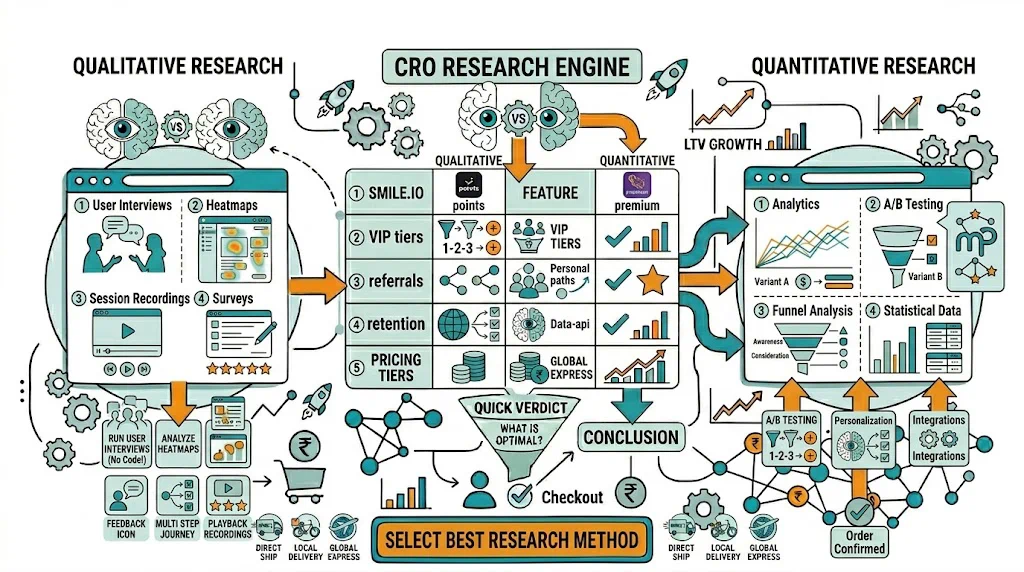
From the conversion glossary
Concepts referenced in this article, defined.
The average cart abandonment rate is 70%. Here are 12 proven tactics to recover more abandoned carts — on-site interventions, email flows, and personalization strategies with real results.
Concepts referenced in this article, defined.
 cro
croPre-order waitlist CRO strategies that convert hype into real revenue - how to design waitlist and pre-order pages that don't lose momentum before launch.
 cro
croFirst purchase experience optimization - practical strategies to turn first-time visitors into buyers, from welcome offers to a smarter new customer funnel.
 cro
croRetail media CRO explained - how to monetize on-site ads and sponsored placements without tanking your conversion rate. A practical balance guide.
Run rigorous A/B tests and personalize every visit on Shopify or any storefront — no engineers required.
Cart abandonment — when a shopper adds items to their cart but doesn't complete the purchase — represents the single largest revenue recovery opportunity for most ecommerce brands. If your site has 70% cart abandonment and $1M in annual revenue, reducing abandonment by 10 percentage points would add over $100K in revenue from existing traffic.
Here are 12 tactics that actually work, organized from on-site interventions (highest impact, instant results) to email recovery flows.
Before fixing cart abandonment, understand why it happens:
| Reason | Percentage of Abandoners |
|---|---|
| Unexpected shipping cost | 48% |
| Required account creation | 24% |
| Checkout too long or complex | 22% |
| Couldn't see or calculate total upfront | 21% |
| Payment security concerns | 18% |
| Wanted to compare prices elsewhere | 16% |
| Just browsing, not ready to buy | 14% |
Source: Baymard Institute research. Multiple reasons possible.
Most of these are fixable. Here's how.
The #1 cause of abandonment is shipping cost shock at checkout. Fix it before checkout:
Result: Brands that display shipping costs in the cart see 12-18% lower checkout abandonment rates.
Forcing account creation before checkout is a 24% abandonment trigger. Make guest checkout the default first option — not a secondary option buried below the account creation form.
Test: Move guest checkout above account creation. In most markets, guest checkout results in higher completion rates.
When a visitor with items in their cart moves their cursor toward the browser close/back button, trigger a targeted exit-intent popup:
CustomFit.ai's behavioral targeting can trigger this popup specifically to visitors with non-empty carts who show exit intent — not to all visitors.
Result: Exit-intent popups for cart abandoners convert at 3-8%, recovering revenue that would otherwise be lost.
For visitors who have cart items and continue browsing your site (collection pages, blog, homepage), show a sticky top or bottom banner:
"You left something behind — [Product Name] is in your cart. [Complete Your Purchase →]"
This passive reminder recovers visitors who weren't ready to checkout immediately but didn't intend to abandon.
Add a dynamic shipping progress bar to the cart drawer and cart page:
"You're ₹350 away from free shipping!"
When the visitor reaches the threshold, update it: "You've unlocked free shipping!"
This tactic increases both average order value and checkout initiation rates.
Add or enhance trust signals at the point of highest anxiety — the checkout form:
Test placement: above the payment form field vs. below the order summary.
Every field is a friction point. Audit your checkout form:
Benchmark: Every unnecessary checkout form field increases abandonment by approximately 1-2%.
Email 1 (60 minutes post-abandonment): Friendly reminder, no discount. Show cart contents, easy checkout CTA. This email has the highest open rates — the session is still fresh.
Email 2 (24 hours): Add urgency or social proof. "X people looked at [product] today." Still no discount — many customers return on the second reminder without needing an incentive.
Email 3 (72 hours): If relevant to your margin structure, include a time-limited offer. "Come back and get 10% off — offer expires in 24 hours."
Benchmark: Well-executed 3-step sequences recover 5-10% of abandoned carts.
For visitors who have phone numbers on file (repeat customers), SMS outperforms email for cart recovery:
Use Meta and Google retargeting to show ads featuring the exact products the visitor added to cart. Dynamic product ads that show the cart item (not a generic brand ad) have 3-5x higher ROAS than standard retargeting.
Use behavioral signals to identify price-sensitive abandoners:
For these visitors, proactively surface a discount or free shipping offer in the cart — before they abandon.
A visitor who has abandoned cart 2+ times is telling you something. Personalize the product page for repeat abandoners:
Tier 1 (Start here): Fix checkout friction (guest checkout, shipping cost display, form simplification). These are permanent improvements that affect every visitor.
Tier 2: Add on-site recovery (exit-intent popup, sticky cart banner, free shipping progress bar). These require CustomFit.ai or similar personalization tools.
Tier 3: Add email recovery sequence. Standard feature in Klaviyo, MoEngage, or any ESP.
Tier 4: Add retargeting and SMS recovery once Tier 1-3 are in place.
Most D2C brands who implement Tier 1-2 see a 15-25% reduction in cart abandonment within 60 days.
Continue reading:
Implement on-site cart abandonment recovery with CustomFit.ai's exit-intent and behavioral targeting — start your free trial.