From the conversion glossary
Concepts referenced in this article, defined.
Concepts referenced in this article, defined.
 cro
croPre-order waitlist CRO strategies that convert hype into real revenue - how to design waitlist and pre-order pages that don't lose momentum before launch.
 cro
croFirst purchase experience optimization - practical strategies to turn first-time visitors into buyers, from welcome offers to a smarter new customer funnel.
 cro
croRetail media CRO explained - how to monetize on-site ads and sponsored placements without tanking your conversion rate. A practical balance guide.
Run rigorous A/B tests and personalize every visit on Shopify or any storefront — no engineers required.
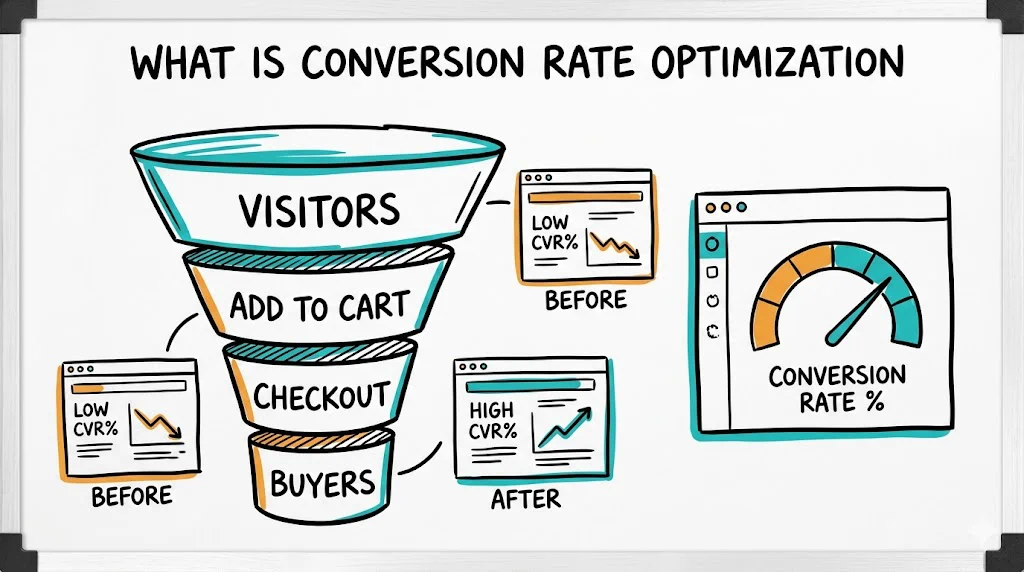
Conversion rate optimization (CRO) is the process of increasing the percentage of website visitors who take a desired action, whether that's buying a product, adding to cart, or signing up, by systematically testing and improving your website. Instead of spending more money to get more traffic, CRO helps you earn more from the traffic you already have. For D2C brands spending ₹50,000 to ₹5L per month on performance marketing, CRO is often the highest-ROI investment available.
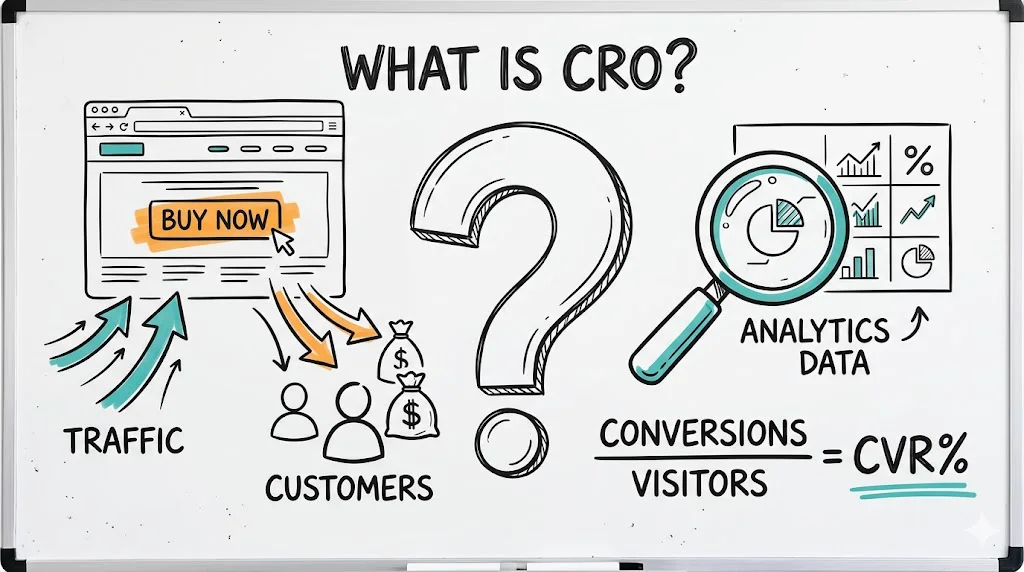
Conversion rate optimization (CRO) is a structured, data-driven process of increasing the share of website visitors who complete a goal, typically a purchase, email signup, or add-to-cart event. Your conversion rate is calculated as: (Conversions ÷ Visitors) × 100. A store getting 10,000 visitors per month with 200 purchases has a 2% conversion rate.
CRO uses A/B testing, user research, heatmaps, session recordings, and quantitative analytics to identify why visitors leave without converting, then systematically fixes those barriers. The discipline sits at the intersection of data science, psychology, and design.
The goal is not to trick visitors into buying. It's to remove friction, build trust, and make it genuinely easier for the right customer to say yes.
Most D2C brands grow by increasing ad spend. Customer acquisition costs (CAC) on Meta and Google have risen 60 to 80% over the past four years. A brand spending ₹50,000/month on ads to get 5,000 visitors at 1% CVR earns ₹50,000 from 50 orders (at ₹1,000 AOV). Doubling revenue by doubling ad spend costs another ₹50,000. Doubling revenue by doubling CVR from 1% to 2% costs a fraction of that, typically the price of a good CRO tool for a few months.
| Metric | Baseline | After CRO (+1% CVR) | Difference |
|---|---|---|---|
| Monthly visitors | 10,000 | 10,000 | , |
| Conversion rate | 1.5% | 2.5% | +1% |
| Orders | 150 | 250 | +100 |
| Revenue (₹1,200 AOV) | ₹1,80,000 | ₹3,00,000 | +₹1,20,000/mo |
That extra ₹1,20,000/month required zero additional ad spend. The same traffic, better conversion.
For Indian D2C brands, CRO compounds further because:
CRO is not guesswork. It follows a repeatable process:
Map every step from landing page to order confirmation. Use funnel analysis to find where visitors drop off. Common leak points for Indian D2C brands:
Numbers tell you where people drop off. Qualitative research tells you why. Use:
A good CRO hypothesis follows this format: "If we [change X], then [metric Y] will improve, because [customer insight Z]."
Example: "If we add a 'Delivered in 2 days to your pincode' banner on the checkout page, cart abandonment rate will fall by 10%, because our exit surveys show delivery uncertainty is the #1 reason for drop-off."
You can't test everything. Use PIE (Potential, Importance, Ease) or ICE (Impact, Confidence, Ease) to stack-rank experiments. Focus first on high-traffic, high-drop-off pages.
Use a visual editor to build your variant. Define your primary metric (conversion rate, RPV, or AOV) before launching. Split traffic 50/50 between control and variant.
Don't stop tests early. Use a tool that shows statistical significance. You need 95%+ confidence before declaring a winner. Calling results early is one of the most common ways CRO programs go wrong.
Every test teaches something, even losers. Document the hypothesis, result, and insight. After 20 to 30 tests, your learning library becomes a real competitive advantage.
Optimizing individual page elements: headlines, CTAs, images, reviews, product descriptions, trust badges. This is where most brands start, and where most quick wins live.
Optimizing the entire customer journey from ad click to order confirmation. Funnel CRO reduces leakage at each step. For Indian D2C, the biggest leaks are typically at checkout and payment.
Showing different experiences to different visitor segments. A new visitor from a Meta ad sees a brand story. A returning visitor who abandoned cart yesterday sees their cart with a 5% urgency nudge. Personalization takes CRO further by targeting the right experience to each person, rather than running one test for everyone.
Page speed, Core Web Vitals, mobile responsiveness. A 1-second delay in page load reduces CVR by 7%. For tier-2/3 city customers on 4G, this matters a lot.
Testing price points, discount structures, free-shipping thresholds, and bundling. A brand selling a ₹299 product might find that ₹349 with a free sample converts better than ₹299 alone.
1. Always test one variable at a time. Changing the CTA button color, headline, and image simultaneously makes it impossible to know what caused the lift. Isolate variables unless you're running a full multivariate test with sufficient traffic.
2. Run tests for statistical significance, not calendar time. Don't stop a test after 7 days because it "looks good." Wait until you have 95%+ statistical significance with at least 100 conversions per variant.
3. Prioritize mobile-first tests. 70 to 80% of Indian D2C traffic is mobile. If your test only looks good on desktop, you're optimizing for a minority. Always preview and test on mobile.
4. Use D2C-specific metrics, not just conversion rate. Track AOV, RPV, and add-to-cart rate alongside CVR. A variant that lifts CVR 10% but drops AOV 15% is a net loser.
5. Test during representative traffic periods. Avoid launching tests during Diwali, Big Billion Days, or Republic Day sales. Festive traffic behaves differently, so results won't generalize to normal periods.
6. Fix the leakiest funnel step first. The highest-leverage CRO work targets your biggest drop-off point. Use funnel analysis to find it before building your test roadmap.
7. Include trust signals for Indian customers. Indian online shoppers are still building trust with D2C brands. Test verified reviews with photos, "Made in India" badges, secure payment logos, delivery guarantees, and easy return policies.
8. Reduce COD friction thoughtfully. COD is a trust signal for many Indian customers, especially in tier-2/3 cities. Don't remove it. Test prepaid incentives (₹50 cashback on UPI, priority shipping) alongside COD to shift the mix.
9. Build a test backlog, not a test calendar. Your backlog should always have 10 to 15 prioritized hypotheses. Teams that run tests ad hoc run out of ideas and stop testing.
10. Share learnings across the team. CRO insights belong to the whole company. What works on the product page often reveals something useful for the email team, the ad creative team, and the product team.
| Tool | Best For | Key Feature | Starting Price |
|---|---|---|---|
| CustomFit.ai | D2C/Shopify brands | No-code editor, D2C metrics (AOV, RPV), 1000+ targeting attributes | $99/mo (₹~8,300) |
| VWO | Mid-market and enterprise | Heatmaps + A/B testing combined | ~$300/mo |
| Optimizely | Enterprise | Feature flags + web experimentation | Custom pricing |
| AB Tasty | Mid-market | AI-driven personalization | ~$300/mo |
Why CustomFit.ai for D2C brands:
Bellavita, a premium Indian beauty brand, was getting strong traffic from Meta ads but losing visitors on the product page. Their hypothesis: trust signals and social proof were weak for first-time visitors.
They used CustomFit.ai to A/B test a product page variant with verified photo reviews above the fold, an "Ordered by 50,000+ customers" badge, and a 15-day easy return banner. The result was an 11% increase in CVR within 3 weeks.
Kapiva's challenge was converting health-conscious customers who needed education before buying. Their exit surveys showed visitors leaving because they didn't understand ingredient benefits.
They tested a "Why it works" accordion section on product pages, explaining key ingredients in simple Hindi-English mixed copy. CVR lifted 9.48%. The insight: educational content converts skeptical buyers.
Mamaearth discovered through funnel analysis that 68% of customers who added to cart never reached checkout. Session recordings revealed confusion about shipping costs. They tested a "Free shipping above ₹499" sticky banner. Cart abandonment rate dropped 12%.
Nykaa implemented segmentation-based personalization: returning visitors who had browsed skincare were shown skincare-first homepages. New visitors saw curated bestsellers. RPV for personalized returning visitors improved 18%.
Sugar ran separate A/B tests for Diwali vs. non-festive periods. Their festive variant included a gift-set banner, countdown timer, and "Order by Dec 22 for guaranteed Christmas delivery" copy. Festive CVR was 2.3x their baseline, but they only applied these changes during the relevant period, protecting annual averages.
1. Stopping tests too early. Checking results daily and stopping when the variant "looks like a winner" inflates false positives. Always wait for statistical significance.
2. Testing low-traffic pages. A page with 200 visitors/month will take 6+ months to reach significance. Focus your first tests on pages with 1,000+ monthly visitors.
3. Ignoring mobile. A desktop test that looks broken on mobile will produce misleading results. Always QA on multiple devices.
4. Copying competitors without context. "Our competitor added a countdown timer, let's do that." Maybe it works for them because their audience responds to urgency. Your audience might not. Test it; don't assume.
5. Measuring the wrong metric. Optimizing for click-through rate on a CTA but not tracking whether those clicks actually converted. Always set your primary metric as a downstream revenue event.
6. No documentation. Running 20 tests and remembering none of them. Without documentation, you'll repeat failed experiments and lose institutional knowledge.
7. Testing by committee (HiPPO-driven). When the highest-paid person in the room demands their idea gets tested first, skipping the prioritization framework, results suffer. CRO has to be evidence-driven, not hierarchy-driven.
1. Build a cohort analysis layer. Don't just measure CVR at the point of the test. Follow converted customers for 90 days. A variant that converts more customers but at lower LTV is worse than a lower-CVR variant with higher repeat purchase rates.
2. Test your traffic sources separately. Meta ad traffic behaves differently from Google search traffic. A visitor from a brand-awareness Instagram reel needs more education than someone who searched "buy Bellavita perfume." Segmentation by source lets you form much more specific hypotheses.
3. Use heatmaps to inform qualitative research, not to make decisions. Heatmaps show you where people click, not why. A heatmap showing visitors clicking on a non-clickable product image tells you to make that image clickable, but it doesn't tell you whether that change will increase CVR. Always validate with an A/B test.
4. Combine CRO with post-purchase optimization. Most CRO stops at the "thank you" page. Post-purchase upsells, NPS surveys, and referral prompts are all conversion opportunities. Testing a post-purchase one-click upsell ("Add a travel-size version for ₹99?") can lift AOV 8 to 12% with zero pre-purchase friction.
5. Run seasonal "always-on" tests, not just project-based CRO. The best D2C CRO programs treat experimentation as infrastructure, not a campaign. They run 3 to 5 tests simultaneously, building compounding learnings month over month.
What is conversion rate optimization (CRO)? CRO is the practice of improving the percentage of website visitors who complete a desired action, like buying, signing up, or adding to cart, through systematic testing and data analysis. It uses A/B testing, heatmaps, and user research to remove friction from the customer journey.
What is a good conversion rate for an ecommerce store? A good ecommerce conversion rate is 2 to 4%. Indian D2C brands on Shopify typically see 1.5 to 3%. If you're below 2%, structured CRO work can double your revenue without increasing ad spend. Top performers in beauty and supplements reach 4 to 6% with ongoing optimization.
How long does CRO take to show results? Basic wins (button color, CTA copy, trust badges) show results in 2 to 4 weeks if you have sufficient traffic. Structural experiments (pricing, checkout flow redesign) take 4 to 8 weeks to reach statistical significance. Expect meaningful revenue impact within 3 months of a structured program.
How much does CRO cost? CRO tools range from ₹8,000/mo (CustomFit.ai Starter) to ₹2L+/mo for enterprise platforms. The ROI is usually 5 to 10x. Every rupee spent on CRO consistently returns more than a rupee spent on paid acquisition, especially as ad CPMs rise.
Do I need a developer to do CRO? No. Tools like CustomFit.ai have a no-code visual editor. You can launch your first A/B test in under 30 minutes without writing a single line of code. Developer resources are an advantage for complex tests but not a requirement for getting started.
What is the difference between CRO and SEO? SEO brings more visitors to your site. CRO converts more of those visitors into customers. Both matter: SEO fills the funnel, CRO makes the funnel efficient. A brand that does SEO without CRO is pouring water into a leaky bucket.
Can CRO work for Indian D2C brands with COD-heavy customers? Yes. CRO for Indian D2C means testing COD vs. prepaid nudges, UPI badge placement, trust signals for tier-2 cities, and festive-season landing pages. The tactics differ from Western markets, but the data-driven process is identical.
What metrics should I track for CRO? Track conversion rate, average order value (AOV), revenue per visitor (RPV), cart abandonment rate, and bounce rate. RPV is the single most important number because it accounts for both CVR and AOV together.
Start your free trial of CustomFit.ai, 14 days, no credit card. Setup under 30 minutes.