From the conversion glossary
Concepts referenced in this article, defined.
Concepts referenced in this article, defined.
 cro
croPre-order waitlist CRO strategies that convert hype into real revenue - how to design waitlist and pre-order pages that don't lose momentum before launch.
 cro
croFirst purchase experience optimization - practical strategies to turn first-time visitors into buyers, from welcome offers to a smarter new customer funnel.
 cro
croRetail media CRO explained - how to monetize on-site ads and sponsored placements without tanking your conversion rate. A practical balance guide.
Run rigorous A/B tests and personalize every visit on Shopify or any storefront — no engineers required.
CRO for marketplace sellers means optimizing the elements within your control — product titles, images, bullet points, A+ content, pricing, and reviews — to increase your listing's click-through rate from search results and conversion rate from listing page to purchase. Unlike D2C website CRO where you control the entire experience, marketplace CRO operates within platform constraints. The brands that win on Amazon and Flipkart understand exactly which levers are available and optimize them systematically.
On Amazon and Flipkart, you control less than on your own website — but what you control still moves conversion rates significantly. The key distinction:
What you control:
What the platform controls:
Marketplace CRO works within this constraint set. Every optimization should maximize the controllable elements.
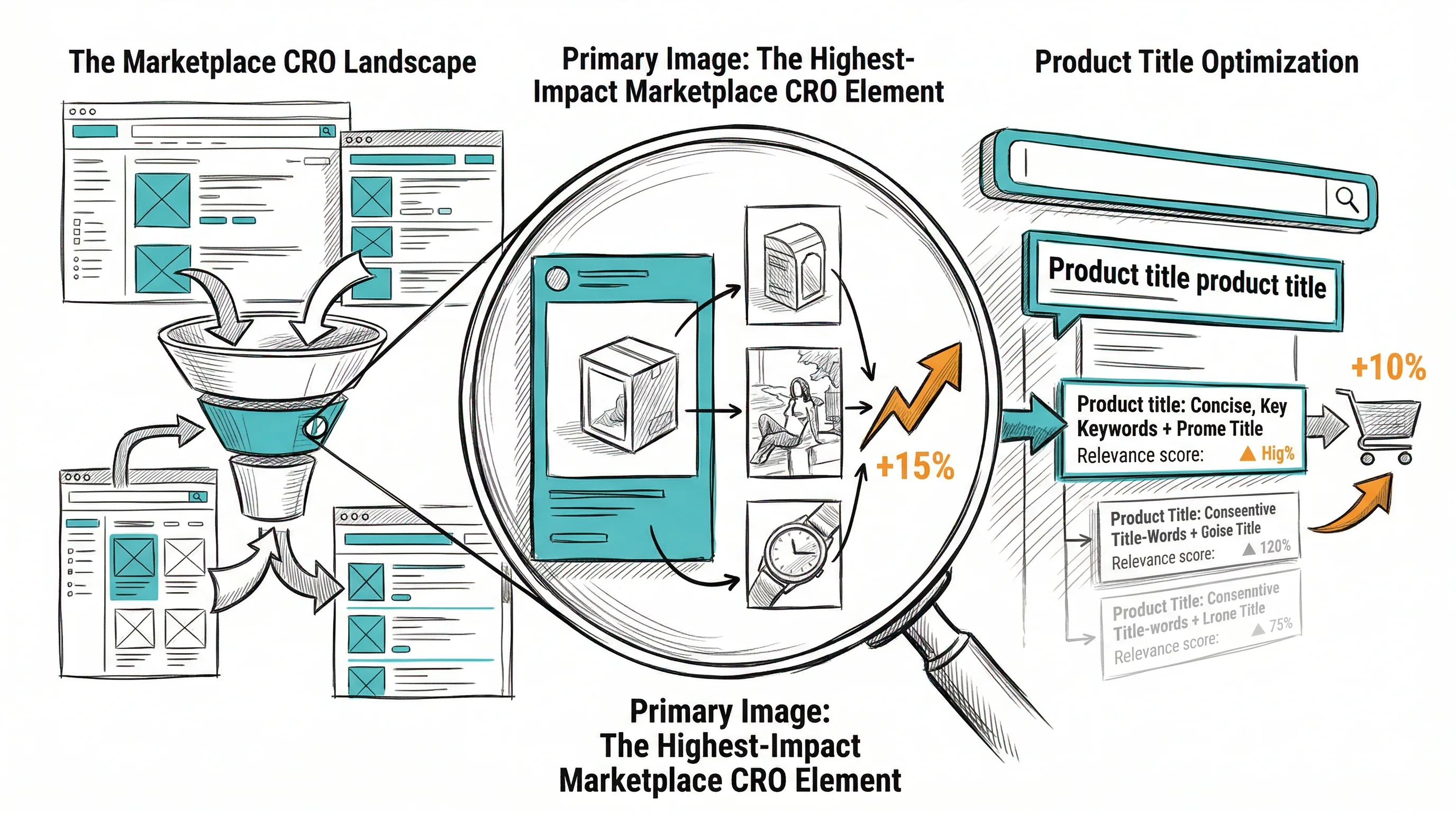
On mobile search results pages (where 70%+ of Indian marketplace browsing happens), the primary image is the first — and often only — thing shoppers see before clicking. Click-through rate from search to listing is the first conversion in the marketplace funnel.
Primary image best practices (consistently validated by Amazon MYE data):
Test: Commission two professional primary image angles (front-facing vs. slight 3/4 angle) and alternate as primary for 4-week periods. Measure unit session percentage (Amazon's conversion rate metric) for each.
Secondary images as trust-builders:
Marketplace product titles serve two masters: search algorithm visibility and human click motivation. The optimal title balances both.
Title structure for Amazon India / Flipkart: [Brand] + [Primary Keyword] + [Key Benefit] + [Specification (size/count)] + [Secondary differentiator]
Example: "Kapiva Aloe Vera Juice 1L — 99% Raw Aloe, No Sugar, FSSAI Certified — Gut Health Supplement for Men & Women"
What to test in titles:
Note: Amazon MYE allows title A/B testing for registered brands. Run 4-week tests and measure unit session percentage.
Bullet points are the primary copy read on listing pages. Five bullets, optimized for a specific buyer persona and use case:
High-converting bullet point structure:
Test (sequential, 4 weeks each):
A+ content (Enhanced Brand Content) is available to Amazon Brand Registry sellers and has been shown to improve conversion 3–10% on average. For Flipkart, the equivalent is brand-enhanced product pages.
High-converting A+ content structure:
Test: A+ content with comparison chart vs. without comparison chart. Comparison tables typically drive 2–5% CVR lift as they help buyers confirm they are choosing the right option.
Marketplace bank offers ("10% off on HDFC cards," "No-cost EMI from ₹999") are negotiated with the platform but can be optimized:
For consumable D2C products on marketplaces:
Test: Create bundle ASIN/listing and measure bundle conversion vs. single unit. Bundles typically increase AOV 25–40% and often have higher unit session percentage.
Reviews are not directly testable, but review strategy affects conversion significantly:
Review count impact: Listings with fewer than 10 reviews convert at significantly lower rates than listings with 100+. Prioritizing review acquisition through follow-up campaigns (Amazon-compliant) is a conversion investment.
Review quality signals: Respond to negative reviews publicly and professionally. Buyers read negative review responses — a well-written response can convert a hesitant buyer. Test response templates for common negative review patterns.
Review content alignment: If buyers consistently mention your product in a specific use case in reviews, update your bullet points to match that language. Review-to-copy alignment improves organic search ranking and conversion.
One critical limitation of marketplace selling: you cannot run personalization, advanced A/B testing, or accumulate first-party customer data. Buyers belong to Amazon or Flipkart, not to your brand.
This is why high-growth Indian D2C brands — Mamaearth, Nykaa, Boat, Kapiva — invest in their own website CRO alongside marketplace optimization:
CustomFit.ai delivers 11% average CVR improvement for D2C Shopify stores with no-code testing — providing the optimization capability that marketplace platforms cannot offer.
Keyword stuffing the title. Titles overloaded with keywords at the expense of readability reduce CTR even if they rank. Balance algorithm optimization with human-readable copy.
Using lifestyle images as primary image. Lifestyle images perform well as secondary images and in A+ content. As primary images in search results, white-background product images consistently outperform lifestyle shots for CTR.
Ignoring mobile image quality. Indian marketplace browsing is predominantly mobile. Images that look adequate on desktop may appear pixelated or unclear at mobile thumbnail size. Review all images at 200px thumbnail before finalizing.
Not using A+ content. A+ content is available at no extra cost to brand-registered sellers and consistently improves conversion. Not using it is leaving free conversion improvement on the table.
Pricing inconsistently across channels. If your D2C website price is significantly higher than your marketplace price, buyers who discover this will choose marketplace. Manage cross-channel pricing strategically.
Related reading: