From the conversion glossary
Concepts referenced in this article, defined.
Concepts referenced in this article, defined.
 cro
croPre-order waitlist CRO strategies that convert hype into real revenue - how to design waitlist and pre-order pages that don't lose momentum before launch.
 cro
croFirst purchase experience optimization - practical strategies to turn first-time visitors into buyers, from welcome offers to a smarter new customer funnel.
 cro
croRetail media CRO explained - how to monetize on-site ads and sponsored placements without tanking your conversion rate. A practical balance guide.
Run rigorous A/B tests and personalize every visit on Shopify or any storefront — no engineers required.
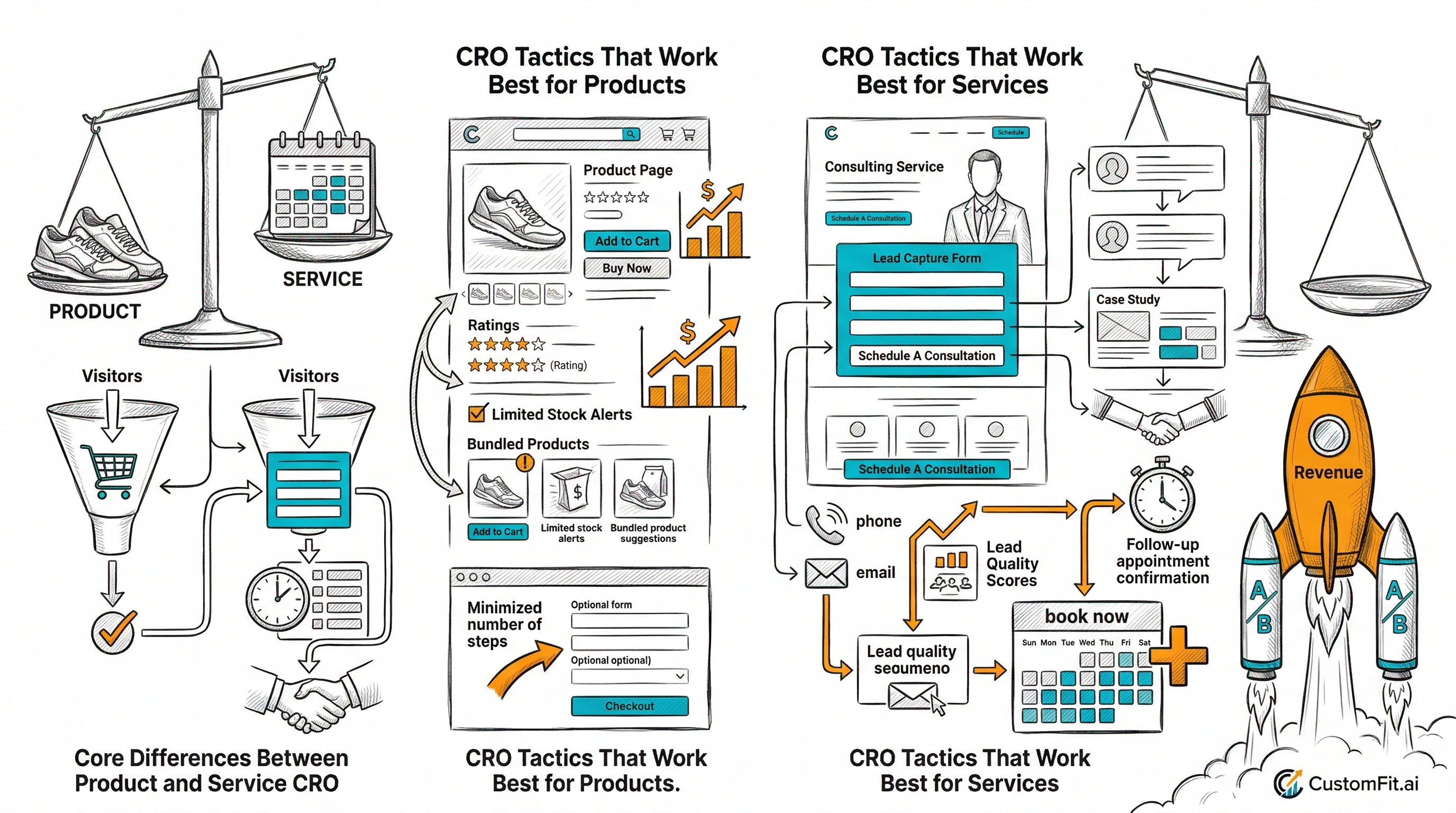
CRO for services and CRO for products use the same underlying method. You form a hypothesis, run a controlled experiment, and measure the results. What changes is what you are optimizing, how you measure success, and which tactics move the needle. Product CRO optimizes a defined transaction with a clear success state: the purchase is completed. Service CRO optimizes the start of a relationship, where the conversion event (booking, lead submission, consultation) is only the first step in a longer journey. Knowing the difference keeps you from applying product tactics to service businesses and missing the ones that actually work there.
| Dimension | Product CRO | Service CRO |
|---|---|---|
| Conversion event | Purchase (add to cart, checkout) | Lead form, booking, trial sign-up |
| Consideration cycle | Minutes (impulse) to days (high-ticket) | Days to weeks |
| Primary trust signal | Reviews, ratings, product images | Case studies, testimonials, credentials |
| Urgency tactics | High impact | Moderate, can feel pressure-y |
| Price visibility | Always show | Sometimes better to show after qualification |
| Post-conversion value | Product shipped | Service relationship begins |
| Measurement horizon | 24 to 48 hours | Days to weeks (quality of lead matters) |
Product buyers, especially for impulse categories, respond well to:
These tactics work because the product transaction is low-risk (you can return it) and defined (you know exactly what you are getting).
High-quality images, 360-degree views, zoom functionality, and lifestyle photography directly affect product add-to-cart rates. This has no direct service equivalent.
Guest checkout, one-click payment, COD availability, and simplified form fields are the primary levers for product conversion at the checkout stage.
For products, show the full price (including shipping) as early as possible. Price surprises at checkout are the top cause of cart abandonment.
The service equivalent of product checkout is the lead form. A few things to optimize:
Service buyers are motivated by transformation, not features. Test:
Problem-led headlines often outperform benefit-led ones for services: "Struggling to grow online sales? Here's what's holding you back."
For services, reviews carry less weight than product reviews because service outcomes are more variable. Case studies with specific, attributable results work better:
Named, specific, verifiable case studies outperform anonymous testimonials by a wide margin.
Service buyers are evaluating the provider's capability, not a defined product. Test:
Service CRO often involves testing whether to show pricing at all:
Test for your specific service and buyer type. Professional services (consulting, coaching) often benefit from price visibility. Consumer services (beauty consultation, nutrition assessment) typically convert better with a lower-commitment first step (free assessment, quiz) than with hard pricing.
Many Indian D2C brands offer both:
CRO for hybrid models requires segmented testing.
Keep separate pages and separate test programs. Product pages and service booking pages should have independent A/B test programs with independent success metrics.
Test cross-sell from product to service. Check whether including a "Free skin analysis" CTA on high-ticket skincare product pages increases conversion (by reducing purchase hesitation) or dilutes it (by distracting from the purchase). Results vary a lot by product category.
Treat service as a trust-builder for product purchase. Some buyers complete a consultation and then convert to a product purchase. If this is a meaningful conversion path in your analytics, optimize the handoff between service booking confirmation and product recommendation.
For products, the primary metric is conversion rate (purchases / sessions) or add-to-cart rate, and the measurement window is 24 to 72 hours for most categories.
For services, the primary metric is lead submission rate (form completions / page visitors). The quality metrics are lead-to-meeting rate and lead-to-sale rate, measured over 7 to 30 days, and the measurement window runs 14 to 30 days, long enough to capture downstream quality signals.
The main service CRO mistake is optimizing for lead volume without tracking lead quality. A service landing page that generates 100 unqualified leads per month performs worse than one that generates 40 highly qualified leads. Always track conversion from lead to sale, not just lead to form submission.
When building your CRO program, use this framework.
If the conversion event is a purchase:
If the conversion event is a lead or booking:
If hybrid:
Use different analytics setups. Product CRO can rely on standard ecommerce analytics (GA4 enhanced ecommerce, Shopify Analytics). Service CRO needs CRM integration to track lead quality beyond the form submission.
Test the confirmation page experience. For services, the confirmation page after booking or form submission is the highest-engagement moment. Test next steps explained vs. a meeting scheduling calendar vs. immediate resource delivery. Reducing buyer uncertainty after the form submission improves show rates for consultations.
Test response time as a CRO variable. For services, how quickly you follow up after a lead submission affects conversion to sale. An immediate automated WhatsApp confirmation with next steps consistently beats email-only follow-up, so test it as a service CRO intervention.
Apply product-review-style thinking to service testimonials. Service testimonials that mention specific outcomes, timeframes, and before/after states perform like detailed product reviews. They convert much better than generic praise.
Related reading: