From the conversion glossary
Concepts referenced in this article, defined.
Concepts referenced in this article, defined.
 cro
croPre-order waitlist CRO strategies that convert hype into real revenue - how to design waitlist and pre-order pages that don't lose momentum before launch.
 cro
croFirst purchase experience optimization - practical strategies to turn first-time visitors into buyers, from welcome offers to a smarter new customer funnel.
 cro
croRetail media CRO explained - how to monetize on-site ads and sponsored placements without tanking your conversion rate. A practical balance guide.
Run rigorous A/B tests and personalize every visit on Shopify or any storefront — no engineers required.
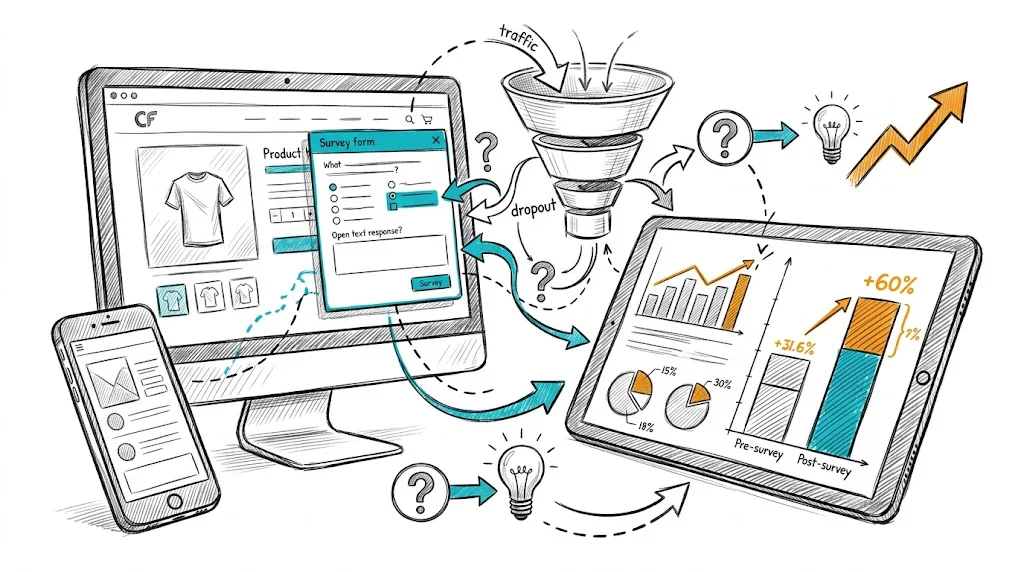
Customer surveys are the fastest way to find out why visitors leave your store without buying. The right questions give you qualitative data that complements heatmaps and A/B test results — revealing the "why" behind the numbers in your analytics dashboard.
Most CRO tools show you what users do — they click here, they scroll this far, they abandon at this step. Surveys tell you why. A heatmap might show 60% of users never scroll past your hero section. A well-placed survey question tells you it's because they couldn't figure out if your supplement ships to Tier-2 cities or whether COD is available.
Indian D2C brands face specific trust barriers that analytics alone can't reveal: concerns about product authenticity, return policies on used wellness products, UPI payment failures, and delivery timelines in non-metro areas. Surveys surface all of this.
Brands like Kapiva and Bellavita have used on-site qualitative research to identify friction points that weren't visible in their funnel data — and used those insights to make targeted changes that lifted conversion rates by 9-11%.
1. Exit-Intent Surveys Trigger when a visitor moves to close the tab or navigate away. Best for product pages and checkout. Keep to one or two questions max.
2. Post-Purchase Surveys Show on the order confirmation page or in the first post-purchase email. Users are satisfied, trust you, and willing to give honest feedback. This is your gold mine.
3. On-Page Micro-Surveys A single targeted question embedded in the page — e.g., on a product page: "Is there information missing that would help you decide?" with a text field.
4. Cart Abandonment Surveys Triggered by exit-intent on the cart page. "What's stopping you from completing your order today?" gives you direct objections you can address in cart copy.
5. Welcome Surveys Shown to new visitors: "What brings you here today?" — helps segment intent and personalizes the experience from the first visit.
6. NPS + Follow-Up Net Promoter Score surveys for existing customers. The follow-up open-text field after the score is where the real CRO gold lives.
See also: Conversion Rate Optimization glossary | A/B Testing glossary | Bounce Rate glossary
Use conditional logic. If a user selects "Shipping cost too high" as their reason for abandoning, follow up with "What shipping cost would feel fair to you?" Don't ask this of everyone — just those who flagged it.
Mix closed and open-ended questions. Closed questions (multiple choice) give you quantifiable data. Open-text fields give you the exact language your customers use — which you can then borrow for your product page copy.
Show the survey at the right moment. Exit-intent surveys need a trigger — mouse moving toward the browser chrome on desktop, back-button gesture on mobile. Post-purchase surveys should appear within 15 seconds of the confirmation page loading, not immediately.
Keep it mobile-first. In India, 70%+ of D2C traffic comes from mobile. Multi-question forms with small radio buttons fail on mobile. Stick to thumb-friendly tap targets and one question per screen.
Don't survey every visitor. Show surveys to a subset — 20-30% of qualifying visitors. Surveying everyone creates fatigue and biases responses toward users who are very happy or very frustrated.
See also: User Experience glossary | Heatmap glossary | Customer Lifetime Value glossary
Raw survey data is not a CRO plan. Here's how to convert answers into testable hypotheses:
Step 1: Categorize responses. Tag each open-text response: shipping concern, trust concern, product information gap, pricing, payment, technical issue, competitor comparison.
Step 2: Find the frequency. If 40% of exit-intent responses mention "not sure about returns," that's your highest-priority CRO hypothesis.
Step 3: Write a hypothesis. "If we add a prominent return policy trust badge to the product page above the Add to Cart button, then cart additions will increase because visitors currently lack confidence in our return policy."
Step 4: Design a test. Create two variants — one with the trust badge, one without. Run it through a no-code A/B testing tool like CustomFit.ai until you reach statistical significance.
Step 5: Implement the winner and repeat. The winning variant becomes your new baseline. Move to the next survey insight.