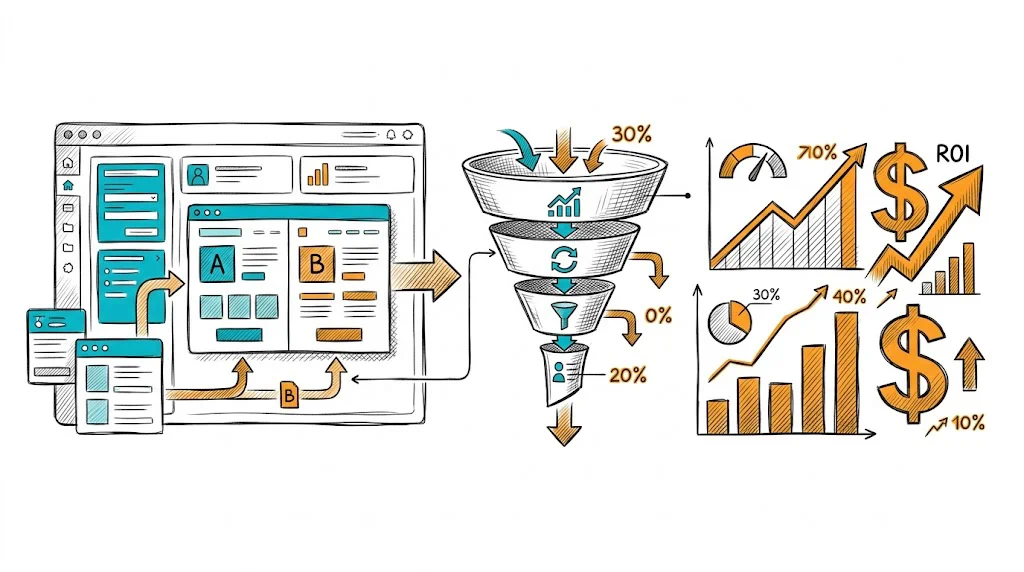
From the conversion glossary
Concepts referenced in this article, defined.
Concepts referenced in this article, defined.
 cro
croPre-order waitlist CRO strategies that convert hype into real revenue - how to design waitlist and pre-order pages that don't lose momentum before launch.
 cro
croFirst purchase experience optimization - practical strategies to turn first-time visitors into buyers, from welcome offers to a smarter new customer funnel.
 cro
croRetail media CRO explained - how to monetize on-site ads and sponsored placements without tanking your conversion rate. A practical balance guide.
Run rigorous A/B tests and personalize every visit on Shopify or any storefront — no engineers required.
Ecommerce conversion rate optimization (CRO) is the discipline of improving the percentage of your store's visitors who complete a purchase, using A/B testing, personalization, UX improvements, and data analysis. For D2C brands, CRO is often the highest-ROI growth lever available. A 1% improvement in CVR on a store doing ₹5L/month in revenue adds ₹2.5L in monthly revenue without spending an extra rupee on ads. This guide covers the complete CRO process for ecommerce brands in 2026.
Ecommerce conversion rate optimization is a structured, data-driven process of increasing the share of website visitors who complete a purchase. Your ecommerce conversion rate is: (Number of orders ÷ Number of visitors) × 100.
A store with 20,000 monthly visitors and 300 orders has a 1.5% CVR. Ecommerce CRO uses A/B testing, heatmap analysis, session recordings, exit surveys, and user research to understand why 98.5% of visitors don't buy, then systematically removes those barriers.
Ecommerce CRO covers the full customer journey: from the first touchpoint (homepage, landing page, product page) through add-to-cart, checkout, payment, and order confirmation. Every step in this journey is a potential leak point and a CRO opportunity.
Meta CPMs have risen 70%+ in three years. Google Shopping CPC has followed. For Indian D2C brands spending ₹50,000 to ₹5L/month on performance marketing, the cost to acquire each customer keeps rising while the store's ability to convert them stays flat.
The math is straightforward: if you're spending ₹500 to acquire a visitor and converting 2%, each order costs ₹25,000 in acquisition. Improve CVR to 3% and your acquisition cost per order drops to ₹16,667 without changing your ad budget.
India's D2C market grew fast on VC-funded ad spending. Now brands are being asked to be profitable. CRO is the most direct path to profitability because it extracts more revenue from every rupee of existing marketing investment.
The gap between a 1.5% and 3.5% CVR on the same traffic doubles your revenue. That gap closes through systematic CRO, not bigger ad budgets.
| Factor | Typical CVR impact |
|---|---|
| Poor product page copy | -15 to -30% vs. optimized |
| No social proof above fold | -10 to -20% |
| Unexpected shipping costs at checkout | -20 to -35% cart abandonment |
| Mobile page speed >3s | -15 to -25% mobile CVR |
| No COD option (tier-2/3 cities) | -20 to -40% in those geographies |
Document your CVR, AOV, RPV, and cart abandonment rate for the past 90 days. Set this as your baseline. Without a baseline, you can't measure improvement.
Use funnel analysis to identify the conversion rate at each step:
The step with the highest drop-off rate is your highest-leverage starting point.
Numbers show where people drop off. Qualitative tools show why:
Use the ICE framework (Impact, Confidence, Ease) to rank hypotheses:
Score each 1 to 10, multiply for a total. Build your test roadmap starting with the highest ICE scores.
Launch one test at a time per page template. Define your primary metric (use RPV to capture both CVR and AOV effects). Wait for 95%+ statistical significance.
Implement winning variants immediately. Document every test, including hypothesis, result, and insight, regardless of outcome. Build a continuous test calendar with 2 to 3 active tests running at all times.
The product page is where most purchase decisions are made and where most D2C brands have the most untested elements. Key levers: hero images, product description format, reviews placement, CTA button, trust signals, FAQs.
Checkout abandonment averages 70% globally. For Indian D2C brands, common drop-off triggers include COD not offered, address form friction, payment gateway errors, and shipping cost surprises. Checkout CRO is often the fastest path to revenue.
The first impression determines whether new visitors stay or bounce. Test the hero banner message, value proposition clarity, category navigation, featured product selection, and social proof placement.
The cart is where AOV optimization happens. Test free-shipping progress bars, cross-sell recommendations, urgency signals ("Only 4 left"), COD availability display, and simplified layout.
Page speed, Core Web Vitals, mobile responsiveness. These often produce the highest ROI for Indian D2C brands, where many customers browse on 4G connections in tier-2/3 cities. A 2-second load time improvement can lift mobile CVR 15 to 20%.
Showing different experiences to different visitor segments. A new visitor from a Meta ad sees a brand story; a returning customer sees their previously browsed products. Personalization compounds the effect of A/B testing by ensuring each segment sees the version that performs best for them.
1. Fix shipping cost surprises before anything else. Unexpected shipping costs at checkout are the #1 driver of cart abandonment globally. Show shipping costs on product pages, not just at checkout. For Indian customers, display free-shipping thresholds early in the journey.
2. Optimize for mobile first, desktop second. Indian D2C traffic is 70 to 80% mobile. Design, test, and prioritize for mobile. Desktop is secondary. A polished desktop experience that performs poorly on mobile is leaving most of your potential revenue on the table.
3. Add trust signals at every friction point. Indian online shoppers are still building trust with D2C brands. Place trust signals where doubt arises:
4. Show COD prominently, then nudge toward prepaid. COD is a trust mechanism, not just a payment method, for tier-2/3 city customers. Don't hide it or you'll lose the sale. Instead, show COD clearly and test prepaid incentives alongside it (₹50 cashback on UPI, priority shipping for prepaid orders).
5. Use RPV as your north star metric. Revenue per visitor captures both CVR and AOV. A test that increases CVR but decreases AOV might be a net loss. A test that increases AOV with a small CVR dip might be a big win. RPV tells you the truth.
6. Build for the customer's intent, not your brand's preference. Your homepage may want to tell the brand story. A visitor who searched "best vitamin C serum" wants to see vitamin C serums, not your origin story. Match your landing experience to the intent that brought the visitor.
7. Run tests for statistical significance, not calendar duration. Two weeks minimum, 95%+ statistical significance, 100+ conversions per variant. These are the minimum standard for reliable results.
8. Treat every test result as a learning, not just a win or loss. A losing test tells you what your customers don't respond to, which is just as useful as knowing what they do respond to. The learning compounds. A team with 50 documented test results knows their customers better than a team with none.
9. Prioritize return rates, not just conversion rates. A variant that converts more customers but produces more returns is damaging margin. Track returns by experimental group. Sometimes a more accurate product page (less salesy copy, more realistic photos) converts slightly less but has dramatically lower return rates.
10. Build a CRO culture, not a one-time CRO project. One-time CRO audits have short-lived impact. Sustainable CRO is a continuous program: always-on testing, regular hypothesis generation, shared learnings across teams, and metrics reviewed weekly.
| Tool | Best for | Key feature | Starting price |
|---|---|---|---|
| CustomFit.ai | D2C/Shopify brands | No-code A/B testing + personalization, D2C metrics, 1000+ targeting attributes | $99/mo |
| VWO | Mid-market ecommerce | Heatmaps + A/B testing + surveys bundled | ~$300/mo |
| Optimizely | Enterprise | Feature flags + web experimentation | Custom (₹10L+/yr) |
| Hotjar | Qualitative research | Heatmaps + session recordings + surveys | Free/$39/mo |
| Google Analytics 4 | Funnel analytics | Free funnel analysis and audience data | Free |
The CustomFit.ai advantage for D2C brands:
Compare CustomFit.ai vs VWO | Compare vs Optimizely | Compare vs Google Optimize
Bellavita's product pages had strong photography but weak social proof at the decision moment. Exit surveys revealed first-time visitors were hesitant about product quality.
Test: Added "Trusted by 50,000+ customers" and photo reviews directly below the Add to Cart button. Result: 11% CVR increase in 3 weeks.
Key learning: Social proof works best when placed at the moment of decision, not as an afterthought at the bottom of the page.
Kapiva's Ayurveda supplements require customer education: why this herb works, what it's good for, who should take it. Their product pages were product-centric, not customer-centric.
Test: Replaced static product description with a "Why it works" accordion section, explaining each ingredient in accessible language. Result: 9.48% CVR increase. The insight: educated customers buy more confidently.
Chargebee (B2B SaaS, included here as a CRO case study) used A/B testing to optimize their pricing page. Testing plan hierarchy, feature emphasis, and CTA copy yielded a 40% increase in average contract value.
The learning for D2C brands: pricing page and bundle optimization can have outsized AOV impact when it's grounded in customer research rather than competitive imitation.
mCaffeine's average order value was ₹380. Free shipping started at ₹499. Few customers were bridging the gap.
Test: Added a cart-page progress bar showing "You're ₹119 away from free shipping" with a product recommendation panel. Result: AOV increased from ₹380 to ₹462 (21.6% increase). The bar alone drove most of the lift; the recommendation panel added incremental improvement.
Boat's mobile checkout had 8 form fields and no express checkout option. Session recordings showed customers abandoning mid-form.
Test: Reduced to 5 essential fields (removed Company Name, Address Line 2, and combined First/Last Name), added Razorpay express checkout at the top. Result: Mobile checkout completion rate improved 19%. Cart abandonment rate fell from 74% to 60% on mobile.
1. Starting with the wrong page. Spending 6 weeks testing your homepage when your product page is where 80% of your drop-off happens is a common trap. Use funnel analysis to find the highest-drop-off page before testing anything.
2. Confusing traffic with conversions. High traffic numbers don't mean much at a 1.2% CVR. Traffic is opportunity; CVR is execution. CRO is about execution.
3. Copying what works for other brands. "Mamaearth does countdown timers, so we should." Maybe their audience responds to urgency. Yours might be trust-sensitive. What works for someone else is a hypothesis for you, not a certainty.
4. Ignoring the return-to-origin (RTO) cost. A test that increases CVR by getting more COD orders in tier-2 cities might also increase the RTO rate. Calculate net revenue (CVR uplift minus RTO cost increase) before declaring a winner.
5. Not segmenting your test data. A test might win overall but lose on mobile, or win for new visitors but lose for returning ones. Always break down results by device, source, and visitor type before implementing.
6. Skipping qualitative research. Running A/B tests without heatmaps, surveys, or session recordings is optimization in the dark. Qualitative research is what shows you where to look.
7. Under-investing in post-purchase CRO. The order confirmation page has 100% of buyers looking at it. Testing post-purchase upsells, referral prompts, and review requests here is free conversion opportunity most brands leave on the table.
1. Build a customer insight repository. Every A/B test, exit survey, customer interview, and support ticket contains a signal. Build a shared document where all customer insights live. When generating test hypotheses, this repository replaces "let's try this and see" with "our customers told us this, let's test the fix."
2. Use cohort analysis to measure LTV impact of CRO changes. A product page change that converts 8% more customers might attract buyers who are less loyal. Track the 90-day LTV of customers acquired during each experiment. The best CRO changes improve both CVR and LTV.
3. Test your ad-to-landing experience, not just your landing page. The gap between what an ad promises and what a landing page delivers is often the biggest CVR leak of all. Run "message match" tests: how much does CVR change when the landing page headline exactly mirrors the ad copy?
4. Build a personalization layer on top of your A/B tests. Once you know the winning version from a test, use personalization to show different visitors different versions based on their segment. What wins for new visitors might not win for returning ones. Serve each segment the version that performed best for them.
5. Account for festive-season behavioral shifts in annual planning. Run your CRO program in annual cycles. Q3 (Diwali-Navratri) is a testing blackout zone because results won't generalize. Use Q1 and Q4 for structural experiments, Q2 for optimization of winning variants, and Q3 for implementing previously validated winners and revenue harvesting.
What is ecommerce conversion rate optimization? Ecommerce CRO is the process of increasing the percentage of store visitors who complete a purchase, using A/B testing, personalization, and UX improvements. It's how D2C brands grow revenue from existing traffic without increasing ad spend.
What is a good ecommerce conversion rate in India? A good ecommerce CVR for Indian D2C brands is 2 to 3.5%. Top performers in beauty and supplements reach 4 to 6% with ongoing optimization. If you're below 1.5%, there are likely fundamental issues (trust signals, mobile experience, COD availability) to fix before running A/B tests.
What is the fastest way to improve ecommerce CVR? Fix your biggest drop-off point first. Use funnel analysis to find where visitors leave, form a hypothesis based on exit survey data, and run a targeted A/B test. For most D2C brands, the fastest wins are on the product page (social proof, CTA) or cart page (shipping threshold display).
Does page speed affect ecommerce conversion rates? Dramatically. A 1-second delay reduces CVR by 7% (Google, 2023). For Indian mobile users on 4G connections, page speed is often the single biggest unaddressed CRO opportunity. Use Google PageSpeed Insights to benchmark your current score.
How do I reduce cart abandonment in ecommerce? Show shipping costs upfront, add a free-shipping progress bar in the cart, simplify the checkout form to 5 essential fields, offer COD, and add express checkout options. For Indian D2C brands, unexpected shipping costs and COD unavailability are the top two cart abandonment drivers.
What metrics matter most for ecommerce CRO? Track conversion rate, average order value (AOV), revenue per visitor (RPV), and cart abandonment rate. RPV is the most complete single metric: it captures both CVR and AOV effects in one number.
Should I hire a CRO agency or use a tool? For most D2C brands under ₹5Cr annual revenue, a good CRO tool (like CustomFit.ai at $99/mo) delivers better ROI than an agency. Agencies add value once you're running 8 to 10 tests/month and need dedicated qualitative research capacity. Start with a tool; bring in an agency when you've exhausted your internal testing bandwidth.
How do I get started with ecommerce CRO? Install an A/B testing tool (CustomFit.ai gets you from Shopify install to first test in under 30 minutes), run a funnel analysis to find your biggest drop-off point, form a hypothesis based on exit survey data, and launch your first test. Don't wait until you have a perfect plan.
Start your free trial of CustomFit.ai: 14 days, no credit card. Setup under 30 minutes.