From the conversion glossary
Concepts referenced in this article, defined.
Concepts referenced in this article, defined.
 d2c ecommerce
Quick commerce conversion optimization for D2C brands selling on Blinkit, Zepto, and Instamart - how 10-minute delivery changes the CRO playbook.
 d2c ecommerce
 d2c ecommerce
Run rigorous A/B tests and personalize every visit on Shopify or any storefront — no engineers required.
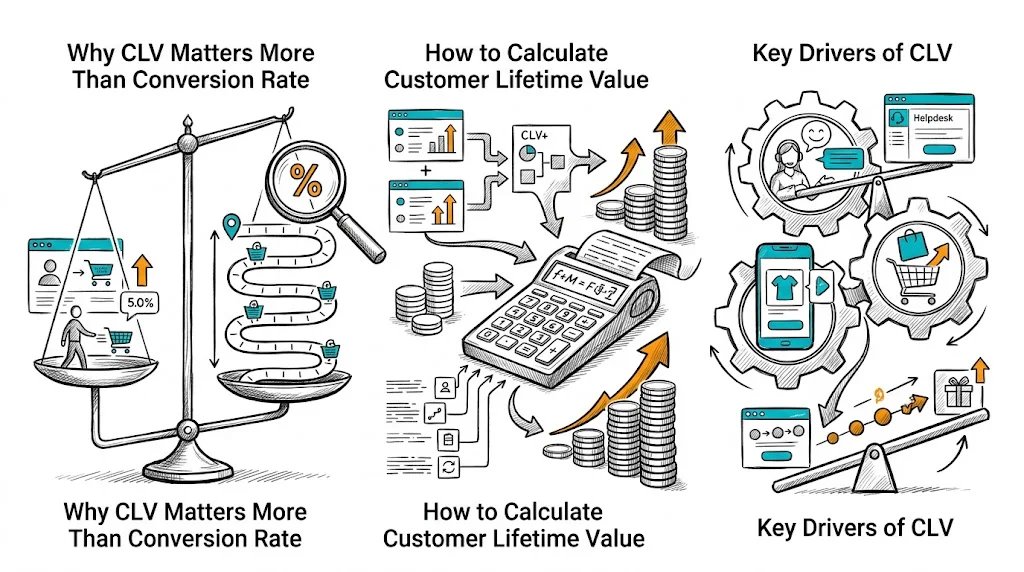
A customer who buys once at ₹1,500 is worth ₹1,500 to your business. A customer who buys four times a year for three years at ₹2,000 average is worth ₹24,000. Most D2C brand economics only make sense with the second type of customer — which is why understanding and optimizing CLV is more important than obsessing over first-purchase conversion rates alone. This guide covers the mechanics of CLV, how to calculate it, and the practical strategies that move the number.
Conversion rate measures how well you turn visitors into buyers. CLV measures how valuable each buyer actually becomes. A brand with a 3% CVR and ₹5,000 CLV is more valuable than a brand with a 5% CVR and ₹2,000 CLV — because total revenue depends on both how many customers you acquire and how much each is worth.
For Indian D2C brands with high customer acquisition costs (₹400–₹1,500 CAC is common for performance marketing), the first purchase is often unprofitable. Business viability depends on second, third, and fourth purchases. This is why optimizing for CLV is optimizing for survival, not just growth.
CLV = Average Order Value (AOV) × Purchase Frequency × Customer Lifespan
Example:
Raw CLV doesn't tell you what a customer is worth — it tells you what they spend. Profit-adjusted CLV subtracts costs:
CLV (profit) = (AOV - COGS - Fulfillment Cost) × Purchase Frequency × Customer Lifespan - CAC
Example:
This is the number that actually matters for business sustainability.
Average CLV masks important variation. Calculate CLV by acquisition cohort to understand:
A typical cohort analysis might show:
This data completely changes acquisition strategy. Google search customers are 40% more valuable than Instagram customers — which should be reflected in bid strategy and budget allocation.
The single biggest lever for CLV in most D2C businesses. A customer who buys twice is worth 2x what a one-time buyer is worth (before factoring in increasing AOV over time). Improving your 90-day repeat purchase rate from 25% to 35% is a 40% increase in the number of customers who become valuable long-term buyers.
Tactics:
Customers often buy more per order as they trust the brand more. Monitoring AOV trend by purchase number (1st order, 2nd order, 3rd order) shows whether this is happening for your brand.
Tactics:
How long customers remain active buyers matters enormously to CLV. Improving average lifespan from 18 months to 24 months (a 33% increase) lifts CLV proportionally.
Tactics:
Not all acquired customers are equal. Optimizing channel mix toward higher-CLV acquisition sources is a leverage multiplier — you're not improving existing customers, you're starting with better customers.
Tactics:
CLV fundamentally changes how to think about acceptable CAC.
If your CLV is ₹9,000 and your target CLV:CAC ratio is 3:1, you can spend up to ₹3,000 to acquire a customer. If you're currently spending ₹800 CAC and achieving ₹9,000 CLV, your 11:1 ratio suggests you're under-investing in acquisition — you could grow faster by spending more.
Most D2C brands that have measured CLV by channel discover they've been under-investing in high-CLV channels (often organic search and email) and over-investing in low-CLV channels (often broad paid social).
Personalization affects CLV directly through two mechanisms:
Repeat purchase: Personalized post-purchase content (usage guides, complementary recommendations, timely repurchase nudges) increases the probability of a second purchase — the single biggest CLV lever.
AOV growth: Personalized product recommendations that expand a customer into new categories increase order value over time. A customer who started buying your protein and now also buys pre-workout, creatine, and vitamins is worth 4x the customer who only buys protein.
Behavioral targeting and first-party data personalization are the technical capabilities that enable CLV-optimizing personalization at scale.
Not all customers have the same CLV potential. Segment and track:
| Segment | Signal | CLV Profile | Strategy |
|---|---|---|---|
| VIP / Power buyers | 5+ orders/year, high AOV | Very high CLV | Retain at all costs, early access, personal attention |
| Growing loyalists | 2–4 orders/year, increasing AOV | High CLV trajectory | Nurture, expand categories, loyalty rewards |
| One-and-done risk | 1 purchase, 60+ days no return | Low CLV risk | Win-back campaign within 90 days |
| Subscription customers | Active subscription | High CLV, predictable | Focus on pause-reduction, not just churn |
| Gift buyers | 1 seasonal purchase | Situational CLV | Nurture beyond the gifting occasion |
Related reading: Flash Sale Optimization | D2C Growth Hacking: Low-Budget Strategies | Ecommerce Optimization Pillar