From the conversion glossary
Concepts referenced in this article, defined.
Concepts referenced in this article, defined.
 d2c ecommerce
Quick commerce conversion optimization for D2C brands selling on Blinkit, Zepto, and Instamart - how 10-minute delivery changes the CRO playbook.
 d2c ecommerce
 d2c ecommerce
Run rigorous A/B tests and personalize every visit on Shopify or any storefront — no engineers required.
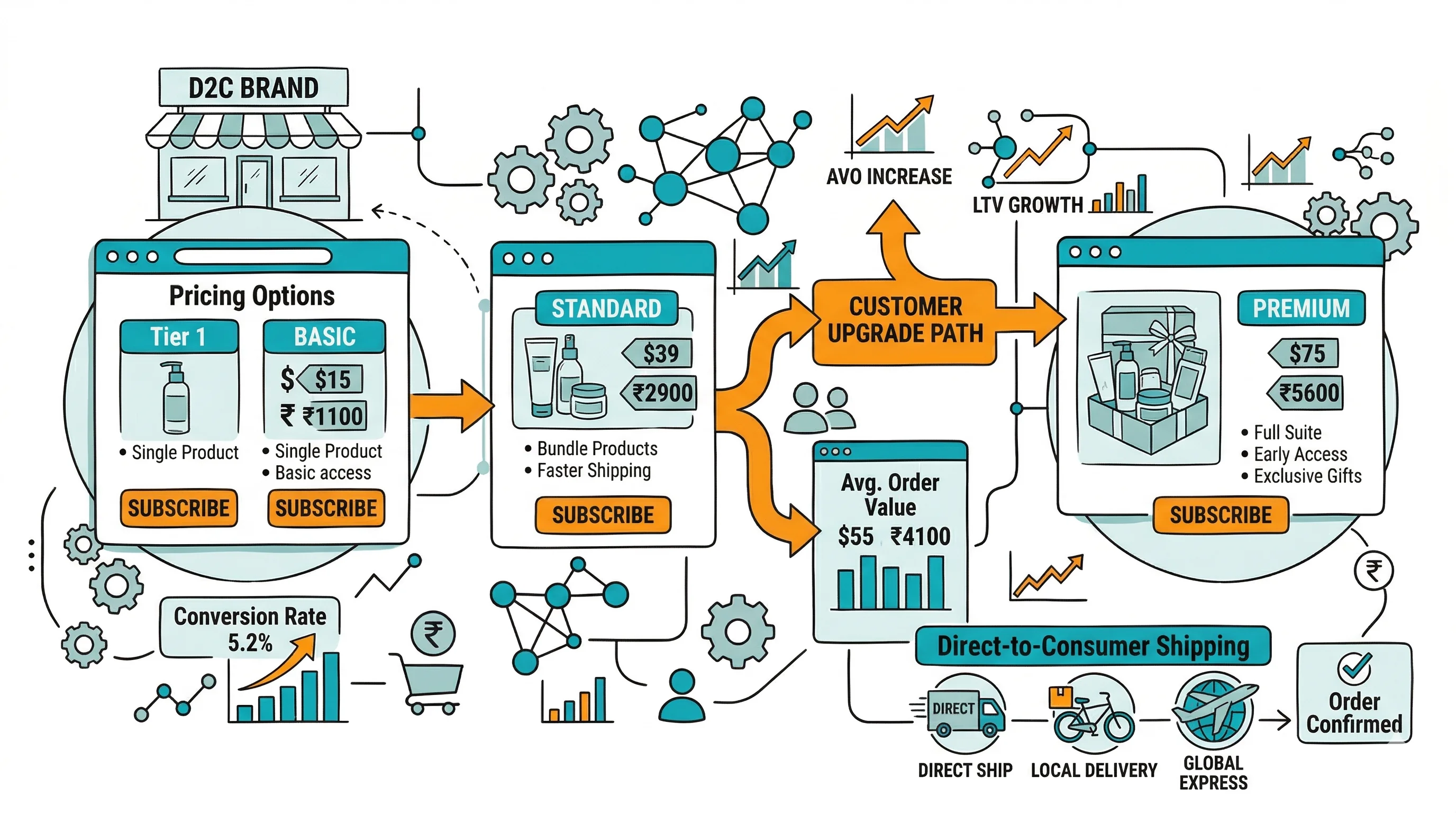
A D2C subscription model converts one-time buyers into predictable recurring revenue—the closest thing to a guaranteed monthly income stream available to an ecommerce brand. For Indian D2C brands in consumable categories, subscriptions can increase customer lifetime value by 3–5x, reduce CAC effective cost because you acquire a customer once and retain them for months, and create a revenue floor that makes business planning significantly more reliable. The challenge is not building a subscription—it's building one that doesn't churn.
Before designing your subscription programme, understand the math that makes it worth building:
LTV comparison:
For a ₹800 monthly skincare subscription at 15% discount (₹680/month) with 5% monthly churn, average subscriber LTV is ₹680 × 20 months = ₹13,600. A one-time buyer of the same ₹800 product who makes 2 purchases total has an LTV of ₹1,600.
The 8.5x LTV difference changes your entire CAC math. If you can acquire a subscriber for ₹1,500 and they're worth ₹13,600, your payback period is 3 months and your unit economics are excellent. This is why subscription is so valuable—and why the fight to retain subscribers is worth every rupee.
Subscription works when three conditions are met:
Predictable consumption rate: The customer uses the product at a roughly predictable rate. A protein supplement lasts 30 days; a face wash lasts 45 days; a coffee blend lasts 2 weeks. When the customer knows they'll run out, they value the "never run out" promise.
Reorder friction exists: Without a subscription, customers have to remember to reorder, navigate back to the site, and complete checkout again. Subscription removes this friction at the exact moment it's most costly.
Habitual use: Products that become part of a daily or weekly routine—morning supplements, weekly coffee order, monthly skincare replenishment—have the lowest churn because switching requires habit disruption.
Categories with the strongest subscription performance in India: nutritional supplements, healthy snacks, pet food, coffee/tea, skincare, and cleaning products.
Subscribe-and-save: Customer sets up recurring orders at a discount. Simple to implement, customer has full control. Best for commoditised consumables where price is the primary motivator.
Curated subscription boxes: Brand curates a monthly selection. Higher perceived value, stronger brand engagement, but operationally complex. Works for discovery categories (artisan food, wellness, beauty sampling).
Membership model: Customer pays a monthly/annual fee for access to benefits (free shipping, exclusive products, early access, community). Not product-locked; can be layered over any product catalogue. Works for brands with strong community and loyal customer base.
For most Indian D2C brands starting out, subscribe-and-save is the right entry point. It's simple to build, easy for customers to understand, and directly addresses the "reorder" friction problem.
Tiered by frequency:
Prepaid tiers reduce churn risk (a customer who's prepaid for 6 months can't churn for 6 months) while rewarding commitment.
Free first shipment + reduced subsequent prices: Aggressive acquisition tactic that gets subscribers in the door, but attracts deal-seekers who churn after the first order. Use cautiously.
No-discount subscription: For premium products where discounting damages brand positioning, offer convenience and exclusive access instead of price savings. "Subscribe for priority restock access and guaranteed delivery before the general sale" is a premium framing.
India's subscription payment landscape is more fragmented than most. Options:
Razorpay Subscriptions: The most widely used for Indian D2C. Supports UPI AutoPay, NACH debit, and card mandates. Loop Subscriptions app integrates natively for Shopify.
UPI AutoPay: Growing rapidly but still has friction—many users are unfamiliar with recurring UPI mandates and cancel them out of unfamiliarity. Include clear onboarding about how recurring UPI works.
Card mandates: More reliable than UPI for recurring billing, but card penetration is lower in India than in Western markets. Best for urban, premium-segment subscribers.
COD subscriptions: COD for recurring orders is logistically complex but possible with a pre-delivery confirmation system (WhatsApp message + customer confirms before dispatch). Some Indian D2C brands offer "COD subscription trial" for first 2 months, then convert to prepaid.
Indian consumers are increasingly wary of subscription traps—hidden charges, difficult cancellation, auto-renewal surprises. Proactively address this:
During Diwali, Christmas, and other festive periods, subscribers may want to skip their regular order (gifts instead of replenishment) or upgrade (buy a gift bundle). Add flexibility:
Churn is the subscription killer. Managing it requires addressing both voluntary churn (active cancellation) and involuntary churn (payment failures).
Exit survey: When a customer cancels, ask why (1-click choices: "Too expensive," "Ran out before new shipment," "Not using it enough," "Switching to a different brand"). Each answer reveals a fixable problem.
Pre-cancellation offer: When a customer clicks cancel, present an alternative before completing: "Before you go—skip your next order instead?" or "Switch to a quarterly plan and save more?" Pause options recover 20–40% of customers who would otherwise cancel.
Usage engagement: For health and wellness products, send monthly usage tips, results check-ins, and motivation content. Subscribers who feel they're getting results stay; subscribers who forget why they started churn.
Delivery timing optimisation: If customers frequently run out before the next shipment, they'll cancel. Let subscribers adjust their delivery date from their customer portal, and proactively suggest adjustments based on order frequency data.
15–25% of all subscription cancellations are involuntary—the customer didn't mean to cancel, their payment simply failed. Fix this with:
Monthly Recurring Revenue (MRR): Total revenue from active subscribers per month. Growing MRR is the North Star metric.
Monthly Churn Rate: Cancelled subscribers / total subscribers × 100. Target under 5% for consumable D2C.
Active Subscriber Count: Track weekly; sudden drops signal a product, payment, or communication problem.
Subscription LTV vs. one-time buyer LTV: This comparison justifies continued investment in subscription infrastructure.
Use CustomFit.ai to A/B test subscription offer placement on product pages and the checkout—which framing of the subscribe-and-save offer drives the highest subscription opt-in rate without reducing one-time purchase conversion rate?