From the conversion glossary
Concepts referenced in this article, defined.
Concepts referenced in this article, defined.
 d2c ecommerce
Quick commerce conversion optimization for D2C brands selling on Blinkit, Zepto, and Instamart - how 10-minute delivery changes the CRO playbook.
 d2c ecommerce
 d2c ecommerce
Run rigorous A/B tests and personalize every visit on Shopify or any storefront — no engineers required.
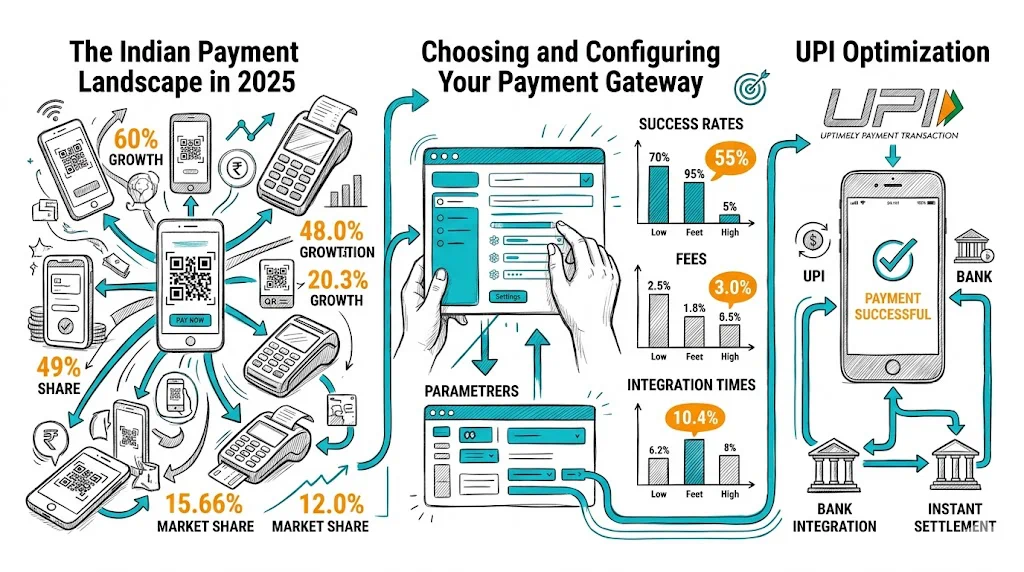
Payment optimization for Indian D2C ecommerce is the process of ensuring every buyer who reaches your checkout can pay in the way they prefer, without friction, without failure, and without confusion—and that the experience is fast enough to capture the intent before it cools. India's payment landscape is among the world's most complex: UPI has democratised digital payments, COD still dominates in mass-market segments, EMI has expanded purchasing power for high-ticket items, and BNPL is reshaping how young consumers buy online. Getting payments right is not just an operational concern; it's directly tied to conversion rate, average order value, and the margin your business keeps.
India's digital payment ecosystem has transformed over the past 5 years. Understanding its current state is prerequisite to optimising it:
UPI dominance: UPI processed over 100 billion transactions in 2024 and is now the default payment method for online purchases among 18–45 year olds in metros and semi-urban India. PhonePe, Google Pay, and Paytm handle the majority of UPI volume.
COD resilience: Despite UPI growth, COD remains 30–50% of order volume for mass-market D2C brands. It is the trust bridge for buyers in Tier-2 and Tier-3 cities and for first-time buyers of unfamiliar brands. COD is a feature, not a fallback.
EMI expansion: No-cost EMI availability from major banks (HDFC, ICICI, Kotak, Axis, SBI) has expanded the consideration set for purchases above ₹1,500. A customer who wouldn't pay ₹3,000 upfront for a skincare kit will pay ₹1,000 per month over 3 months.
BNPL growth: Simpl, LazyPay, and ZestMoney have created a BNPL layer that allows deferred or split payments for customers without credit cards. Penetration is highest with 18–30 year olds and in categories like fashion and electronics.
Card and net banking: Still relevant for older demographics and business purchases. Declining share for consumer D2C but should be available.
Razorpay: The default choice for most Indian D2C brands on Shopify. Native Shopify integration, excellent UPI checkout experience, support for all payment methods, subscription billing, and a well-documented API. Transaction fees: 2% per transaction.
Cashfree: Particularly strong for subscription and recurring billing use cases. Worth evaluating if subscriptions are more than 20% of your revenue. Slightly lower transaction fees in some categories.
PayU: Broader bank partnership network for EMI, which can improve EMI availability and no-cost EMI offers. Worth using as a secondary gateway for customers whose EMI banks don't partner with Razorpay.
CCAvenue: Large bank relationship network, established brand trust with older demographics. Higher setup complexity, less seamless UX than Razorpay.
Multi-gateway strategy: At ₹5 crore+ ARR, maintain a primary gateway (Razorpay) and a backup (Cashfree or PayU) configured to automatically route failed transactions to the backup. Gateway downtime, even at 99% uptime, represents hundreds of failed transactions per month at scale.
On your Shopify checkout, the order in which payment methods appear affects which method customers choose. Optimise the order:
Moving COD to last in the payment method list reduces COD order percentage by 5–15% in most implementations, converting those orders to prepaid without losing them—an operational efficiency improvement with no conversion impact.
UPI has a specific failure mode that most D2C brands don't address: the UPI app timeout. When a customer selects UPI payment, they're redirected to their UPI app to confirm. If they switch apps, get distracted, or the confirmation times out, the payment fails and they're dropped back to checkout—where many don't retry.
UPI checkout best practices:
COD costs significantly more to fulfil than prepaid (settlement delays, RTO risk, cash handling). Every COD order that converts to prepaid improves your margins without reducing revenue. The conversion tactics:
Pre-payment incentive: Show a ₹50–₹100 discount for choosing prepaid over COD at checkout: "Pay online and save ₹75 — instant discount applied." This should appear as a dynamic prompt when a customer selects COD.
Post-order conversion window: After a COD order is placed, send a WhatsApp message within 15 minutes: "Switch to prepaid and get ₹100 off! Pay in 1 tap via UPI before your order is shipped. Link expires in 4 hours: [payment link]"
Subscription COD to prepaid: For subscription orders, offer a larger incentive to switch: "Set up auto-pay via UPI and get your first month free." Recurring UPI mandates are substantially cheaper to manage than monthly COD orders.
Target: convert 20–30% of COD orders to prepaid through these interventions. Each conversion saves ₹30–₹100 in operational cost and eliminates RTO risk.
For products above ₹1,500, displaying EMI options on product pages (not just at checkout) significantly increases consideration from buyers who are interested but hesitant about the upfront cost.
Product page EMI display: "Starting from ₹499/month with no-cost EMI | HDFC, ICICI, Kotak"
This is one of the simplest AOV-increasing changes available to D2C brands selling high-ticket products. A buyer who wouldn't consider a ₹2,997 fitness kit at full price will consider it at ₹999/month.
BNPL integration: Add Simpl or LazyPay to your Shopify checkout. These services handle credit risk assessment and pay you upfront; the customer pays over 3 installments. Particularly effective for fashion, electronics accessories, and premium personal care.
BNPL availability at checkout typically increases conversion for the 18–30 demographic by 10–20% and average order value by 15–25% for cart values above ₹1,000.
Payment failure at checkout is a silent conversion killer. India's payment infrastructure, while improved, still has higher failure rates than many Western markets due to bank-level blocking of international or unfamiliar merchant codes, UPI timeouts, and debit card 3D Secure flows.
Failure rate benchmarks: Top Indian payment gateways achieve 85–92% payment success rates. If your success rate is below 80%, investigate gateway configuration or bank relationship issues.
Failure reduction tactics:
The checkout page is where payment optimization and UX converge. Key elements:
Progress indicator: Show customers how many steps remain. "Step 2 of 3" reduces abandonment at the payment step.
Trust signals at payment step: Security badges (Razorpay Secure, PCI DSS, SSL) near the payment fields reduce last-moment hesitation.
Autofill for returning customers: Saved payment methods and address autofill reduce checkout time from 90 seconds to 20 seconds for returning buyers—and speed correlates with conversion.
Mobile payment keyboard: On mobile, number fields should auto-trigger the numeric keyboard, not the alphabetic one. This sounds trivial but is a measurable friction point on devices where it defaults incorrectly.