A product launch is the single highest-leverage moment in your product's ecommerce life. The first 30 days determine organic search ranking trajectory, customer perception, and the initial review corpus that will drive conversions for months. Brands that launch with a complete checklist outperform those that scramble—often dramatically. This guide covers every step from pre-launch preparation to post-launch optimization.
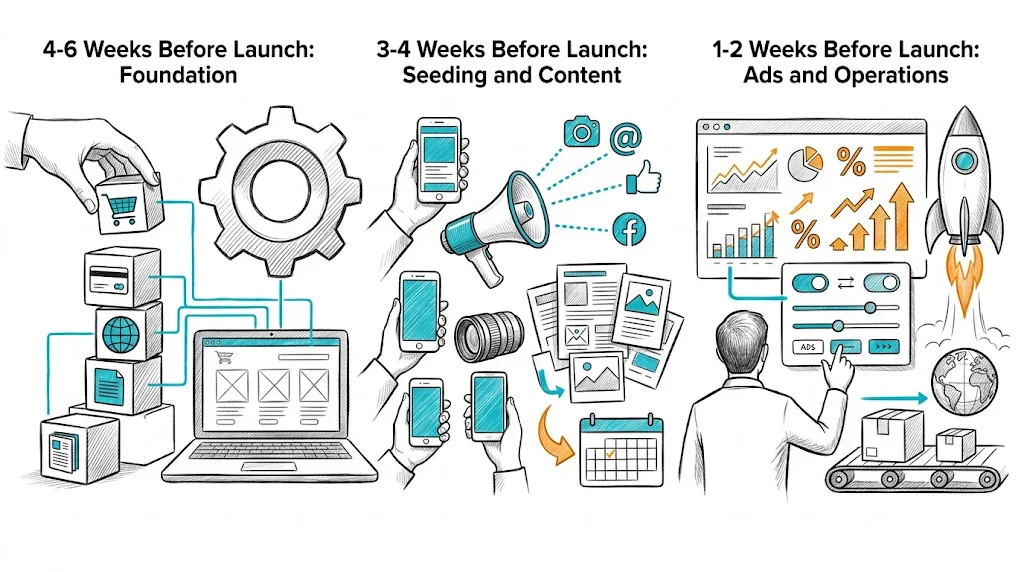
4–6 Weeks Before Launch: Foundation
Product Page Creation
Build your product page well before launch so search engines can begin indexing it:
- Title: Include the primary keyword naturally in the first 60 characters
- Description: Lead with the top customer benefit, not ingredients or features
- Images: Minimum 6 images—hero, lifestyle, detail shots, size reference, packaging, ingredient/material callout
- Video: A 30–60 second product video increases add-to-cart rates by 25–35%
- Variants: All size/color/flavor variants loaded with clear display names
- Metafields: Category, material, weight, dimension for structured data
SEO Preparation
- Meta title and description: Written to maximize clicks from search results
- URL slug: Short, keyword-rich, no stop words (e.g.,
/vitamin-c-serum-30ml not /products/vitamin-c-brightening-serum-30ml-new)
- Schema markup: Product schema with price, availability, and review data
- Internal links: Add links to the new product from 3–5 existing high-traffic pages
Demand Capture Setup
- Back-in-stock / pre-launch notify-me form live on the page
- Waitlist email/WhatsApp sequence drafted and ready to activate
- Early bird offer defined (first 100 orders get free gift / 15% off)
3–4 Weeks Before Launch: Seeding and Content
Influencer and Customer Seeding
Send product samples to:
- Your top 20–30 loyal customers (ask for honest feedback, not necessarily a review yet)
- 5–10 micro-influencers in your category (10K–100K followers with high engagement)
- Internal team for authentic UGC content
Schedule their content to go live on or just before launch day for maximum impact.
Content Calendar
- 3 Instagram Reels/posts ready for launch week
- WhatsApp broadcast message drafted
- Email announcement to full list ready to schedule
- Founder story or product development story for blog/social
Inventory Check
- Stock level confirmed for projected 30-day demand
- Safety stock allocated (do not sell the last unit—maintain buffer)
- Packaging and inserts ready
- Logistics partner briefed on new SKU
1–2 Weeks Before Launch: Ads and Operations
Paid Advertising
- Meta ads: 3–5 creative variants ready (video + static), audiences defined
- Google Shopping: Product feed updated and approved
- Retargeting audience: Pixel fired on the pre-launch page to build retargeting pool from notify-me visitors
Operational Readiness
- Product correctly tagged in order management system (Unicommerce/Shopify admin)
- Customer support briefed on product FAQs, return policy, and common questions
- Shipping weight/dimensions entered for accurate logistics rate calculation
- COD/prepaid settings confirmed
Email/WhatsApp Sequences
- Launch announcement email scheduled
- Day 3 post-purchase follow-up drafted (request review)
- Day 7 "running low" or "bestseller" email ready if demand is strong
- Back-in-stock notification sequence ready for any OOS scenario
Launch Day Checklist
Morning (before 10 AM):
During the day:
Evening:
Post-Launch: Days 2–30
Reviews and Social Proof
- Day 3: Send review request to first-day purchasers
- Day 7: Follow up with customers who received the product (logistics tracking shows delivery)
- Day 14: Reach out to seeded influencers for timeline on posting
- Day 21: Aggregate and display first batch of reviews on the product page
CRO Optimization
After 2–3 weeks, you have enough data to identify gaps:
- Check add-to-cart rate (target: 8–15% for most categories)
- Check checkout abandonment rate
- Review customer support questions for FAQ gaps on the product page
- Heatmap analysis (Hotjar or similar) to see where shoppers scroll and click
Use CustomFit.ai to start A/B testing elements once you have baseline traffic—test the hero image, headline, variant display order, or CTA button text. Even small improvements compound significantly over a product's lifetime.
Sales Velocity Analysis
- Week 2: Compare actual sales to projections; adjust ad spend accordingly
- Week 4: Calculate contribution margin per order (after COD costs, returns, ad spend)
- Week 4: Identify your top customer segment (age, location, acquisition channel) for lookalike expansion
Tips / Best Practices
- Never launch without at least 5 real reviews. Zero reviews is a conversion killer for first-time buyers. Invest in seeding.
- Mobile experience must be flawless. 70–80% of Indian D2C traffic is mobile; test every step on a real device, not just a desktop emulator.
- Prepare for success. Stock out on launch day is a missed opportunity. Have a back-in-stock system ready before you need it.
- Pre-launch waitlist converts at 20–35%. Even a small list of 200–300 interested people can generate strong opening day numbers.
- Document your launch playbook. After your first launch, document what worked and refine the checklist for every subsequent launch.
Key Takeaways
- A structured 4-6 week launch preparation process gives your product the best chance of strong first-30-day performance.
- Product page, SEO setup, and demand capture should be done first—before ads or content.
- Reviews at launch are critical; invest in seeding 3–4 weeks before go-live.
- Monitor closely on launch day and in the first week to catch operational issues early.
- Start CRO testing 2–3 weeks post-launch once you have sufficient traffic data.
Related reading: Conversion Rate Optimization | Product Page | A/B Testing | Cart Abandonment | Ecommerce Inventory Display
See also: D2C & Ecommerce Growth Pillar