From the conversion glossary
Concepts referenced in this article, defined.
Concepts referenced in this article, defined.
 d2c ecommerce
Quick commerce conversion optimization for D2C brands selling on Blinkit, Zepto, and Instamart - how 10-minute delivery changes the CRO playbook.
 d2c ecommerce
 d2c ecommerce
Run rigorous A/B tests and personalize every visit on Shopify or any storefront — no engineers required.
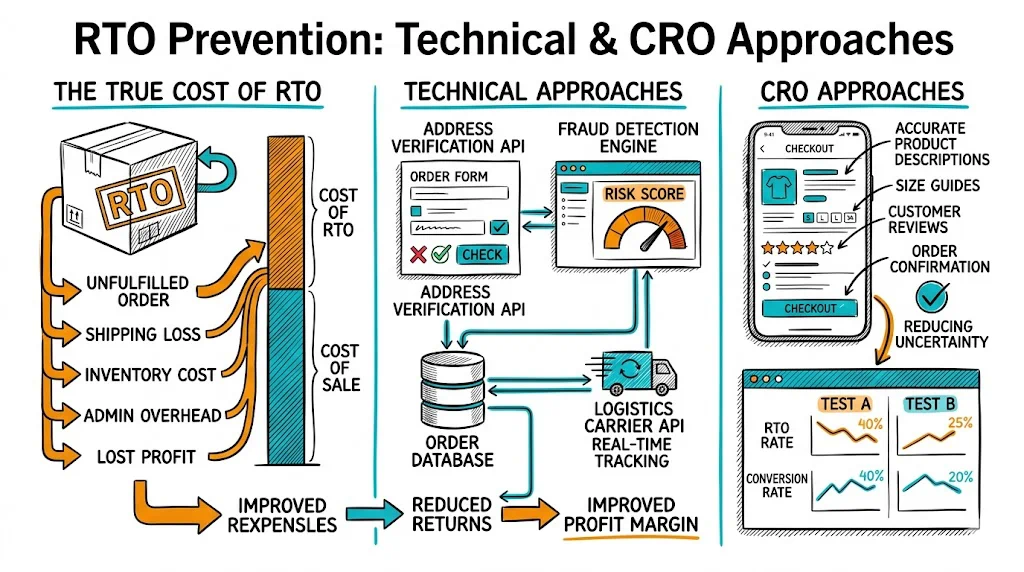
Return-to-origin (RTO) is one of the most damaging metrics in Indian D2C ecommerce. When an order travels to a customer and comes back, the brand bears the cost of both legs of shipping, the handling fee, and potentially damaged or unsellable inventory. An RTO rate of 25% on COD orders can make an otherwise profitable brand unprofitable. Preventing RTO requires a combination of technical safeguards, smart checkout design, and post-order engagement—not a single silver bullet.
Most brands calculate RTO cost as "two-way shipping." The real cost is higher:
For a brand with ₹500 AOV and 20% RTO on 1,000 monthly COD orders, the monthly RTO cost easily exceeds ₹3 lakh—money that could fund growth instead of losses.
Validate PIN codes in real time against deliverability databases. If a PIN code has consistently high non-delivery rates with your logistics partner, show a warning or restrict COD for that PIN.
Most Shopify apps integrate with India Post and major courier pin code serviceability APIs. Set up your Shopify store to automatically disable COD for high-RTO PIN clusters. CustomFit.ai can dynamically show or hide COD based on this data without developer involvement.
Free-text address fields produce garbled addresses that couriers cannot deliver. Address auto-complete using Google Places API or Shiprocket's address intelligence reduces format errors by 40–60%.
Key implementation tips:
Requiring an OTP confirmation (via SMS or WhatsApp) immediately after a COD order is placed filters out fake orders—where someone placed an order with no intent to receive it. OTP verification typically reduces fake COD orders by 30–50%.
Keep the OTP step as a post-order confirmation, not a checkout blocker. A message like "Confirm your order #12345 by entering this OTP" converts better than asking for OTP during checkout, which feels intrusive.
Advanced brands integrate RTO risk scoring into their order management workflow. Signals that predict high RTO:
When risk score exceeds a threshold, trigger manual review, require prepaid, or send a confirmation WhatsApp before dispatch. Shiprocket, NimbusPost, and Pickrr offer built-in risk scoring.
NDR is the moment RTO is born. When a courier marks an order as "delivery attempted," fast follow-up dramatically improves final delivery. Automated NDR management:
Brands with active NDR management reduce NDR-to-RTO conversion by 40–60%. Tools like Clickpost and Shipway automate this workflow.
The single highest-impact RTO prevention tactic is reducing COD share. Prepaid orders have 5–8x lower RTO. Every percentage point shift toward prepaid is a structural improvement to your RTO rate.
Tactics that work (see our detailed guide on COD vs prepaid payment mix):
A COD checkout that takes 15 seconds produces more impulse orders than one that takes 45 seconds. Adding intentional friction—without being annoying—filters low-intent orders:
Not every customer needs the same checkout experience. Use personalization to:
CustomFit.ai enables this kind of segment-based personalization without needing a developer to write conditional checkout logic.
For categories like fashion (size-fit issues) and electronics accessories (compatibility questions), reducing pre-purchase uncertainty cuts returns significantly. Add:
When customers know what they are buying, they are less likely to reject delivery or return.
Order confirmation and delivery update communications are RTO prevention tools, not just courtesy messages:
Brands that implement a full pre-delivery communication sequence see 15–25% reduction in "customer unavailable" RTO.
Related reading: Conversion Rate Optimization | Cart Abandonment | A/B Testing | Average Order Value | COD vs Prepaid
See also: D2C & Ecommerce Growth Pillar | CRO Pillar