From the conversion glossary
Concepts referenced in this article, defined.
Concepts referenced in this article, defined.
 d2c ecommerce
Quick commerce conversion optimization for D2C brands selling on Blinkit, Zepto, and Instamart - how 10-minute delivery changes the CRO playbook.
 d2c ecommerce
 d2c ecommerce
Run rigorous A/B tests and personalize every visit on Shopify or any storefront — no engineers required.
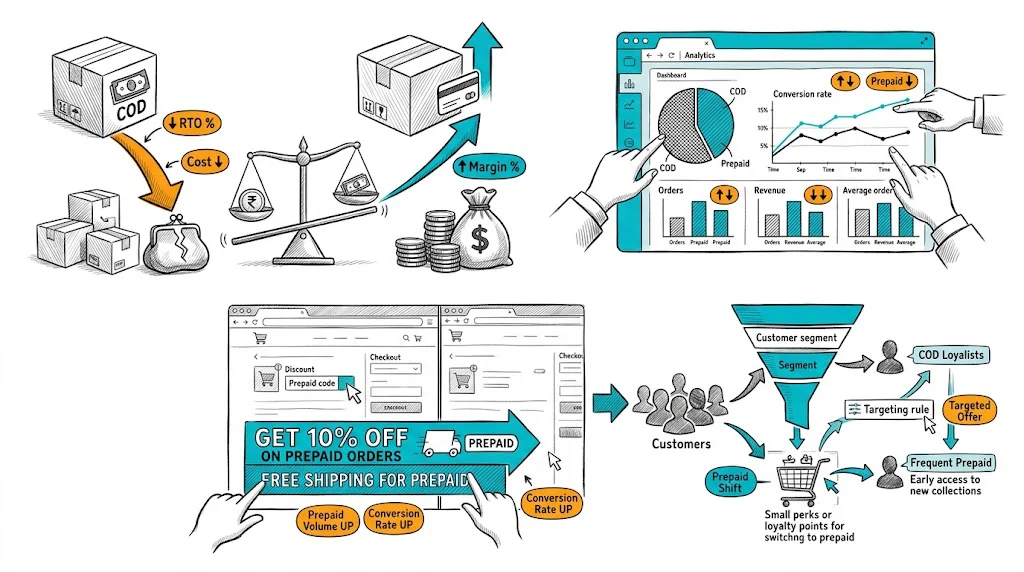
For Indian D2C brands, payment method is a profitability lever, not just a checkout detail. COD (cash on delivery) drives order volume but inflates return-to-origin rates and operational costs. Prepaid orders have lower RTO but can suppress conversions if you push them too hard. The right payment mix depends on your brand and your segments, and finding it takes testing rather than guesswork.
Every COD order that comes back costs your brand twice: once for outbound shipping and once for the return. Industry data puts average RTO at 20 to 30% for COD versus 3 to 8% for prepaid. On a ₹600 average order value with ₹120 shipping each way, a single returned COD order wipes out the margin on two successful prepaid ones.
Beyond returns, COD creates cash flow delays of 7 to 15 days as logistics partners reconcile remittances. For brands scaling fast on working capital, this gap compounds quickly.
Dropping COD entirely is not realistic for most Indian brands. A large share of Indian shoppers, particularly first-time buyers, Tier 2/3 city customers, and people buying from a brand they don't yet know, need COD as a trust mechanism. The goal is not elimination but optimization.
Before you can improve your mix, measure it clearly. Track these metrics per payment method:
Run this breakdown monthly and segment it by city tier, product category, customer type (new vs. returning), and traffic source. You will likely find that COD RTO is much worse for certain segments, often new customers from performance ad traffic buying low-AOV products.
A small prepaid incentive, such as ₹30 off, free shipping, or an extra gift, is the most reliable way to shift behavior. Calibration is the tricky part: too small and shoppers ignore it, too large and you erode the margin advantage of going prepaid.
Test at ₹30, ₹50, and ₹75 discount levels. For AOVs above ₹1,500, free shipping (valued at ₹80 to ₹120) often outperforms a cash discount because it feels larger.
Display the discount at the payment step, not buried deeper in checkout. A banner that reads "Pay online and save ₹50 instantly" placed above payment options consistently outperforms inline text.
UPI has made prepaid payments easy for most Indian shoppers. Yet many checkout pages default to showing all payment options alphabetically or with cards first. Reorder so UPI appears at the top, ideally with familiar logos like PhonePe, GPay, and Paytm, and prepaid stops looking complicated.
In A/B tests run on Shopify stores using CustomFit.ai, making UPI the default-expanded option increased prepaid share by 8 to 12 percentage points with no drop in overall checkout completion.
Rather than removing COD, add light friction: a small COD handling fee (₹30 to ₹50), an OTP verification step, or a confirmation screen that shows the total cost including the fee. These steps filter out casual, low-intent COD orders while keeping genuine buyers.
Communicate the fee honestly. "₹40 COD handling charge" is better than hiding it. Transparency reduces complaints and keeps trust intact.
Not all customers respond to the same nudge. A returning customer who has paid online before does not need a prepaid discount, since they will likely pay online anyway. A first-time buyer from a Meta ad for a ₹299 product is a high-RTO risk who needs stronger COD friction.
CustomFit.ai lets you personalize the checkout payment section by customer segment: show a prepaid discount only to first-time buyers, apply COD verification only to high-RTO geographies, or highlight EMI options for high-AOV returning customers. This targeted approach beats blanket policies.
After a COD order is placed, send an SMS/WhatsApp within 30 minutes offering a small reward to switch to prepaid before dispatch. Frame it as a convenience benefit: "Pay now and skip the cash hassle at delivery." Conversion rates on these messages run 15 to 25% for brands with good brand recall.
Some customer segments will have persistently high RTO regardless of nudges. Common patterns include:
For these segments, either disable COD or require OTP verification. Most logistics partners provide RTO prediction scores, so integrate these into your checkout logic. CustomFit.ai can surface different checkout experiences based on these risk signals.
During Diwali, Big Billion Days, and similar festive windows, COD share typically spikes by 10 to 15 percentage points as new shoppers enter the market. Plan for this:
Kapiva, a D2C Ayurveda brand, used targeted prepaid nudges during festive campaigns and improved their prepaid share by 11 percentage points, which directly improved post-festive cash flow.
Related reading: Conversion Rate Optimization | A/B Testing | Cart Abandonment | Average Order Value | RTO Prevention
See also: D2C & Ecommerce Growth Pillar | Ecommerce Checkout Optimization