CustomFit.ai — Website personalization, A/B testing and CRO for Shopify and D2C
Product
Features
✱
Website Personalization
Adapt to each visitor's behavior & intent
⧖
A/B & Multivariate Testing
Rigorous experimentation
✨
AI CopilotNEW
Personalize with a prompt
🤖
AI WingmanNEW
Auto-optimize toward winners
🎯
AI Conversion OptimizerNEW
GPT-grade test ideas
✎
No-Code Visual Editor
Drag-and-drop edit any element
▦
Product Recommendations
Personalized recs that lift AOV
⚑
Feature Flags
Ship safely with kill-switches
◧
Chrome Extension
Edit your store in the browser
⧉
Shopify, WooCommerce & more
All platform integrations
View all features →
Use Cases
$
Price A/B Testing
Test price points to maximize revenue
▦
Theme A/B Testing
Compare whole layouts & designs
🗂
Template A/B Testing
Test whole PDP/PLP templates
🏷
Discount A/B Testing
Find the offer that converts
🚚
Shipping A/B Testing
Thresholds, speed & copy
✍
Content A/B Testing
Copy, images & reviews
💳
Checkout Gateway A/B
Payments & one-click
⌖
Geo-Based Personalization
Per-location content & offers
⚡
Buyer-Intent Nudges
Exit-intent & retargeting
↔
Split-URL / Redirection
Full-page redirect tests
View all use cases →
Solutions & Guides
⤢
Conversion Rate Optimization
The complete CRO guide
⧖
A/B Testing Software
Buyer's guide for D2C
🛒
Cart Abandonment Recovery
Win back lost carts
📰
Landing Page Optimization
Convert more paid traffic
S
Shopify A/B Testing
Test your store, no code
S
Shopify Personalization
Tailor the store per shopper
◔
First-Time Visitor Offers
Convert new shoppers with trust & offers
★
Repeat-Customer Experiences
Reward and re-engage loyal buyers
◎
Campaign-Matched Pages
Match the landing page to the ad
⌖
Location-Based Experiences
Currency, language & regional offers
Explore CRO →
Customer stories
GIVA
+32%
conversion via personalized recs
GIVA
Mamaearth
+18%
revenue lift from PDP A/B tests
ME
The Sleep Company
+24%
AOV from product recommendations
TSC
Read customer stories →
Integrations
SWsfGA+15
✦
Not sure where to start?
Let AI Copilot pick your first tests

“We wake up to evidence-backed tests ready to deploy — not a backlog of maybe ideas.”

AN
Anirudh S.
Growth · Chargebee
★★★★★4.8on G2 · 2,400+ brands
Talk to our team →
Widgets
Integrations
Ecommerce & Checkout
Shopify
Shopline
Shoplazza
GoKwik
ShopFlo
Razorpay Magic Checkout
Breeze
Shiprocket
View all integrations →
Analytics & Behavior
Google Analytics 4
Microsoft Clarity
Hotjar
Mixpanel
Amplitude
Heap
Adobe Analytics
Segment (CDP)
View all integrations →
Engagement, CRM & More
Klaviyo
MoEngage
CleverTap
WebEngage
HubSpot
Salesforce
Slack
Meta Ads
View all integrations →
CustomersPricing
Resources
CRO
▤
Playbooks
Proven strategies to boost conversions
🎙
Interviews
D2C leaders & marketing experts
▶
Webinars
Live deep dives & product sessions
Learn
✎
Blog
Tips, experiments & best practices
📕
Free E-Books
Mastering personalization
📖
Conversion Glossary
Every CRO term, defined
✦AI CopilotNEWLog inBook a demo
Start free trial
Select your platform — Install in 2 minsWe'll tailor the setup
⚡ Risk-free 14-day trial · No credit card · Cancel anytime
S
Shopify
Install from Shopify App Store
›
W
WooCommerce
Install the WooCommerce plugin
›
B
BigCommerce
Install from BigCommerce App Marketplace
›
SL
Shopline
Install from Shopline App Store
›
M
Salesforce / Magento
Install from the marketplace
›
SZ
Shoplazza
Install from Shoplazza App Store
›
WP
WordPress / Webflow
Install plugin or paste the script
›
◧
Others
Custom-built on React, Next.js, etc.
›
Tip: pick your platform — we handle the restBook a demo →
Product
Website PersonalizationA/B & Multivariate TestingAI CopilotAI WingmanAI Conversion OptimizerNo-Code Visual EditorProduct RecommendationsFeature FlagsView all features →
Use Cases
Price A/B TestingTheme A/B TestingTemplate A/B TestingDiscount A/B TestingShipping A/B TestingContent A/B TestingCheckout Gateway A/BGeo-Based PersonalizationBuyer-Intent NudgesSplit-URL / Redirection
Solutions & Guides
Conversion Rate OptimizationA/B Testing SoftwareCart Abandonment RecoveryLanding Page OptimizationShopify A/B TestingShopify Personalization
Explore
WidgetsIntegrationsCustomersPricing
Resources
BlogPlaybooksWebinarsInterviewsE-BooksConversion Glossary
Platforms
ShopifyShoplineShoplazzaChrome ExtensionAll integrations
Start free trialBook a demo
Home›Blog›email retention›Customer Referral Programs for D2C

Customer Referral Programs for D2C

SJSapna JoharHead of Growth & CRO, CustomFit.aiJanuary 15, 20258 min read
On this page
  1. Why Referrals Work Especially Well for D2C
  2. The Core Referral Program Structure
  3. Double-Sided Rewards: The Gold Standard
  4. One-Sided Rewards: Simpler, Lower Cost
  5. When to Ask for Referrals
  6. The Referral Share Mechanism
  7. Setting Up Referrals on Shopify
  8. Driving Referral Volume
  9. Personalizing the Referred Customer's First Visit
  10. Preventing Referral Fraud
  11. Measuring Referral Program Performance
  12. Tips and Best Practices
  13. Key Takeaways
0%
Customer Referral Programs for D2C

From the conversion glossary

Concepts referenced in this article, defined.

Definition
What Is Discount Code? Definition & Guide
Definition
What Is Coupon? Definition & Guide
Definition
What Is Control? Definition, Formula & Guide
Definition
What Is Friction? Definition & Guide
Definition
What Is Paid Traffic? Definition, Formula & Guide
← Back to Email Retention guide
Try CustomFit.ai

Run A/B tests and personalize your store without code. 14-day free trial, no credit card.

Start free trial →
Share
XLinkedInEmail

Related articles

email retention

Win-Back Email Campaigns for D2C Brands

Sapna Johar· 8 min read
email retention

WhatsApp Marketing for D2C in India

Sapna Johar· 7 min read
email retention

Welcome Email Series: Templates for Ecommerce

Sapna Johar· 8 min read

Start lifting conversions today.

Run rigorous A/B tests and personalize every visit on Shopify or any storefront — no engineers required.

Start free trialBook a demo

Built for every D2C category

🧴
Skincare
💄
Beauty
🌿
Wellness
☕
F&B
👟
Apparel
💍
Jewelry
🛋️
Home
🍼
Baby
Live · Right now
Mamaearth — free-shipping band +12.4% AOVGIVA — festive collection page +34% revenueBellavita — PDP CTA test +27.4% CVRKapiva — Quiz-driven recs +9.48% CTRThe Sleep Co — landing personalized 2× capturesPlum — Returning shopper swap +18.2% CVRMamaearth — free-shipping band +12.4% AOVGIVA — festive collection page +34% revenueBellavita — PDP CTA test +27.4% CVRKapiva — Quiz-driven recs +9.48% CTRThe Sleep Co — landing personalized 2× capturesPlum — Returning shopper swap +18.2% CVR
Get in touch

Tell us about your store.

We reply within an hour during business hours. No sales pitch, no spam — just answers from someone who's seen 2,400+ D2C stores.

✓ Reply within 1 hour✓ No spam, ever✓ Free demo & setup help
✓ Thanks! We'll be in touch shortly.
CustomFit.ai

The all-in-one website personalization, A/B testing & CRO platform for high-growth D2C brands. Made by marketers, fueled by coffee.

in𝕏◎▶f
Product
  • Features
  • A/B Testing
  • Personalization
  • AI Copilot
  • AI Wingman
  • AI Conversion Optimizer
  • Feature Flags
  • Widgets
  • Integrations
  • ROI Calculator
Platforms
  • Shopify
  • Shopline
  • Shoplazza
  • Salesforce
  • Chrome Extension
  • All Integrations
Resources
  • Blog
  • Playbooks
  • Webinars
  • GrowthFit Interviews
  • Free E-Books
  • Conversion Glossary
  • Case Studies
Compare
  • vs VWO
  • vs Optimizely
  • vs Google Optimize
  • vs Mutiny
  • vs Intelligems
  • vs Shoplift
  • vs AB Tasty
  • vs Convert
  • vs Kameleoon
Company
  • About Us
  • Partners
  • CustomFit Awards
  • Recognition
  • Contact
  • Privacy Policy
  • Terms & Conditions
© 2026 CustomFit.ai · Valley Monks Pvt Ltd · Made by marketers, fueled by coffee, and obsessed with conversions.
SOC 2 Type II · GDPR · CCPA · ISO 27001

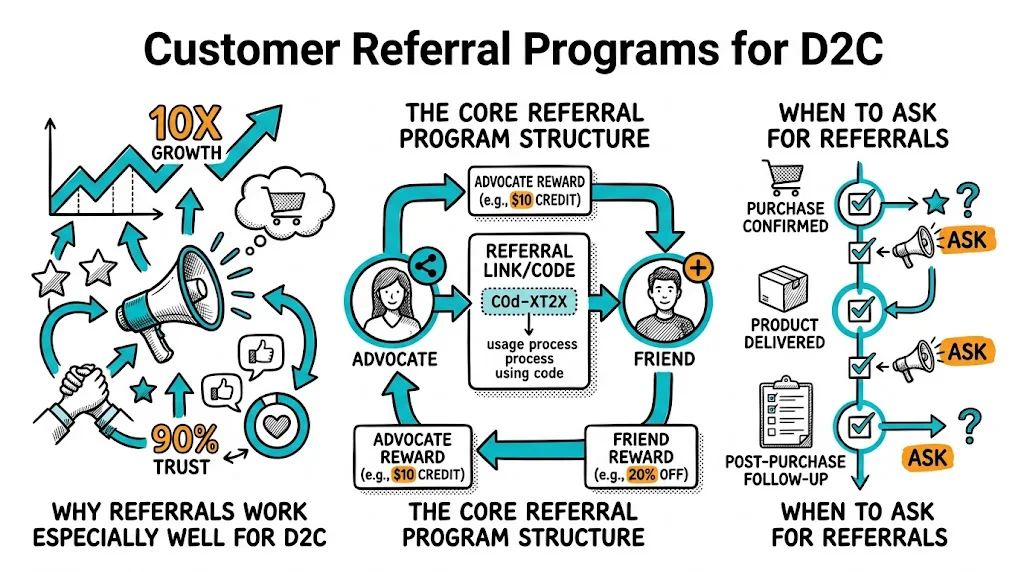
A referral program turns your happiest customers into your cheapest and best acquisition channel. Referred customers convert at 3–5x the rate of cold traffic, have 18–25% higher LTV, and are more likely to become referrers themselves. For D2C brands paying ₹400–₹800 per new customer on Meta and Google, even a partially effective referral program dramatically improves CAC blended across all channels. Here's how to build one.

Why Referrals Work Especially Well for D2C

D2C brands compete with established brands on trust. A new shopper sees your Instagram ad and wonders: is this real? Will the product actually work? What happens if it doesn't? Every barrier to that first purchase is a conversion leak.

Referrals bypass this entire concern. When a friend says "I use this protein powder and it's genuinely good—here's 15% off," the trust is pre-established. The referred customer comes in with:

  • Zero brand awareness gap (their friend already explained the value)
  • Built-in social proof (someone they trust has used it)
  • A financial incentive (the discount removes the remaining risk)

This is why referred customers convert at rates comparable to your best email segment, not your cold paid traffic.

The Core Referral Program Structure

Double-Sided Rewards: The Gold Standard

Give something to both the referrer and the new customer:

  • Referrer reward: ₹150–₹300 store credit, or a free product with next order
  • New customer reward: 10–20% off first order, or free shipping

The referrer reward motivates sharing. The new customer reward motivates converting. Without both, referral programs stall.

Example: "Give a friend ₹200 off their first order. Get ₹200 store credit when they buy."

This structure works because:

  1. The referrer has a concrete, tangible reason to share (not just "help a friend")
  2. The new customer gets an incentive worth using (₹200 off is a meaningful discount for most Indian D2C categories)
  3. The brand pays rewards only when a purchase happens — no wasted spend

One-Sided Rewards: Simpler, Lower Cost

Some brands only reward the referrer, or only the new customer:

Referrer only: Motivates sharing but the new customer has no extra incentive to convert. Lower conversion rate on the referred click.

New customer only: Great entry-price incentive but doesn't motivate current customers to share proactively.

One-sided programs work as supplemental acquisition (offering a discount code to new customers) but not as true referral programs. If you want referral volume, use double-sided.

When to Ask for Referrals

Timing is critical. Asking a customer who just received their order and is still uncertain about it to "refer a friend" is premature. The ideal moments:

After a positive signal:

  • After a 4 or 5-star review is submitted
  • After a repeat purchase (they've validated the product twice)
  • After the post-purchase "how's it going?" email gets a positive reply
  • After they engage with your loyalty program (high-engagement members are high-NPS)

In post-purchase email sequences: Add a referral ask in Email 4 or 5 of your post-purchase flow—after the review request, once the customer has had enough time to form a strong opinion.

In win-back campaigns: Customers who come back after lapsing and order again are in a high-satisfaction state. Reach them with a referral ask in the first post-win-back email.

The Referral Share Mechanism

How customers share the referral determines volume. Options:

Unique referral link: Most common. Each customer gets a unique URL (e.g., yourbrand.com/ref/[customer-code]). The link auto-applies the new customer discount. Easy to track.

Referral code: A short code (e.g., PRIYA15) that the new customer enters at checkout. Slightly higher friction than a link but works well for WhatsApp sharing (people copy-paste codes).

WhatsApp share button: An in-flow "Share via WhatsApp" button that pre-populates a message with the referral link. In India, WhatsApp is where referrals actually happen. A green "Share on WhatsApp" button on the referral program page dramatically outperforms an email share option.

SMS referral: Less common but effective for older demographic segments. Pre-written SMS with the referral code.

Setting Up Referrals on Shopify

Popular referral tools for Shopify:

  • ReferralCandy: Plug-and-play double-sided rewards, good analytics
  • Friendbuy: More customizable, better for high-growth brands
  • Smile.io (Referrals module): Integrates with their loyalty program
  • Referral Rock: Flexible structure, good reporting
  • Klaviyo + Custom Shopify App: For brands that want full control

Most tools handle:

  • Unique link/code generation per customer
  • Reward issuance (automatic store credit or discount code)
  • Fraud prevention (preventing customers from referring themselves)
  • Basic analytics (referrals sent, clicks, conversions)

Driving Referral Volume

A referral program that nobody knows about generates zero referrals. Drive awareness:

Post-purchase email sequence: Add referral CTA starting from Email 3 or 4.

Loyalty program integration: Make sharing a points-earning action. "Earn 500 points when your friend makes their first purchase" adds referral into the habit loop.

Product packaging insert: A physical card in the box saying "Love [Brand Name]? Here's a gift for your friends" with a referral code is unexpectedly effective. Opening a beautifully packaged D2C product is a shareable moment—channel that.

Account dashboard: Make the referral link prominent in the customer account page. Customers who log in are high-engagement; they'll find it.

Festive campaigns: "Gift a friend for Diwali — they get ₹300 off, you get ₹300 credit" during October–November converts at higher rates. The gifting mindset aligns perfectly with referral behavior.

Thank-you page popup: Immediately after purchase, show a "Share and give your friend ₹200 off" offer. Purchase satisfaction is at its peak — this is one of the best conversion moments for referral signup.

Personalizing the Referred Customer's First Visit

When a referred customer clicks a referral link, their first experience on your site matters enormously. They come in with partial information (what their friend told them) and a discount code. The site needs to:

  • Welcome them with context: "Your friend [First Name] sent you ₹200 off"
  • Surface the specific product the referrer likely told them about (if you can infer it)
  • Make the discount application clear and immediate

CustomFit.ai lets you build personalized landing experiences for referral traffic. When a visitor arrives via a referral link, you can show a tailored welcome message, highlight relevant products, and display the discount prominently—without any developer work. This referral-specific experience converts at meaningfully higher rates than sending all traffic to the generic homepage.

See how CustomFit.ai personalizes referral traffic landing pages →

Preventing Referral Fraud

Referral programs attract self-referrals and fraud if not protected. Common fraud patterns in D2C:

  • Customer creates a second account to refer themselves
  • Customers share referral codes publicly (social media, coupon sites) diluting the trust component
  • Bulk fake referrals from automation scripts

Basic protections:

  • One-time use referral codes per new customer (not reusable codes)
  • Email domain deduplication (same email domain can't refer itself)
  • Device fingerprinting (catches same-device self-referrals)
  • Minimum order value before reward issues
  • Coupon-site blocking (terms of service prohibiting public sharing)

Most referral platforms include basic fraud prevention. Review it and test it before launching.

Measuring Referral Program Performance

Referrals sent per customer: How actively is your customer base sharing? Under 0.1 (1 in 10 customers sends a referral) is low. Target 0.3–0.5 for active referral programs.

Referral link click-through rate: Of referral links sent, what percentage get clicked? 15–30% is typical; below 10% suggests the referral message is weak or the incentive isn't compelling.

Referred-to-buyer conversion rate: Of clicked referral links, what percentage result in a purchase? Target 15–25%.

Referred customer LTV vs. non-referred: Over 6–12 months, do referred customers have higher LTV? They almost always do. Quantifying this justifies higher reward spend.

CAC for referred customers: (Reward cost × referral volume) / new customers acquired via referrals. Compare to your paid CAC. Typically, referral CAC is 40–70% lower than paid.
Tips and Best Practices

  • Don't launch referrals before you have a solid post-purchase experience. Unhappy customers don't refer. Fix order fulfillment, packaging, and post-purchase communication first.
  • Test your reward amounts. ₹100 off isn't compelling for a ₹1,500 product. ₹300 off is compelling. Run quick tests on reward size to find the optimal conversion threshold.
  • Celebrate successful referrers. When a customer generates 3+ referrals, thank them personally. This recognition creates super-referrers who continue to share.
  • Track referral source by product. Some products inspire more sharing than others (typically the products with strong emotional response or transformative results). Double down on referral asks for those SKUs.
  • Run seasonal referral campaigns separately. Don't just let the evergreen program run. Layer dedicated "Refer a friend for Diwali" campaigns with higher incentives and specific festive framing on top.

Key Takeaways

  • Referred customers convert at 3–5x cold traffic rates because they arrive with built-in trust
  • Double-sided rewards (give both referrer and new customer a benefit) consistently outperform one-sided programs
  • Timing matters: ask for referrals after positive signals—post-review, post-repeat-purchase, not immediately after checkout
  • WhatsApp sharing is the primary referral mechanism for Indian D2C audiences; make it frictionless
  • Protect against fraud with one-time codes, email deduplication, and minimum order requirements
  • Personalize the referred customer's landing page with CustomFit.ai to convert referral traffic at its full potential