From the conversion glossary
Concepts referenced in this article, defined.
Concepts referenced in this article, defined.
Run rigorous A/B tests and personalize every visit on Shopify or any storefront — no engineers required.
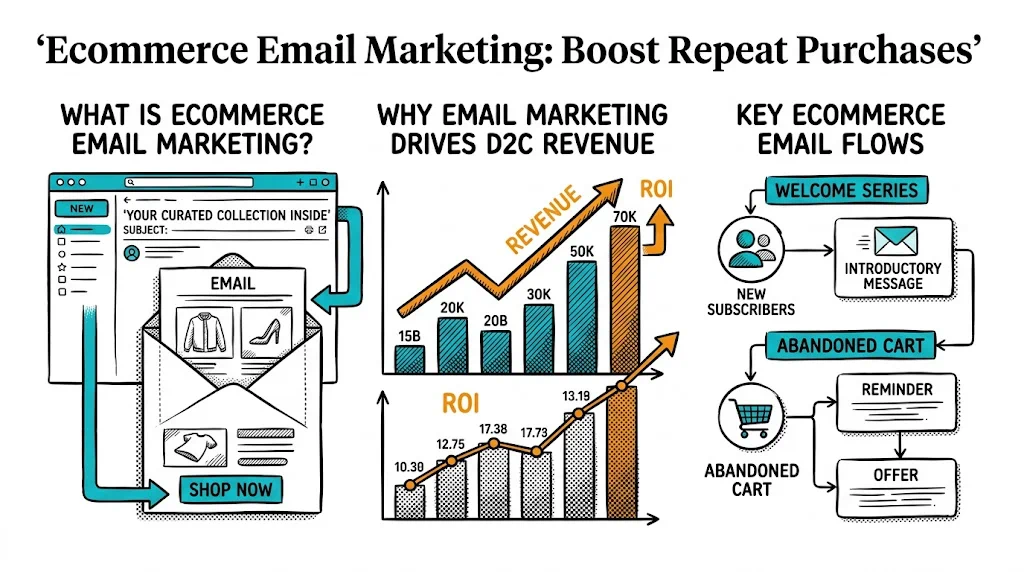
Ecommerce email marketing is the practice of using targeted, automated email campaigns to convert new subscribers, recover abandoned carts, drive repeat purchases, and retain customers over their lifetime. Email delivers the highest ROI of any digital marketing channel, typically ₹35 to ₹42 per ₹1 spent, and for D2C brands, automated email flows alone can drive 15 to 25% of total revenue. This guide covers the flows, sequences, and strategies that move the needle.
Ecommerce email marketing covers all email communications from an online brand to its subscribers and customers, from promotional campaigns to automated lifecycle flows triggered by specific customer actions.
There are three broad categories:
1. Automated flows (lifecycle emails): Triggered by customer behaviour, signing up, abandoning a cart, completing a purchase, lapsing after 90 days. These run continuously without manual intervention and generate disproportionate revenue relative to the effort of setting them up.
2. Broadcast campaigns: Sent manually to a segment of your list, for new product launches, seasonal sales, editorial content, brand stories. These require more active management but allow timely, contextual communication.
3. Transactional emails: Order confirmations, shipping notifications, and delivery confirmations. Often overlooked as marketing channels, transactional emails have the highest open rates of any email type (70 to 80%) and are prime real estate for post-purchase upsells and cross-sells.
For D2C brands, email marketing sits at the intersection of retention and conversion rate optimisation. An abandoned cart email is a direct recovery of a lost conversion. A replenishment reminder is a revenue per visitor optimisation for your existing customer base. Email is not a separate channel from CRO; it is an extension of it.
1. Zero incremental acquisition cost for repeat purchases. Email-driven repeat purchases carry no paid media cost. Once a customer is on your list, the cost of re-engaging them is limited to your email platform subscription. Gross margin on email-driven orders is significantly higher than on paid acquisition-driven orders.
2. Higher LTV through consistent engagement. Customers who receive regular, relevant emails from a brand have higher 90-day and 365-day LTV than those who do not. Email maintains brand recall between purchase cycles, reducing the risk of losing a customer to a competitor during the gap between replenishment events.
3. Cart abandonment rate recovery. Cart abandonment affects 70%+ of ecommerce sessions. Abandoned cart email flows sent 1 hour, 24 hours, and 72 hours after abandonment typically recover 5 to 15% of abandoned carts with no additional ad spend.
4. Average order value improvement through cross-sell and upsell. Post-purchase emails are an underutilised AOV lever. "Complete your routine" cross-sell emails sent 3 to 5 days post-purchase (when the customer's first impression of the product is still fresh) generate incremental orders with high purchase intent.
5. Lower CAC through word-of-mouth amplification. Referral program emails ("Give ₹200, get ₹200") turn satisfied customers into an acquisition channel. For Indian D2C brands where word-of-mouth in WhatsApp groups and family networks is a significant purchase driver, email-triggered referral programs can materially reduce blended CAC.
The India context: Email is not India's dominant consumer communication channel; WhatsApp and Instagram hold that position. But for D2C ecommerce specifically, email remains the highest-ROI direct-to-customer channel because:
Combining email with WhatsApp Business API for transactional and time-sensitive messages creates a retention stack that outperforms either channel alone.
Select an email platform with ecommerce-native capabilities: Shopify data integration, behaviour-triggered automation, segmentation by purchase history, and A/B testing. Klaviyo, Omnisend, and Drip are the leading Shopify-native options.
Connect your email platform to Shopify to sync:
This data is the fuel for behaviour-triggered automation.
Your email list is the foundation of the program. Set up:
Start with these five flows (covered in detail in the next section):
Once automation is running, layer in 2 to 3 broadcast campaigns per week:
Test systematically:
Goal: Convert new subscribers into first-time buyers.
Recommended sequence:
Benchmark CVR for welcome series: 3 to 8% (subscribers who make a first purchase within 30 days of signing up).
Goal: Recover visitors who added to cart but did not complete purchase.
Recommended sequence:
Benchmark recovery rate: 5 to 15% of abandoned carts convert through the flow.
India-specific additions:
Goal: Confirm the purchase, build post-purchase satisfaction, drive review, and generate repeat purchase.
Recommended sequence:
Goal: Re-engage customers who have not purchased in 90+ days.
Recommended sequence:
Subscribers who do not re-engage after the win-back flow should be sunset (unsubscribed or moved to a suppression list) to maintain list health and deliverability.
Goal: Trigger repurchase before the customer runs out (and potentially buys from a competitor).
Timing: Based on your product's average usage cycle. A face wash that lasts 45 days should trigger a replenishment reminder on Day 35, giving a 10-day buffer before they run out.
Subject line examples:
Replenishment flow CVR benchmarks: 8 to 20% for well-timed, personalised reminders.
1. Segment before you broadcast. Never send the same email to your entire list. At minimum, segment by: new subscribers (in welcome series), active customers (purchased in last 90 days), lapsed customers (90+ days since purchase), VIP customers (top 10% by LTV). Different segments need different messages.
2. Personalise beyond first name. First-name personalisation is table stakes. Personalise by last product purchased ("Time to replenish your [product name]?"), by browse behaviour ("You browsed our sunscreens, here's what 2,000 customers love"), by location ("Free next-day delivery to Mumbai on orders above ₹499"), and by purchase history ("You're a Vitamin C fan, try our new Niacinamide serum").
3. Optimise subject lines relentlessly. The subject line determines whether the email gets opened. Run A/B tests on every broadcast campaign: two subject line variants sent to 20% of your list each, with the winner sent to the remaining 60%. Test length (short 3 to 4 words vs. longer 8 to 10 words), urgency vs. curiosity vs. benefit, emoji vs. no emoji, question vs. statement.
4. Design mobile-first emails. Over 70% of emails are opened on mobile in India. Use a single-column layout, minimum 14px font size, CTAs that are at least 44px tall, and images that load quickly (WebP where possible, total email weight under 100KB).
5. Send at the right time. For Indian D2C audiences, 7 to 8am (before the commute) and 7 to 9pm (post-work) tend to generate the highest open rates. That said, test this against your specific list. B2C ecommerce audiences in India can show different patterns by category (beauty vs. electronics vs. home goods).
6. Maintain list hygiene. Remove hard bounces immediately. Run a 90-day re-engagement campaign for subscribers who have not opened any email in 90 days, and sunset those who do not respond. A clean, engaged list of 50,000 outperforms a bloated, disengaged list of 200,000 in both deliverability and revenue.
7. Use transactional emails as marketing moments. Order confirmation and shipping notification emails have 70 to 80% open rates, far higher than any promotional email. Use the space below the transactional content to showcase a complementary product cross-sell, invite a product review, promote your referral program, or invite social media follows.
8. Include COD and UPI signals in cart abandonment emails. For Indian D2C brands, a leading cause of cart abandonment is payment-related trust. Including "COD available" and UPI logos in your abandoned cart email addresses this objection directly. This addition can increase recovery rate by 10 to 20% for COD-heavy audiences.
9. Test incentive depth in recovery and win-back flows. The instinct is to offer the biggest discount in recovery emails. Testing often shows that a smaller, earlier incentive outperforms a larger, delayed one. Test 10% off in Email 1 vs. free shipping vs. no incentive (just the reminder), and separately, 15% off in Email 3 vs. ₹200 flat discount vs. a free gift.
10. Coordinate email with on-site experience. When an email links to a specific PDP or landing page, the on-site experience should be consistent with the email's offer and messaging. A customer who received a "15% off for coming back" email and clicks through to a PDP that shows no discount will feel misled. Use CustomFit.ai to serve personalised landing pages to email traffic that match the campaign's messaging.
| Platform | Shopify Native | Automation Depth | WhatsApp Integration | SMS | Price |
|---|---|---|---|---|---|
| Klaviyo | Yes | Deep | Via integration | Yes | From $45/mo |
| Omnisend | Yes | Good | Via integration | Yes | From $16/mo |
| Drip | Yes | Good | No | No | From $39/mo |
| Mailchimp | Partial | Limited | No | Yes | From $13/mo |
| Brevo (ex-Sendinblue) | Partial | Good | Yes | Yes | From $25/mo |
| WebEngage | Yes | Deep | Yes (India-native) | Yes | Custom |
Note on CustomFit.ai integration: CustomFit.ai connects with your email platform to personalise the on-site experience for email-driven traffic. When a Klaviyo email sends a "Welcome back" segment to lapsed customers, CustomFit.ai can detect those visitors (via UTM parameters or email click identity) and serve a personalised homepage or PDP experience that matches the email's message. This email-to-on-site personalisation consistently increases the CVR of email campaigns. See CustomFit.ai vs VWO for how this compares to other approaches.
Pilgrim, a D2C beauty brand with a large Tier 2/3 customer base, found that standard abandoned cart emails with just a cart recovery link were converting at 3.2%. After adding a "COD available at checkout, no advance payment needed" callout in the first abandoned cart email, recovery rate increased to 5.8%.
The insight: for Pilgrim's audience, the primary cart abandonment driver was payment anxiety, not indecision. Addressing it explicitly in the first recovery email, rather than offering a discount, produced a higher recovery rate and better margins (no discount required).
Kapiva launched a replenishment email flow for their 1L juice range (30-day average usage cycle). Emails sent on Day 22 after delivery ("Your Aloe Vera Juice is probably running low") with a "Reorder in one click" CTA generated a repeat purchase rate of 34% from the flow, compared to 18% organic repeat purchase rate for the same SKU cohort without the flow.
The addition of a "Subscribe and save ₹100 per order" upsell in the Day 22 email converted 12% of replenishment buyers into subscribers.
Bellavita's analytics identified 8,000 customers who had spent ₹3,000+ in a single order 6 to 12 months ago but had not returned. These were high-LTV customers who had likely gone quiet.
A 3-email win-back sequence with a personalised subject line referencing their last purchase ("It's been a while since you visited us, your [fragrance name] is probably running low?") and a ₹300 cashback offer recovered 22% of the segment within 30 days. The revenue from this one campaign exceeded ₹5 lakh.
A D2C home care brand's Diwali email calendar across the 3-week lead-up:
Week 1 (3 weeks before Diwali): Early bird offer, 20% off gifting sets, exclusive to email subscribers. Subject: "Early Diwali access for our email family only."
Week 2 (2 weeks before): Curated gifting guide by budget (₹500, ₹1,000, ₹2,500). Subject: "The only Diwali gifting guide you need." Added "Order by [date] for Diwali delivery" urgency.
Week 3 (1 week before): Countdown emails, 7 days, 5 days, 3 days, 1 day. Progressive urgency. Final email: "Last chance, order today for pre-Diwali delivery."
Result: Email drove 34% of total Diwali campaign revenue, with a 6.8x ROI on email platform costs for the campaign period.
Mistake 1: Sending to your entire list with every broadcast. Blasting 100,000 subscribers with every email, regardless of relevance, destroys deliverability (high unsubscribe and spam rates) and trains subscribers to ignore your emails. Segment every broadcast campaign by relevance.
Mistake 2: Ignoring email deliverability. A beautiful email that lands in spam has zero ROI. Monitor your sender reputation, maintain list hygiene, use a custom sending domain (not a shared Klaviyo domain), and warm up new sending domains properly.
Mistake 3: Not mobile-optimising email design. Single-column layouts, large tap targets, and compressed images are not optional. A desktop-designed email renders poorly on mobile and will be closed before it is read.
Mistake 4: Sending the same abandoned cart email to everyone. A first-time visitor who abandoned a ₹299 product needs different messaging than a repeat customer who abandoned a ₹2,500 bundle. Segment your abandoned cart flow by: new vs. returning visitor, cart value, product category, and previous purchase history.
Mistake 5: Under-investing in flow automation and over-investing in broadcast campaigns. Automated flows run 24/7 and generate revenue without manual intervention. Broadcast campaigns require weekly effort and deliver lower ROI per hour spent. Invest heavily in building and optimising your 5 core flows before expanding your broadcast calendar.
Mistake 6: Not testing subject lines. Subject line testing is the single highest-ROI email marketing activity. A 5 percentage point improvement in open rate (from 20% to 25%) on a 50,000-subscriber list means 2,500 more opens per email. Test every significant broadcast campaign with at least two subject line variants.
The optimal Indian D2C retention stack combines email and WhatsApp for different jobs:
For brands using both channels: do not duplicate messages across both. Use WhatsApp for the most time-sensitive, highest-priority touches; email for richer, longer-form content where layout and imagery matter.
Modern email platforms (Klaviyo's Smart Send Time, Omnisend's Smart Sending) use ML to determine the optimal send time for each individual subscriber based on their historical open behaviour. Rather than sending your entire list at 7am, the platform staggers sends so each subscriber receives the email at their personal optimal open time. Brands using predictive send time typically see 10 to 20% higher open rates vs. fixed-time sending.
Default email attribution (last-click, 5-day window) overstates email's revenue contribution. A customer who received an email on Monday and purchased after seeing a retargeting ad on Wednesday is attributed to email in most default configurations. A more accurate attribution model looks like this:
Using CustomFit.ai, you can create on-site experiences personalised for specific email segments. When a lapsed customer clicks through from a win-back email, they see a homepage banner: "Welcome back, [first name]! Your ₹200 credit is waiting." When a VIP customer clicks through from a new product launch email, they see the product page with a "VIP early access, exclusive to our top customers" badge.
This email-to-on-site continuity, matching the email's promise with a personalised landing experience, consistently generates 15 to 30% higher CVR for email-driven traffic vs. the default on-site experience.
What is ecommerce email marketing? Ecommerce email marketing is the use of targeted, automated, and segmented email campaigns to drive purchases, recover abandoned carts, retain customers, and increase repeat purchase rate for online stores.
What is the ROI of email marketing for ecommerce? Email marketing typically delivers ₹35 to ₹42 of revenue for every ₹1 spent, the highest ROI of any digital marketing channel. For D2C brands, automated email flows (welcome, abandoned cart, post-purchase) often drive 15 to 25% of total revenue.
What are the most important email flows for D2C ecommerce? The five most revenue-critical flows are: welcome series (new subscriber conversion), abandoned cart recovery, post-purchase sequence (review request + upsell), win-back (lapsed customers), and replenishment reminders (consumable products).
How often should a D2C brand email their list? Most D2C brands email their list 2 to 4 times per week. More important than frequency is relevance, segmented, behaviour-triggered emails outperform broadcast campaigns regardless of frequency. List health (open rates, unsubscribe rates) guides the right frequency for your specific audience.
What is a good open rate for ecommerce email? Industry benchmarks for ecommerce email open rates are 15 to 25%. D2C brands with well-segmented, behaviour-triggered flows (vs. broad broadcast emails) typically achieve 25 to 40% open rates. Subject line personalisation consistently outperforms generic subject lines.
How do I grow my email list for a D2C brand? The most effective list growth tactics for D2C are: homepage pop-up with a first-purchase discount offer (10 to 15% off), post-purchase upsell email capture, quiz/product finder with email gate, and social media lead generation ads driving to an email capture landing page.
Should I use WhatsApp alongside email for D2C retention in India? Yes. WhatsApp has 90%+ open rates in India vs. 20 to 25% for email. For D2C brands with Indian audiences, a WhatsApp + email combination, using each channel for what it does best, consistently outperforms either channel alone.
How does email marketing connect to A/B testing? Email subject lines, send times, CTA text, and offer structures should all be A/B tested systematically. For landing page personalisation after email clicks, CustomFit.ai can serve segment-specific on-site experiences to email audiences.
Email drives repeat purchases, and CustomFit.ai ensures every email click lands on a personalised experience that converts. Connect your email platform to CustomFit.ai to create email-to-site continuity for your D2C brand.