From the conversion glossary
Concepts referenced in this article, defined.
Concepts referenced in this article, defined.
Run rigorous A/B tests and personalize every visit on Shopify or any storefront — no engineers required.
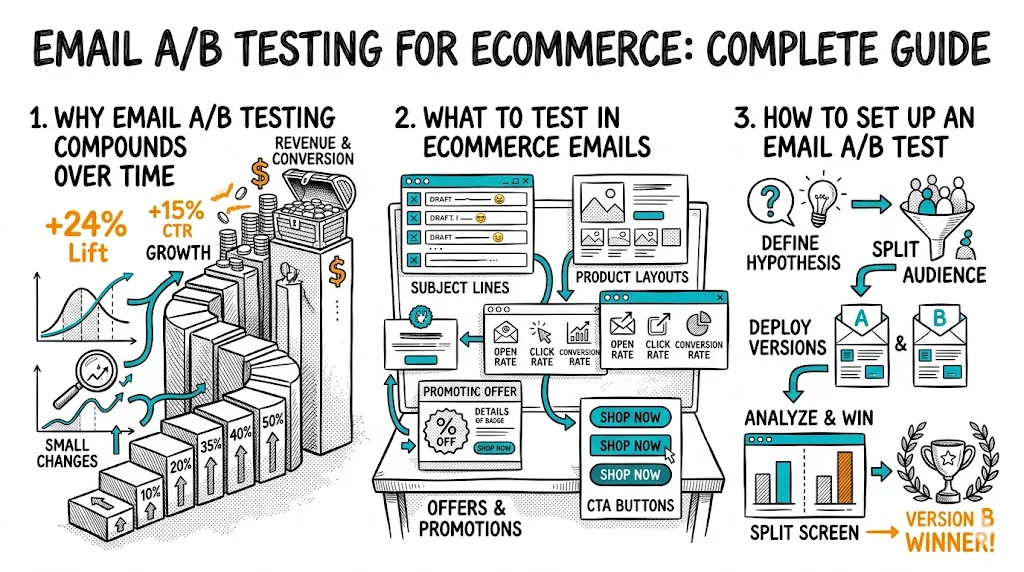
Email is the highest-ROI channel for most D2C brands — but the difference between a well-optimised email programme and a mediocre one is often not the email volume or the creative budget. It is systematic A/B testing. Brands that consistently test subject lines, CTA placement, offer framing, and personalisation see measurably higher revenue per email over time. This guide covers what to test, how to set it up correctly, and how to interpret results for ongoing improvement.
Unlike paid acquisition, where A/B test learnings improve a single ad or landing page, email A/B testing learnings compound across your entire subscriber base for every future send.
If you discover that emails with the customer's city in the subject line (e.g., "Your Mumbai-exclusive offer inside") get 8% higher open rates, that insight applies to every promotional email you send to that segment for the next year. Over 50 email sends to 20,000 subscribers, an 8% open rate improvement translates to hundreds of thousands of additional opens and the resulting revenue.
The investment in A/B testing is small (most email platforms support it natively). The compounding return is large.
Subject lines are the highest-leverage test because open rate is the first multiplier in the email revenue equation:
Revenue per email = Send volume × Open rate × Click rate × Purchase rate × AOV
Improving open rate lifts every downstream metric. Test these subject line variables:
Personalisation:
Curiosity vs. directness:
Emoji vs. no emoji:
Question format:
Length:
A practical approach: test subject lines on 20% of your list (10% to each variant), wait 4 hours, then send the winning subject line to the remaining 80%. Most email platforms (Klaviyo, Mailchimp, Omnisend) have this built in.
The preview text is the line that appears after the subject line in the inbox. It is effectively a second subject line and has almost as much impact on open rate.
Test preview text that complements vs. contradicts the subject:
The content visible without scrolling in the email preview pane on mobile. Test:
Hero image vs. text-only:
Offer placement:
CTA position:
The same discount can be framed different ways. Test which framing gets more clicks and revenue:
| Framing A | Framing B |
|---|---|
| "25% off" | "Save ₹350 on your order" |
| "Buy 2 Get 1 Free" | "Effectively 33% off when you buy 3" |
| "Free delivery above ₹499" | "Your ₹89 delivery charge is waived today only" |
The framing that wins varies by category, product price point, and customer segment. Testing reveals which mental model your customers use to evaluate value.
Test the same email at different send times to different segments:
For Indian D2C audiences, common high-performance windows are 8–10 AM (commute check), 12–1 PM (lunch break), and 9–10 PM (after-dinner scroll). The best send time varies significantly by list demographics and product category. Test it rather than assuming.
Automated flows (welcome series, abandoned cart, post-purchase, re-engagement) are especially worth testing because they send to every qualifying subscriber indefinitely. An improvement in an abandoned cart subject line affects every abandoned cart email for the next year.
For abandoned cart specifically:
Test one thing at a time. Changing the subject line and the hero image in the same test means you cannot attribute the result to either change.
Most email platforms split the test audience randomly from the same list segment. Ensure:
Decide in advance:
| Metric | What it measures | Use for |
|---|---|---|
| Open rate | Subject line + preview text | Subject line tests only |
| Click rate | Email body effectiveness | Body copy, CTA, offer framing tests |
| Click-to-open rate (CTOR) | Body effectiveness independent of subject | Isolating body changes from subject influence |
| Revenue per email | Ultimate business outcome | Offer and full-email tests |
Revenue per email is the metric that matters most. An email with a higher open rate but lower revenue per email is not actually a better email.
Wait for statistical significance. Most email A/B test tools show whether results are statistically significant. Do not call a winner based on early data — open rates stabilise after 4–6 hours; click and purchase data needs 24–48 hours.
Look for patterns, not one-time wins. A subject line format that wins once might win again — or might have been a fluke. Run variations of the winning format in future tests to confirm the insight.
Build a learning log. Document every test: what you tested, what the variants were, the result, and the insight. A log of 20 tests becomes a content strategy guide for your email programme.
Test during different campaigns. A subject line that wins during Diwali might not outperform the control during a January clearance campaign. Subject lines are context-sensitive — validate learnings across contexts.
Maintain a holdout group. For major automated flow tests, send 10% of subscribers the existing flow (control) while 90% get the new version. This protects against the test variant being significantly worse.
Use the 80/20 winner approach for promotional emails. Test on 20% of your list, wait 4 hours, send the winner to the remaining 80%. This maximises the impact of the winning variant while still generating test data.
Do not just optimise for open rate. It is possible to game open rates with misleading subject lines. Always track click rate and revenue per email alongside open rate.
For more on email and retention strategy, see the Email & Retention pillar guide and the A/B testing pillar guide.