From the conversion glossary
Concepts referenced in this article, defined.
Concepts referenced in this article, defined.
Run rigorous A/B tests and personalize every visit on Shopify or any storefront — no engineers required.
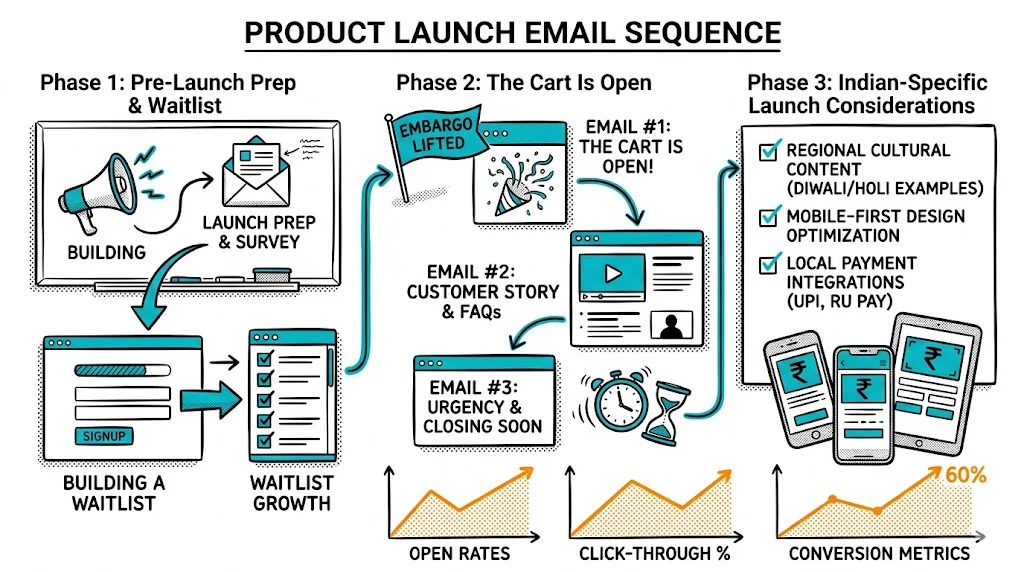
A product launch is one of the highest-potential revenue events in a D2C brand's calendar — but only if the launch is executed with a structure that builds anticipation, converts on the day, and follows up with buyers and non-buyers alike. A well-built product launch email sequence does not just announce; it creates a narrative arc that makes the launch feel like an event, not just a notification.
The goal of pre-launch emails is to create a segment of high-intent, warm subscribers who are primed to buy on launch day. Every pre-launch email should end with a clear action — usually joining a waitlist or enabling launch notifications.
Pre-launch Email 1 (Day -14): The Tease
Send to: full active list
Subject line: "Something we've been working on for months — launching soon"
Content:
The content should be more about the problem than the product. You are not selling yet — you are creating resonance.
Pre-launch Email 2 (Day -7): The Reveal
Send to: full active list + waitlist subscribers (separate subject lines for each)
Subject line for general list: "It's almost here — here's what we've built for you" Subject line for waitlist: "You're first to see this — [Product Name] launches in 7 days"
Content:
The reveal generates the first real intent signal — who opens and clicks this email is your highest-intent launch audience.
Pre-launch Email 3 (Day -2): The Final Build
Send to: full active list
Subject line: "2 days to go — here's everything you need to know"
Content:
This email converts the middle-funnel subscribers — those who were interested but not committed. The full reveal with pricing gives them enough information to decide.
Launch Email 1: The Go-Live Announcement (Send at optimal time — usually 9 AM)
Send to: full active list (waitlist subscribers get a separate, slightly earlier email)
Subject line for waitlist: "You're first — [Product Name] is live right now" Subject line for general list: "[Product Name] is here — launched today"
Content:
Keep the launch email short. The subscriber has seen the pre-launch emails — they know the product. The launch email's job is to create urgency to act now, not to re-educate. Every additional piece of content between the subscriber and the CTA is friction.
Launch Email 2: The Urgency Reminder (Send 6–8 Hours After Launch Email 1)
Send to: non-openers and non-clickers from Email 1
Subject line: "Still available — but selling faster than we expected"
Content:
This is the only launch day email to non-engagers. Do not send more than two launch day emails — the second is already aggressive.
Post-launch Email 1: Social Proof (Send Day 3 After Launch)
Send to: non-buyers from the launch sequence
Subject line: "What early buyers are saying about [Product Name]"
If you have early reviews or feedback within 3 days, this email shares them. If not, share pre-launch testimonials from beta users, influencer quotes, or a founder comment on why the product matters.
Post-launch Email 2: The Long-Form Story (Send Day 5–7 After Launch)
Send to: non-buyers
Subject line: "The real story behind [Product Name]"
Content: the origin story, the problem that motivated the product, the development process (how many iterations?), the team behind it. This is a relationship-building email for subscribers who need more context and trust before buying.
Post-launch Email 3: Offer Close (Send Day 10 After Launch)
Send to: non-buyers
Subject line: "The launch offer ends this week — last chance"
If you had a launch-specific offer (early bird price, free gift), this email creates a genuine close. If there was no launch offer, this email can introduce a first-week-only gift or bundle.
A waitlist is the highest-converting segment in a product launch. Subscribers who signed up have actively expressed interest and opted into launch communication. They are not surprised by launch day emails — they are expecting them.
Building a waitlist for Indian D2C:
Treat the waitlist as a separate list segment within your ESP. Launch day, email waitlist subscribers 1–2 hours before the general list announcement.
Timing relative to festive calendar: Product launches that land within 2 weeks of Diwali, Navratri, Holi, or other major shopping events benefit from ambient shopping intent. If your product can be framed as a festive gift or a celebration essential, align the launch with the festive calendar.
COD and delivery prominence: Indian consumers, especially first-time buyers of a new product, want to know immediately: "Can I pay on delivery? How fast will it arrive?" Address both in every launch email, not just on the product page.
Regional launches: If your product has a city-specific angle (e.g., a regional food product, a local brand recognition), a regionally targeted launch sequence outperforms a national announcement. Hyderabad customers seeing "Available in Hyderabad from Day 1" respond better than seeing a generic national launch message.
WhatsApp broadcast as launch channel: Indian audiences have far higher WhatsApp open rates than email. A WhatsApp broadcast message on launch morning ("It's live — [Product Name] is available now!") should complement, not replace, the launch email.
The pre-launch Email 2 (the reveal) and the launch day email are the highest-value tests to run:
| Test | Variant A | Variant B |
|---|---|---|
| Reveal email CTA | "Join waitlist" | "Set launch reminder" |
| Launch email hero | Product image | In-use lifestyle image |
| Launch subject line | Straightforward ("Product Name is live") | Curiosity ("The wait is finally over") |
| Post-launch offer | None (track organic reorder) | 10% off for non-buyers on day 5 |
Keep the launch email mobile-first. Most subscribers will open launch day emails on mobile during commute hours. One hero image, large CTA button, no horizontal scrolling.
Do not over-email before launch. Two pre-launch emails plus a launch day email is the minimum; three pre-launch plus two launch day is the maximum. More than this causes unsubscribes from subscribers who are tired of hearing about a product they have not bought yet.
Personalise the launch email for existing buyers of related products. If you are launching a new flavour of a protein bar, subscribers who have bought your existing flavours should receive a personalised launch email: "As a chocolate flavour fan, you'll love what we just made."
For more on email strategy, see the Email & Retention pillar guide.