From the conversion glossary
Concepts referenced in this article, defined.
Concepts referenced in this article, defined.
Run rigorous A/B tests and personalize every visit on Shopify or any storefront — no engineers required.
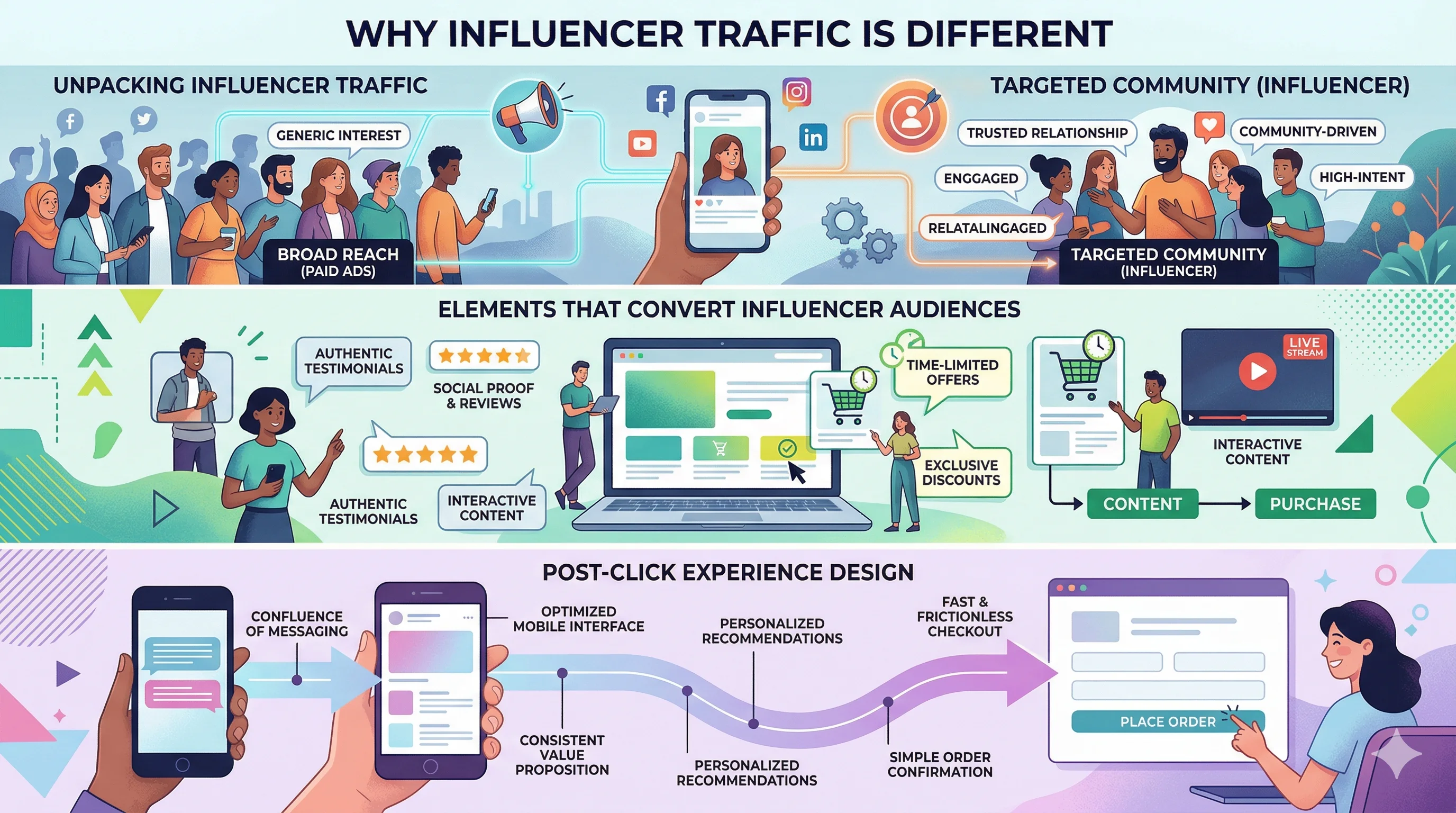
When a beauty influencer tells her 200,000 Instagram followers "I've been using this face serum for 3 months and my skin has never been clearer," the followers who click her link arrive with something rare in digital marketing: pre-built trust. Your landing page's job is to not break that trust. A generic product page that ignores the influencer context, their name, their discount code, their specific recommendation, wastes the trust signal they spent years building.
Influencer visitors are "warm." They arrive with:
This is higher quality than cold Facebook traffic. The conversion potential is significantly greater, but only if the landing page honors the context they arrived with.
What typically happens instead: The influencer posts a reel with a link in bio. The link goes to the brand's homepage or a generic product page. The visitor sees no reference to the influencer, no reminder of the recommendation, and no special offer. The trust signal dissipates immediately. They leave.
What should happen: The link goes to a personalized landing page that says "Meera's exclusive pick" with her photo, her testimonial, her specific recommendation, and her discount code applied automatically.
The first thing a visitor sees should confirm they are in the right place. This can be:
If you have permission to use their image or a screenshot of their content, even better.
Do not land influencer traffic on a full catalogue. Show specifically what the influencer talked about, ideally in the same way they described it. If they said "this makes my skin glow," use "glow" in your product description on this page.
Auto-apply the influencer's affiliate code to the cart when the visitor lands. Show "MEERA20 has been applied, you save ₹200" prominently. This:
A 15-30 second clip from the influencer's video review is the strongest form of social proof on an influencer landing page. It continues the trust transfer from their social feed to your checkout.
If video is not available, a direct quote with their handle and follower count works: "Honestly the best skin investment I've made this year.", @meera_skincare (198K followers)
The influencer's endorsement is the lead, but it should be backed up by verified customer reviews from people like the influencer's audience. If the influencer is a 25-year-old woman focused on natural skincare, show reviews from similar demographics.
Maintaining dozens of influencer-specific pages manually is not feasible. The solution:
Option 1: UTM-based personalization
Create one landing page but use a tool like CustomFit.ai to swap the hero section content based on the UTM source. When a visitor arrives from utm_source=meera_skincare, they see Meera's content. From utm_source=nisha_beauty, they see Nisha's content. One page, many personalized experiences.
Option 2: Influencer-specific landing page subfolders
Create /collections/meera-picks, /collections/nisha-picks as separate collection pages with pre-curated products. Lower-tech but requires more page maintenance.
Option 3: Personalized product pages Use Shopify metafields to store influencer-specific content blocks and show them conditionally based on URL parameters.
Track these metrics per influencer:
Set up UTM parameters for every influencer link:
utm_source=[influencer_handle]&utm_medium=instagram&utm_campaign=q1_collabs
This lets you compare performance across influencers and identify which content types and price points attract the best traffic.
Test 1: Influencer acknowledgment prominent vs subtle Full hero section with influencer photo vs small "As recommended by [Handle]" badge. Prominent acknowledgment typically wins with the influencer's direct followers; subtle acknowledgment works better for cross-posted content where visitors are less familiar with the influencer.
Test 2: Auto-applied coupon vs manual code entry Does auto-applying the coupon increase conversion vs showing the code and requiring manual entry? (It almost always does. Remove the friction of entering the code.)
Test 3: Influencer video on page vs no video Embedding a short product review clip from the influencer vs a standard product image. Video typically increases time on page and conversion for beauty and wellness products.
Use CustomFit.ai to segment and test influencer-sourced traffic without developer help.
Related reading: