From the conversion glossary
Concepts referenced in this article, defined.
Concepts referenced in this article, defined.
Run rigorous A/B tests and personalize every visit on Shopify or any storefront — no engineers required.
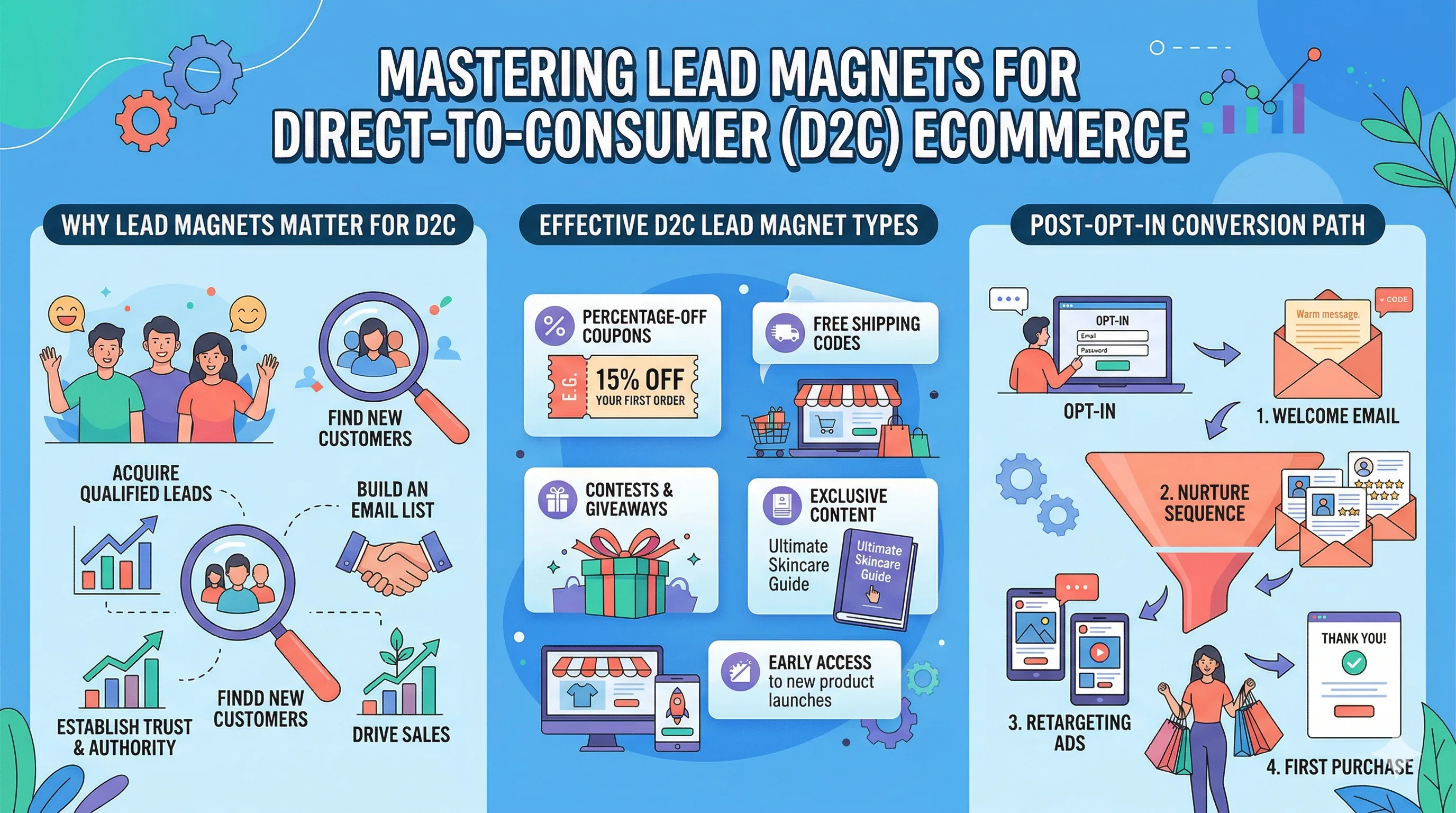
Not every visitor is ready to buy on their first visit. In Indian ecommerce, where 95%+ of first-time visitors leave without purchasing, capturing their email or phone number before they go is the difference between a single conversion chance and a multi-touch relationship that eventually closes. A lead magnet landing page offers something of immediate value in exchange for contact information, building a list you own independently of ad platforms.
Paid advertising platforms (Meta, Google) own your ad traffic. When costs rise or your account is suspended, you lose access to that audience. Your email list and SMS/WhatsApp subscriber base are assets you own permanently.
The economics of lead capture:
Lead magnet landing pages are where this list gets built.
"Get ₹100 off your first order, enter your email"
The classic ecommerce lead magnet. Conversion rates are typically 5 to 15% of visitors on a popup and 15 to 30% on a dedicated landing page with paid traffic. It works best for brands where price is a conversion barrier.
Indian optimization: Test ₹50/₹100/₹150 discount amounts. The optimal level depends on your average order value. For AOVs under ₹399, ₹50 off feels small; for AOVs over ₹799, ₹150 off feels compelling.
"Take our 2-minute quiz. Get personalized recommendations + ₹75 off your first order."
Quiz lead magnets produce higher engagement and higher-quality leads than discount popups. Visitors who complete a quiz:
Plum Goodness and mCaffeine have built quiz funnels that collect skin type, concern, and age information, then recommend specific routines. Each quiz submission is a segmented lead that enters a targeted email sequence.
"Get a free sample of [product]. Pay only ₹49 for shipping."
This is the highest-quality lead type for consumable products because the person receiving a sample is actively evaluating your product. Follow-up conversion rates from free sample recipients are 2 to 4x higher than from discount code recipients.
Note: "Pay for shipping" micro-conversions (₹29 to ₹49) are also worth considering because they convert leads into buyers. Even at ₹49, completing a payment creates a purchasing relationship.
"Join our WhatsApp community for exclusive deals, restocking alerts, and skincare tips."
For Indian D2C, WhatsApp is increasingly the highest-performing communication channel. WhatsApp message open rates are 90%+, compared to 15 to 25% for email. Landing pages that offer WhatsApp sign-up (via a WhatsApp link or QR code) build a high-engagement channel.
This works best for brands with ongoing content to share: tutorials, restocking alerts, community discussions.
"Be first to know about our [new product] launch. Sign up for early access."
Covered in the product launch section, but applicable as a general lead capture mechanism for any brand with a frequently-launching product pipeline.
A lead magnet landing page should be simpler and shorter than a product landing page:
Keep the form above the fold on mobile. Every scroll required before sign-up reduces conversion.
The lead magnet is only valuable if the follow-up converts. Design a nurturing sequence:
WhatsApp sequences can run on a similar cadence with shorter messages: 1 to 2 sentences rather than 3 to 5 paragraphs for email.
Offer type: Discount code vs quiz vs free sample. Quiz lead magnets have lower volume but higher quality (higher conversion to purchase); discount codes have higher volume but attract more discount-motivated leads.
Discount amount: ₹50 vs ₹100 vs ₹150. Track both sign-up rate and first purchase rate. The optimal discount level maximizes purchases, not sign-ups.
Form fields: Email only vs email + phone vs email + phone + name. Every additional field reduces sign-up rate by 20 to 30%. Only ask for what you will use.
Popup vs dedicated page: Popup on product page vs standalone landing page for paid traffic. Popups work for organic traffic; dedicated landing pages work better for paid lead generation campaigns.
Use CustomFit.ai to run these tests on your Shopify store.
Related reading: