From the conversion glossary
Concepts referenced in this article, defined.
Concepts referenced in this article, defined.
Run rigorous A/B tests and personalize every visit on Shopify or any storefront — no engineers required.
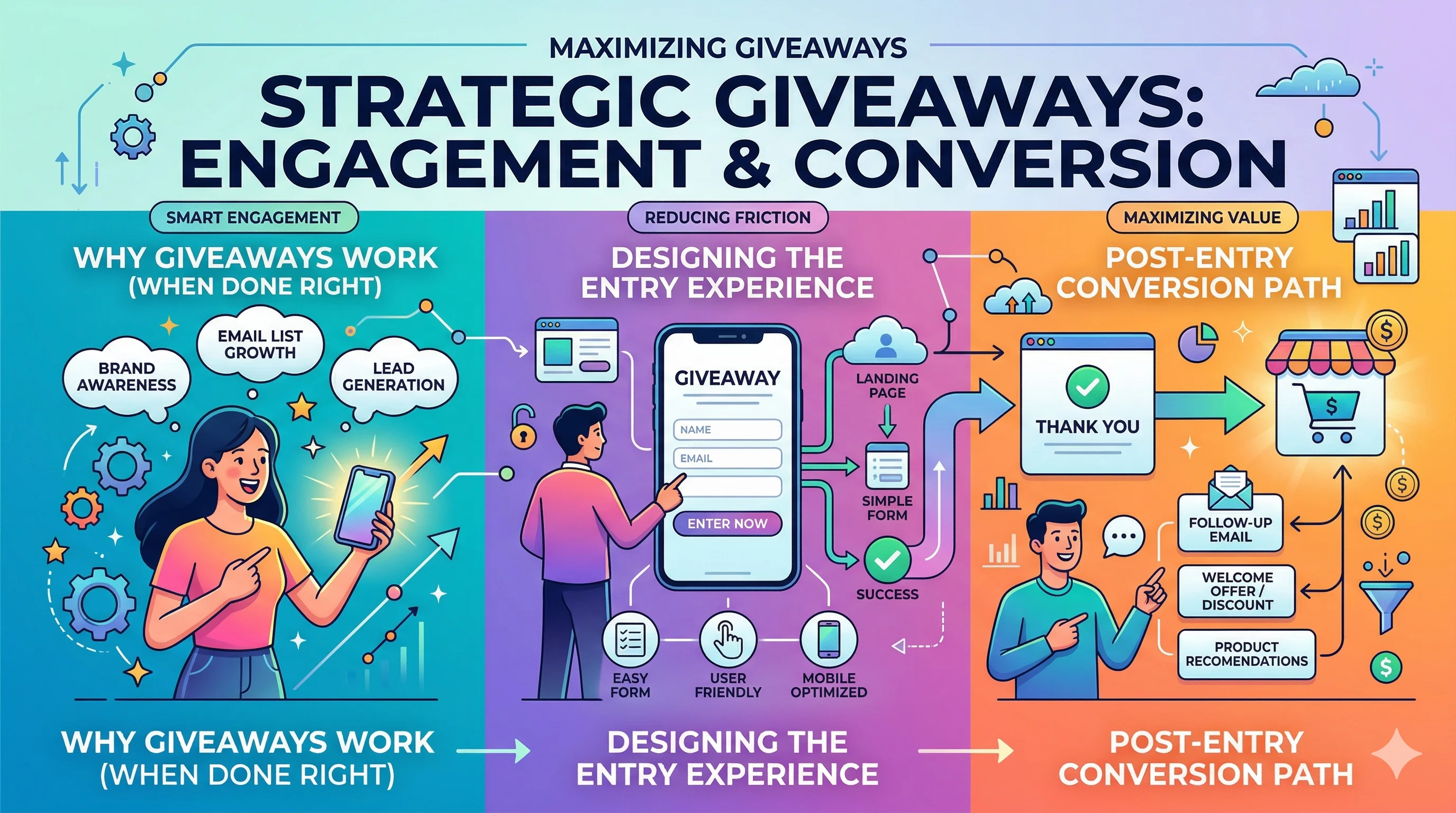
A giveaway or contest landing page can generate thousands of email leads in 48–72 hours — but only if it is designed to attract potential buyers, not just people who want free stuff. The difference lies in the prize, the participation mechanic, and how you follow up. For Indian D2C brands, giveaways are particularly effective during festive seasons and product launches, when cultural gift-giving and celebratory sharing amplify organic reach.
A well-designed giveaway:
When giveaways fail:
The prize is the most important design decision. The prize defines who enters.
Use your own products: A giveaway of "our complete skincare routine (worth ₹3,499)" attracts people interested in that routine. Every entrant is a potential buyer — they self-selected based on product interest.
Use product bundles: "Win a year's supply of [your supplement]" — entrants who want a year's supply are people who would buy it. This is a much higher-quality audience than an iPhone giveaway.
Use experiences: "Win a beauty consultation with [celebrity/expert] + ₹5,000 in products" — higher perceived value, attracts engaged category enthusiasts.
What to avoid: Generic cash prizes, gift cards for other retailers, or electronics that have no connection to your product category. These attract everyone, which means your leads list is full of noise.
The bonus entry mechanic is the virality engine — every tagged friend is a new potential entrant who has been referred by someone they trust.
Show the products clearly. List what is included. Add up the individual retail value: "This bundle is worth ₹4,299 retail." The perceived value of the prize directly affects entry rate.
Indian shoppers are appropriately skeptical of online giveaways. Legitimate signals (real brand account, clear winner announcement mechanism) reduce skepticism and increase entry rate.
"12,430 people have already entered" — live entry counts build FOMO and validate that the giveaway is real.
Pure giveaway (random draw): Lower barrier to entry → more entries → more top-of-funnel leads. Best for awareness campaigns and list building.
Contest (judged or skill-based): Higher barrier → fewer entries → higher-quality leads. Best when you want UGC (photos, reviews, creative submissions) or when you want to demonstrate community engagement to press or investors.
"Vote to win" contest: Users vote for their favorite product/flavor/variant — generates both leads and valuable product preference data. Boat and Nykaa have used this format effectively for product development validation.
The highest-converting giveaway funnels connect the entry to product discovery:
Step 1: Enter giveaway (email captured) Step 2: "While you wait, here's 15% off your first purchase" — monetizes the interest immediately Step 3: Post-giveaway email sequence (winner + consolation offer) Step 4: "You didn't win — but here's a special post-giveaway offer: ₹200 off"
The consolation offer sequence typically converts 5–12% of non-winners into buyers — which, on a list of 5,000 entrants, is 250–600 new customers from a single giveaway.
Timing giveaways to festive moments amplifies organic sharing:
Diwali: "Gift someone you love — tag a friend to enter them to win our Diwali gift set" — the gifting frame resonates culturally and generates high tag rates.
Holi: "Celebrate with free skincare — enter our Holi giveaway" — Holi's association with color and celebration makes beauty product giveaways especially relevant.
Mother's Day / Father's Day: "Gift your mother a year's supply of [product]" — emotional gifting framing generates high sharing because people want to do something nice for someone they care about.
Test 1: Prize reveal above vs below fold Showing the prize prominently above fold vs revealing it after an initial headline hook. Above fold wins for audience recognition of the prize; below fold can work when the hook creates curiosity.
Test 2: Single entry vs multi-entry mechanic One-action entry (email only) vs multi-action entry (email + follow + share). Multi-action entries reduce total entry volume but increase social sharing and brand following.
Test 3: Entry count social proof "12,430 people entered" visible vs no entry count. Entry counts create FOMO and validate legitimacy simultaneously — almost always lifts entry rate.
Test 4: Consolation offer timing Immediate consolation offer on the thank-you page vs consolation offer in the post-giveaway announcement email. Immediate offers convert better; email offers feel less aggressive.
Use CustomFit.ai to test these variants on your Shopify landing pages.
Related reading: