From the conversion glossary
Concepts referenced in this article, defined.
Concepts referenced in this article, defined.
 marketing channels
Social commerce conversion optimization for Instagram and TikTok Shop — where checkout friction actually happens and how to fix it on each platform.
 marketing channels
 marketing channels
Run rigorous A/B tests and personalize every visit on Shopify or any storefront — no engineers required.
Affiliate traffic sends visitors who arrived because a third party said your brand was worth clicking. That warm referral should convert at above-average rates — and it does, when the landing page matches what the affiliate promised. When it doesn't, you pay commission on traffic that bounces. The fix is landing page personalization per affiliate type, message match, and systematic A/B testing. Done right, affiliate CVR typically improves 20–40% without changing your affiliate commission structure.
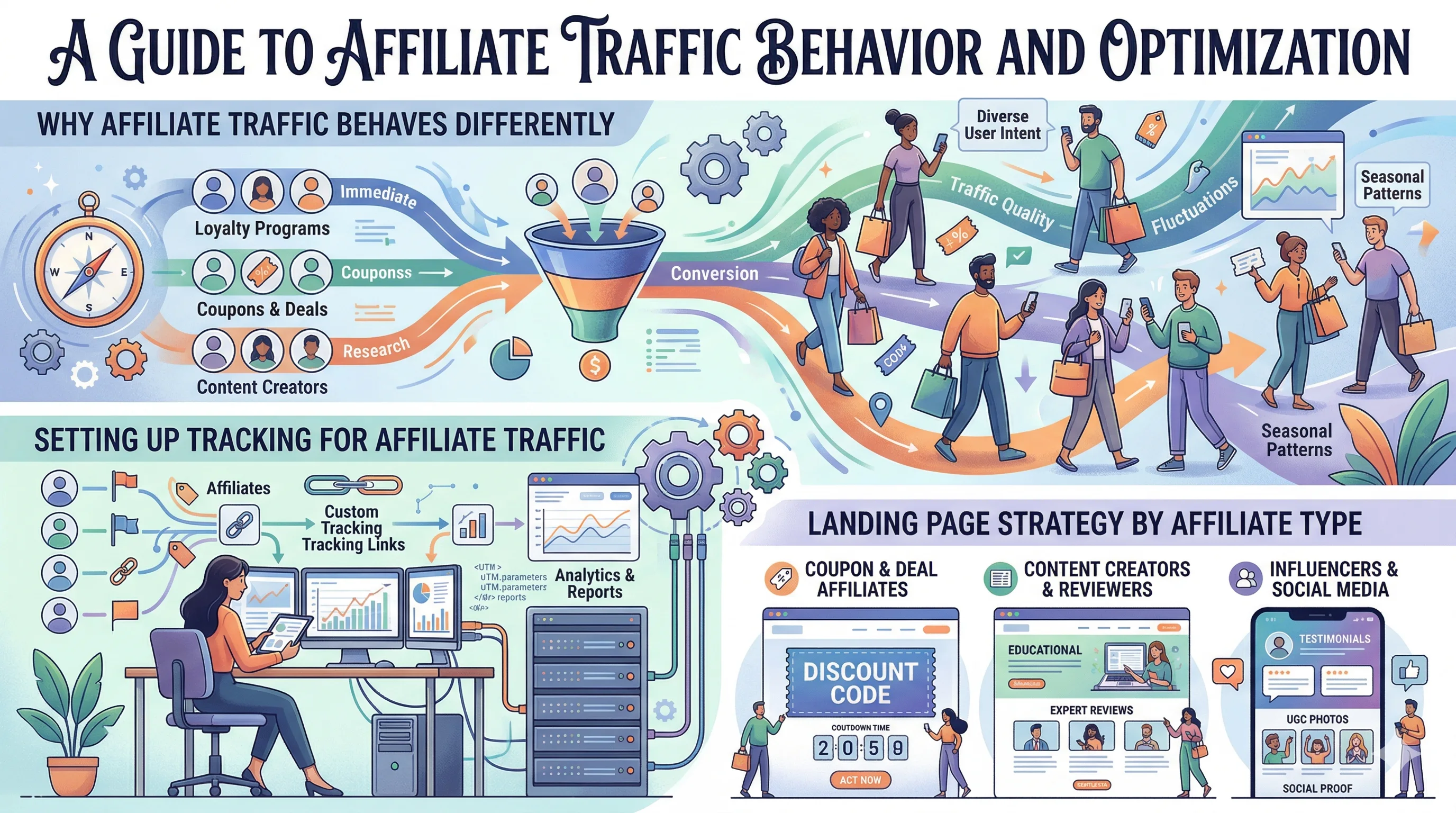
Affiliate traffic is not one channel — it is many micro-channels, each with its own audience intent:
Coupon and cashback sites (GoPaisa, CashKaro, Coupondunia): High volume, low brand loyalty. These visitors are motivated purely by the deal. They will comparison-shop and leave if the discount isn't immediately visible.
Content and review sites: The affiliate published a detailed review or "best of" list. The visitor has read context about your product and arrives pre-sold. Intent is high, decision anxiety is lower.
Influencer and social affiliates: The visitor saw a recommendation from someone they trust. The emotional context of that recommendation matters — your landing page needs to acknowledge and extend it.
Email newsletter affiliates: A curated newsletter included your product. Audience is typically educated, engaged, and responsive to detailed product information and clear calls to action.
Comparison sites: The visitor is actively comparing your product to competitors. Your landing page needs to reinforce your differentiators immediately.
One homepage cannot optimally serve all five of these visitors. That is the core CRO problem with affiliate traffic.
The foundation of affiliate CRO is knowing which affiliate sent which visitor. Two methods:
UTM parameters:
Each affiliate gets a unique link: yourstore.com/product?utm_source=affiliate&utm_medium=content&utm_campaign=affiliate_name
Sub-affiliate IDs:
Your affiliate platform (Impact, Commission Junction, PartnerStack) assigns a unique sub_id or aff_id parameter. Use this alongside UTM parameters for granular tracking.
Your personalization tool reads these parameters and can serve different landing experiences to each affiliate's audience.
With CustomFit.ai, you create audience rules like:
utm_campaign=cashkaro → show deal-prominent landing page"utm_campaign=healthblog_review → show detailed product page with review integration"No developer involvement needed.
Visitors from coupon sites are looking for one thing: the deal. Every additional step between landing and applying the discount is friction that increases bounce rate.
Optimize for:
Test: Does showing the discount code in the first viewport without any other promotional content improve CVR vs a standard promotional banner?
These visitors arrive knowing your product. They read the review. They clicked because they want to buy — not browse.
Optimize for:
Test: Does an affiliate-specific landing page ("Welcome, [Affiliate] readers") convert better than a standard product page?
The influencer's personal recommendation carries trust. Your landing page needs to not break that trust.
Avoid: An aggressive pop-up as the first thing visible. This clashes with the warm referral feeling.
Optimize for:
Test: Does removing the standard promotional pop-up for influencer traffic increase CVR? (It typically does — influencer visitors arrive warm and pop-ups feel intrusive.)
Newsletter audiences are used to reading detailed content. They can handle more product information than typical ad traffic.
Optimize for:
Test: Long-form product page vs standard product page for newsletter affiliate traffic.
The most important test you can run. Send 50% of affiliate traffic to your standard homepage, 50% to a campaign-specific landing page.
The landing page should:
Expected result: Landing page typically wins by 20–50% CVR lift.
For coupon site visitors:
Pre-applied discounts eliminate a friction step and typically convert 8–15% higher.
The personalization signal ("I know how you got here") converts because it feels intentional rather than accidental.
For content and influencer affiliates, pop-ups interrupt a high-intent user about to convert. Suppressing them often increases CVR.
Traffic volume from an affiliate is a vanity metric. Revenue per visitor (RPV) is the real indicator:
| Affiliate type | Typical CVR | Typical AOV | RPV |
|---|---|---|---|
| Content/review | 4–8% | High | Highest |
| Email newsletter | 3–6% | High | High |
| Influencer | 2–5% | Medium-high | Medium-high |
| Comparison site | 2–4% | Medium | Medium |
| Coupon/cashback | 1–3% | Lower (discount-driven) | Lower |
Build a report that shows revenue per visitor (not just CVR or volume) by affiliate. This tells you which affiliate relationships deserve more investment.
If your affiliate program pays flat-rate commission regardless of order value, you're incentivizing affiliates to send volume over quality. Consider:
These structure changes combined with landing page personalization create a compounding improvement in affiliate channel ROI.
Sending all affiliate traffic to the homepage. Affiliates promote specific products or offers. The homepage is a discovery environment — not the destination a motivated buyer needs.
Not suppressing standard pop-ups for warm affiliate traffic. An exit-intent pop-up that fires 5 seconds after a high-intent influencer visitor lands is CRO self-sabotage.
Treating coupon affiliates and content affiliates the same. Their audiences, intent, and optimal landing experiences are fundamentally different.
Not tracking sub-IDs. If you only track at the affiliate platform level, you cannot distinguish which specific affiliate is sending quality traffic or test affiliate-specific landing pages accurately.
Ignoring COD for affiliate traffic. Affiliate traffic often comes from a broad geographic base — including tier-2 and tier-3 cities where COD preference is high. Not displaying COD availability is a silent conversion killer.
Related reading: