From the conversion glossary
Concepts referenced in this article, defined.
Concepts referenced in this article, defined.
Run rigorous A/B tests and personalize every visit on Shopify or any storefront — no engineers required.
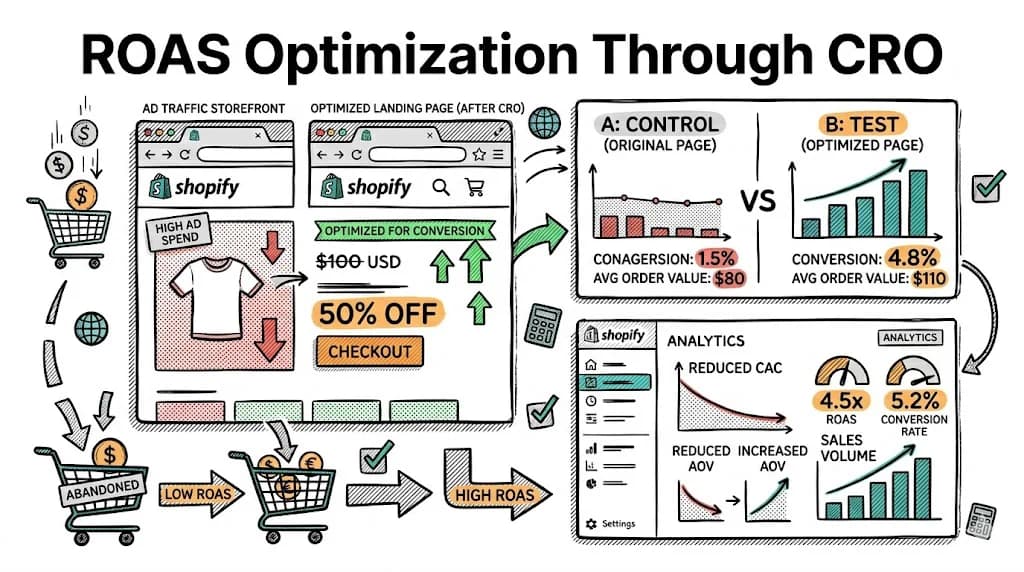
A/B testing your landing pages while paid ads are running is one of the most common growth tactics — and one of the most misunderstood. Done poorly, it corrupts your conversion pixel data, disrupts Meta's learning algorithm, and produces misleading CRO results all at the same time. Done correctly, it generates faster results than testing on organic traffic alone and gives you landing page data tied directly to paid visitor intent. This guide covers the right way to do it.
When you run a standard A/B test, your testing tool splits incoming visitors between Variant A and Variant B — typically 50/50. If those visitors came from your Meta ads, the purchase events generated by Variant A visitors and Variant B visitors both fire your Meta Pixel under the same ad set.
Here's why that's a problem:
Meta's algorithm optimizes based on conversion signals. When it sees that a visitor who came from Ad Creative X converted, it learns to show that creative to more people who are likely to convert. But if your landing page is split-testing and Variant B is converting at half the rate of Variant A, Meta interprets this as the ad creative performing inconsistently — leading to fluctuating ad delivery and inaccurate ROAS reporting.
Google Ads has the same issue with conversion tracking. If a keyword's landing page is being split-tested and conversions are randomly assigned to Variant A or B, Google's Smart Bidding algorithm receives mixed signals. Your campaign optimization can degrade, and Quality Score attribution becomes unreliable.
The testing tool results are also affected. If your paid and organic traffic have very different behavior profiles (which they almost always do), mixing them in one test produces results that are an average — not an accurate read for either audience.
The cleanest approach for most D2C brands. Tag your paid traffic with consistent UTM parameters (which you should already be doing). Then in your A/B testing tool, create a targeting rule that only shows a variant to non-paid traffic, or explicitly assigns paid traffic to the control variant.
How to set it up:
Your paid campaigns continue receiving consistent landing page experiences, your pixel data stays clean, and your A/B test still gets meaningful traffic.
Instead of testing within a single landing page, run two parallel ad campaigns — identical targeting, same budget — each sending to a different landing page URL.
Both pages are fully live, and each ad campaign's pixel data remains clean because conversions map clearly to which page they came from. This also gives you a true apples-to-apples comparison of landing page performance specifically for paid traffic.
Limitation: Requires careful budget matching between campaigns and enough volume in each to reach statistical significance. Works best for higher-spend brands (₹5L+/month in ad spend).
If your ad sets are in the learning phase (typically the first 50 conversions), don't run landing page tests yet. Meta's algorithm is actively adjusting delivery based on early conversion data — introducing a landing page variable during this window amplifies the noise.
Rule of thumb: Wait until an ad set has 200+ conversions before running a landing page test that affects that traffic. At this point, the algorithm is stable enough to handle the slight variation in conversion rate that a test introduces.
If you must test during an active paid campaign, switch your primary metric to an upper-funnel signal: add-to-cart rate rather than purchase conversion, or product page scroll depth rather than add-to-cart.
These micro-conversion events happen more frequently (giving you faster statistical significance) and are less sensitive to pixel attribution issues (since they don't directly affect your paid campaign's optimization signals).
Once you identify the winning variant on a micro-conversion metric, implement it permanently and then verify the full conversion impact afterward.
Advanced D2C brands with higher traffic use holdout testing: route 90% of traffic to the current control experience and hold 10% back to receive no test treatment. Any conversion difference between the 90% test group and the 10% holdout represents the causal impact of the test.
This is more complex to set up but is the most statistically clean approach for brands running multiple experiments simultaneously on high-traffic campaigns.
If you notice your A/B test results are inconsistent — high variance day-to-day, or metrics moving in opposite directions for different traffic sources — your paid traffic is probably introducing noise. Here's how to salvage the data:
Segment your results by traffic source. In your testing tool's reporting, filter to only organic + direct + email traffic. If the test result becomes clear when you exclude paid traffic, you have your answer — implement the winner and apply it to your paid landing pages too.
Check for time-of-day patterns. If paid traffic is heavier on weekdays and organic is heavier on weekends (common), your test results may reflect different visitor intent rather than variant performance. Analyze by day of week as a sanity check.
Look at statistical confidence over time. If confidence is jumping between 60% and 95% day-to-day, your sample is being contaminated by inconsistent traffic quality. Don't call the test — extend it or restart with cleaner segmentation.
There's an additional risk with landing page testing that's often overlooked: Google evaluates landing page experience as part of Quality Score. If you're testing a significantly worse variant (lower quality, slower, less relevant) and Google's crawler happens to index it during testing, your Quality Score can temporarily degrade.
Mitigate this by:
The best D2C brands treat paid ad campaigns and landing page testing as coordinated activities, not independent efforts:
Before a campaign launch: Run a 2-week landing page test on your existing traffic to identify the highest-converting version. Launch the campaign to the tested winner.
During a campaign: Don't change your landing page mid-campaign unless performance is clearly failing. Minor changes mid-campaign corrupt your campaign's attribution data.
After a campaign (post-festive season): Analyze which landing page variants performed best for paid traffic specifically. Use this data to brief your next round of CRO experiments.
Around Diwali and other major sale events: Freeze landing page tests 1 week before the event and resume 2 weeks after. Festive traffic behaves so differently from regular traffic that test results during this period are rarely generalizable.
Always use UTM parameters on 100% of your paid traffic. This isn't just for CRO — it's table stakes for any digital marketing measurement. Without consistent UTMs, you can't segment test results, attribution falls apart, and you're flying blind.
Keep a test-change log. Any time you make a change to a landing page — design, copy, layout — record the date, what changed, and what campaigns were running. When you see a CVR or ROAS anomaly, this log tells you whether a landing page change could be the cause.
Run the right test for the right audience. Personalization often outperforms static A/B testing for paid traffic. Instead of finding one winner for all visitors, show cold paid traffic the trust-heavy variant and warm retargeting traffic the urgency-heavy variant automatically.
Align with your paid team on test timing. If you're CRO and someone else manages paid ads, get a weekly sync going. Landing page changes affect ROAS; campaign structure affects test results. These functions need to communicate.
Related reading: Meta Ads + CRO: Post-Click Experience | Google Ads Quality Score & Landing Page CRO | A/B testing glossary.