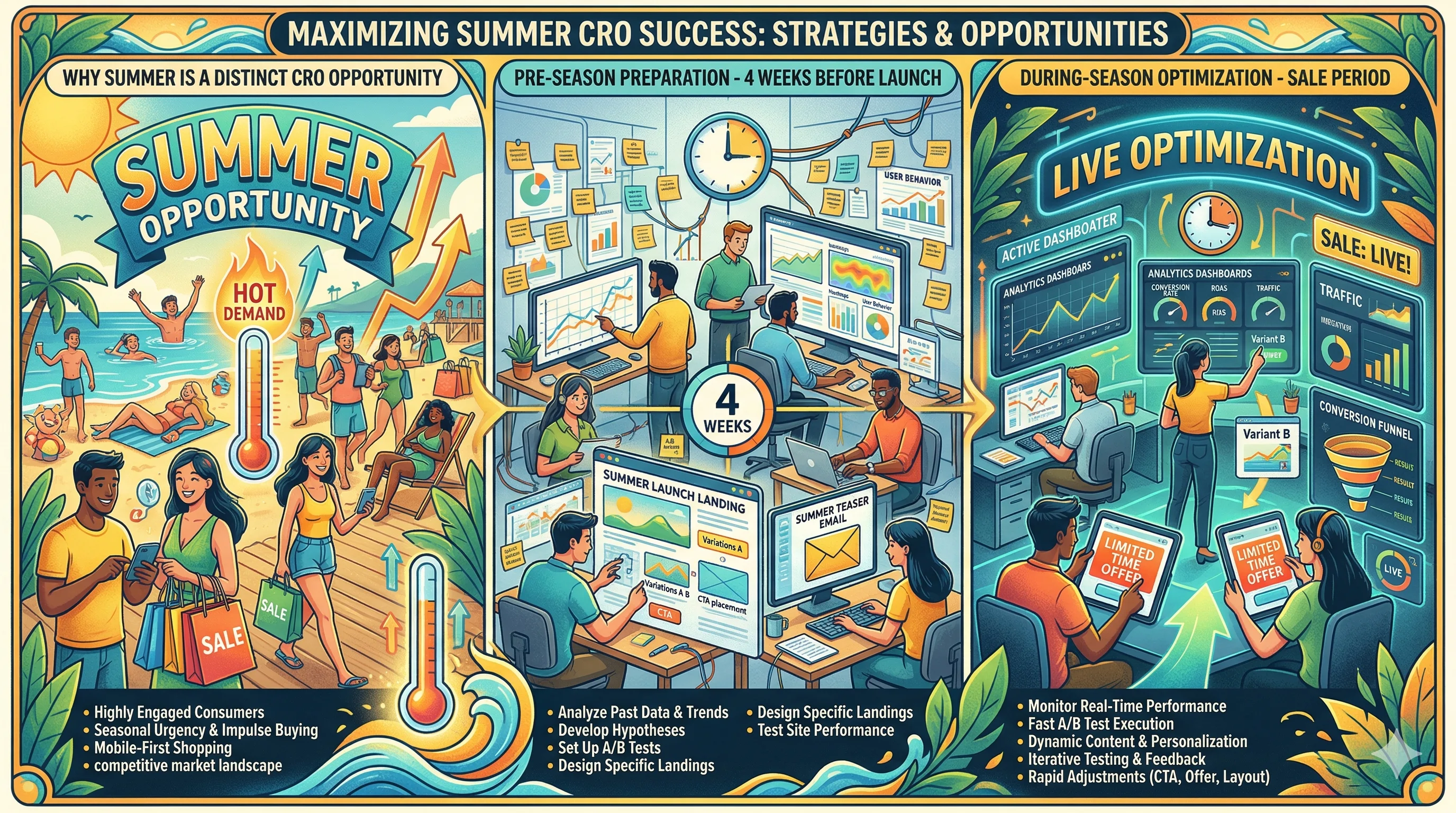
Summer is India's longest retail selling window — four months of heat-driven demand, school holidays, and pre-monsoon buying. Brands that treat it as one big discount event leave money on the table. The ones that optimize for seasonal intent at each stage of the funnel consistently outperform their own growth targets. Start preparing 4 weeks before your sale launch and keep testing through June.
Why Summer Is a Distinct CRO Opportunity
India's summer is not a quiet period. It is one of the most category-specific buying seasons of the year:
- Cooling and comfort products spike: air coolers, fans, cotton clothing, refrigerators, cold beverages.
- Skin and hair care categories shift: SPF, after-sun care, anti-humidity hair care, matte foundations.
- Travel accessories surge for April–May school holidays and summer vacations.
- Kids' products peak during school holidays (April–May and again in June).
- Pre-monsoon clearance creates urgency in fashion and home categories.
The visitor arriving in May for "best sunscreen for Indian summer" is not casually browsing. They are ready to buy. Your job is not to persuade them to want the product — it is to remove the friction between their intent and your checkout.
That is a CRO problem, not a marketing problem.
Pre-Season Preparation (4 Weeks Before Launch)
Identify Your Summer Opportunity Categories
Pull your data from last March–June:
- Which categories had high traffic but below-average CVR? (Opportunity: better product pages or landing pages)
- Which had high CVR but you ran out of stock? (Opportunity: earlier buying decisions, stock urgency messaging)
- Which products had high add-to-cart but high checkout abandonment? (Opportunity: remove checkout friction)
No last-year data? Use Google Trends for your category to confirm the demand spike is real and time it correctly.
Build Season-Specific Landing Pages
Generic category pages convert at baseline. Season-specific pages — built around the visitor's summer context — convert higher.
Create:
/summer-essentials — curated top sellers for the season/beat-the-heat — cooling products collection/summer-skin-kit — bundled SPF + moisturiser + after-sun at a set price/kids-summer — toys, summer clothing, holiday travel products
These dedicated pages let you run A/B tests cleanly without affecting your year-round category pages.
Set Up A/B Tests Before Your Sale Starts
Tests need 1–2 weeks of data to reach statistical significance. Launch them before your sale goes live:
Test 1 — Seasonal hero vs generic hero:
- Control: Standard homepage hero
- Variant: Summer-specific hero ("Beat the heat — up to 40% off summer must-haves")
Test 2 — Bundle vs individual:
- Control: Individual suncare products on category page
- Variant: "Summer Skin Kit — SPF 50 + Moisturiser + Lip Balm — ₹799" featured at top
Test 3 — Urgency type:
- Control: No urgency signal on product page
- Variant A: "Only 47 left in stock"
- Variant B: "Summer sale ends June 15"
Test 4 — COD visibility:
- Control: COD mentioned in footer or FAQ
- Variant: COD badge ("Cash on Delivery available") displayed on product card and hero
During-Season Optimization (Sale Period)
Match Messaging to the Temperature
Literal heat references convert better than abstract seasonal language in Indian markets. "Keep cool this summer" lands better than "summer essentials" for cooling products. "Monsoon-proof your skin" outperforms "long-lasting coverage" for foundation.
Test headline variations that use heat-specific language:
- "Survive the 45°C peak with these cooling picks"
- "Your skin needs SPF 50+ this May — here's why"
- "School holidays sorted: gift ideas for active kids"
Segment by Geography
India's summer heat is not uniform. Rajasthan and Gujarat hit 45°C+ in May while Bengaluru stays mild and coastal cities deal with humidity more than heat.
Geo-based personalization:
| Geo segment | Messaging angle | Example |
|---|
| North India (May–June) | Extreme heat relief | "For 45°C+ summers — cooling that actually works" |
| South India | Humidity + sweat | "Humidity-proof hair care and skin care" |
| Hill stations | Mild summer | "Make the most of pleasant weather — summer collection" |
| Metros | Convenience | "Summer delivery in 2 days — order now" |
Optimize for Mobile Shoppers
Summer in India = peak mobile browsing. People are indoors during peak afternoon heat, browsing on phones. Your mobile experience needs to be fast and friction-free:
- Hero images should load in under 1.5 seconds on a 4G connection
- Add-to-cart button should be thumb-reachable (not buried below a long description)
- Size/variant selectors should be large touch targets
- Show "COD available" and "Free returns" above the fold on product pages
Test: Does removing the product description accordion and showing 3 bullet points directly below the title increase add-to-cart rate on mobile?
Run Flash Sale Tests
If you're running 24-hour flash deals, test:
- Countdown timer placement (above fold vs sticky bar)
- Flash sale landing page vs regular category page with badge
- "Flash sale" label on product cards vs highlighted price-drop percentage
Flash sales compress the decision window — but only if the visitor knows the timer is running.
Post-Season Analysis (June–July)
Revenue Attribution by Test
For every A/B test you ran, document:
- Which variant won and by what margin
- Revenue per visitor improvement
- Sample size when you called the winner
- Whether the win held across mobile and desktop
This becomes your summer 2026 playbook.
Convert Summer Buyers to Year-Round Customers
Shoppers acquired during summer sales are often deal-motivated first-time buyers. To retain them:
- Email them 3 weeks post-purchase with a "how is your [product] working for you?" angle + a related product recommendation
- Retarget with monsoon-relevant products (waterproofing, rain gear, indoor entertainment for kids)
- Offer a loyalty program sign-up reward within 30 days of first purchase
Bridge to the Next Seasonal Moment
India's retail calendar flows quickly. Summer (March–June) → Independence Day (August) → Onam (August–September) → Navratri-Diwali (October–November). Build a retargeting audience from your summer buyers and activate them for the next window.
Specific A/B Test Ideas for Summer
- Homepage: Summer sale countdown timer vs static sale badge
- Category page: Bundle row at top vs standard product grid
- Product page: "Only X left" vs "Sale ends [date]" urgency
- Cart: "Add ₹200 more for free delivery in summer heat" vs static free delivery threshold message
- Mobile nav: "Summer sale" tab vs standard categories
- Exit intent: Summer-specific offer ("Take 10% off your summer kit") vs generic coupon
- COD badge: Above-fold placement vs standard location
- Product images: Model wearing in outdoor summer context vs studio white background
Tips and Best Practices
- Season-specific copy beats generic sale copy. "Beat the heat" converts better than "Big summer sale" in heat-sensitive categories.
- Bundle pricing reduces decision fatigue. Summer shoppers often need multiple products (SPF + moisturiser + after-sun). A ready bundle at a smart price removes the need to build a cart manually.
- Pre-monsoon urgency is real. In June, "get this before monsoon sets in" is a genuine and high-converting urgency angle for outdoor and travel categories.
- Test mobile and desktop separately. Your homepage hero test results may differ by device — segment your analytics before declaring a winner.
- COD is non-negotiable for tier-2/3 summer demand. Summer travel and holiday shopping comes from every corner of India — make COD visible.
Key Takeaways
- Summer is a four-month, multi-category CRO opportunity — not just a clearance event.
- Season-specific landing pages and headlines consistently outperform generic category pages.
- Run A/B tests 4 weeks before launch so they reach significance before peak days.
- Geo-personalization (by heat level, humidity, altitude) is uniquely effective in India's diverse climate.
- Post-summer: convert seasonal buyers to year-round customers and bridge to the next festive moment.
Related reading: