From the conversion glossary
Concepts referenced in this article, defined.
Concepts referenced in this article, defined.
Run rigorous A/B tests and personalize every visit on Shopify or any storefront — no engineers required.
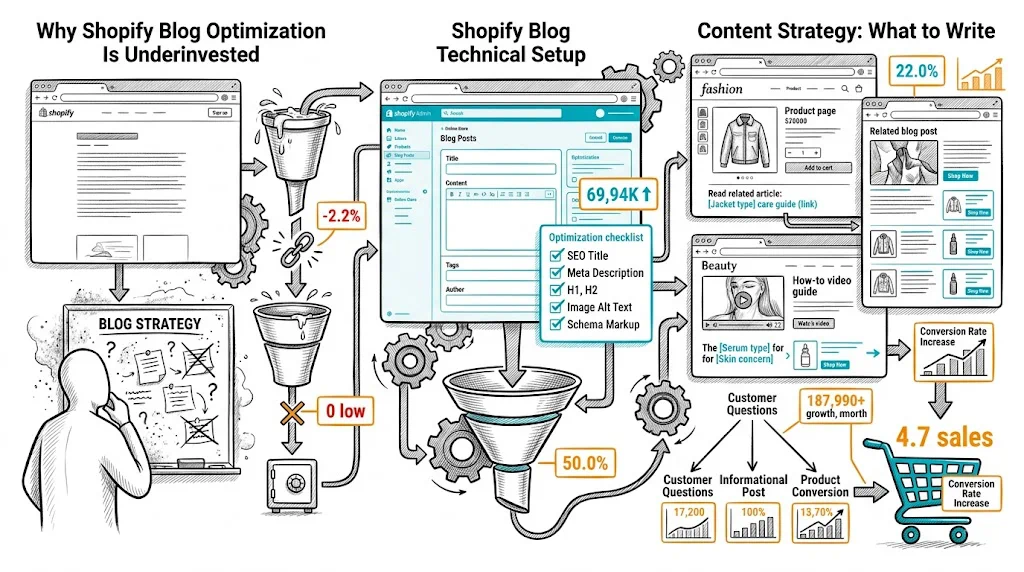
A Shopify blog, when properly optimized, functions as the top-of-funnel traffic engine and a conversion tool simultaneously — drawing in customers researching your product category through informational search, then converting them with contextual product recommendations and trust-building content. Indian D2C brands like Mamaearth and Plum have built significant organic traffic moats through consistent, well-optimized blogs that answer the specific questions their customers ask before buying skincare or wellness products. This guide covers every element of blog optimization for traffic and conversions on Shopify.
Most Indian D2C brands treat their blog as an afterthought — publishing occasional brand updates or promotional announcements that rank for nothing and convert nobody. The opportunity cost is significant:
Informational keyword traffic converts. A visitor searching "how to use vitamin C serum with niacinamide" is 5–7 days away from making a purchase decision. Converting this visitor to an email subscriber or direct purchase is far cheaper than acquiring them via Meta ads.
Blog content compounds. A well-optimized blog post published in January continues driving traffic in December — unlike paid ads that stop the moment you stop paying.
Blog builds topical authority. Google's E-E-A-T (Experience, Expertise, Authoritativeness, Trustworthiness) evaluations reward brands that demonstrate deep domain expertise through comprehensive content coverage of a topic area.
Before optimizing content, ensure the technical setup is correct.
Shopify's blog URLs default to /blogs/news/post-slug. You can rename the blog section to something more descriptive:
/blogs/skincare-guide/post-slug/blogs/wellness/post-slugDo this before publishing any posts — changing later requires redirects.
Add the blog to your site navigation. Hidden blogs don't receive internal link equity and are rarely discovered organically. A "Journal," "Learn," or "Blog" link in the primary or footer navigation is sufficient.
Shopify's blog list page (/blogs/news) paginates as you add more posts. Ensure Google can crawl paginated pages — they should not be blocked in robots.txt.
Shopify's default author display is minimal. For E-E-A-T signals, consider creating a landing page for each author with bio, credentials, and expertise — then link author names in blog posts to these pages. Google uses author credibility as an expertise signal for YMYL (health/wellness) content.
The blog content strategy for Indian D2C brands should cover three content types:
Target keywords: "what does niacinamide do," "vitamin C serum benefits," "retinol for Indian skin"
These posts rank for high-intent informational queries and naturally lead to product recommendations. Structure:
Word count target: 1,200–2,000 words. These posts compete with authoritative skincare sites — thin content won't rank.
Target keywords: "best routine for oily skin India," "how to reduce hyperpigmentation," "hair fall solution for Indian women"
These address the specific concerns your customers search before deciding what products to buy. Higher conversion intent than pure ingredient education.
Target keywords: "niacinamide vs vitamin C," "cleanser vs face wash difference," "retinol vs bakuchiol"
Visitors searching comparison keywords are close to purchase. These posts have lower traffic volume than educational content but higher conversion rates (3–5% vs 1–2%).
Target keywords: "best skincare for Indian skin," "haircare routine for humid climate," "winter skincare routine North India"
These posts rank where global skincare content fails — the specific Indian context. Brands like mCaffeine and Plum built early organic traction by addressing Indian skin and climate specifically, which global brands don't.
155 characters. Include primary keyword, a key benefit, and a mild call-to-action: "Complete guide to vitamin C serum for Indian skin — benefits, how to use safely, and the best options for every budget."
Never use bold text as a substitute for heading tags — it's invisible to search engines.
Every blog post needs 3–5 internal links:
To products/collections: Contextual product links ("...our Vitamin C Serum contains 15% ascorbic acid..."). These drive direct conversion from reading to purchasing.
To other blog posts: Link to related educational content to increase time on site and build topical authority clustering.
To pillar pages or guides: Link to your comprehensive category guides.
Anchor text: Use descriptive anchor text that includes keywords ("our vitamin C serum" not "click here"). Both better for SEO and clearer for users.
A high-quality, original image related to the post topic. For Indian D2C:
Add Article schema (Shopify apps like SEO Manager handle this) to qualify blog posts for Google's rich results — date, author, article type, and estimated read time in search results improve click-through rates.
Getting traffic to a blog post is half the work. Converting readers to customers requires specific on-page conversion elements.
Natural product mentions with links are the primary conversion mechanism. Don't place them in the first 200 words (too promotional before value is established) or only at the end (most readers don't reach the bottom of long posts). Place the primary product recommendation at 40–60% scroll depth.
A content upgrade (a related checklist, PDF routine guide, or calculator) offered in exchange for email converts 3–5% of blog readers into email subscribers. These subscribers convert to first purchase at 15–25% over the following 90 days via email flows.
End each post with a "Products mentioned in this post" or "Shop this routine" section — a product carousel with your recommended items. Many Indian D2C blogs skip this; it's a direct conversion opportunity.
CustomFit.ai enables showing different CTAs to different reader segments within blog posts:
Blog CTA personalization lifts conversion from organic blog traffic by 15–25% without changing the post content itself.
Track separately from product page metrics:
yourbrand.com/blogs/ not blog.yourbrand.com. Subdomains don't share link equity with the main domain.Related reading: Shopify SEO Checklist | Shopify Store Architecture SEO CRO | Shopify Collection Page Optimization | Conversion Rate | Bounce Rate | A/B Testing