From the conversion glossary
Concepts referenced in this article, defined.
Concepts referenced in this article, defined.
Run rigorous A/B tests and personalize every visit on Shopify or any storefront — no engineers required.
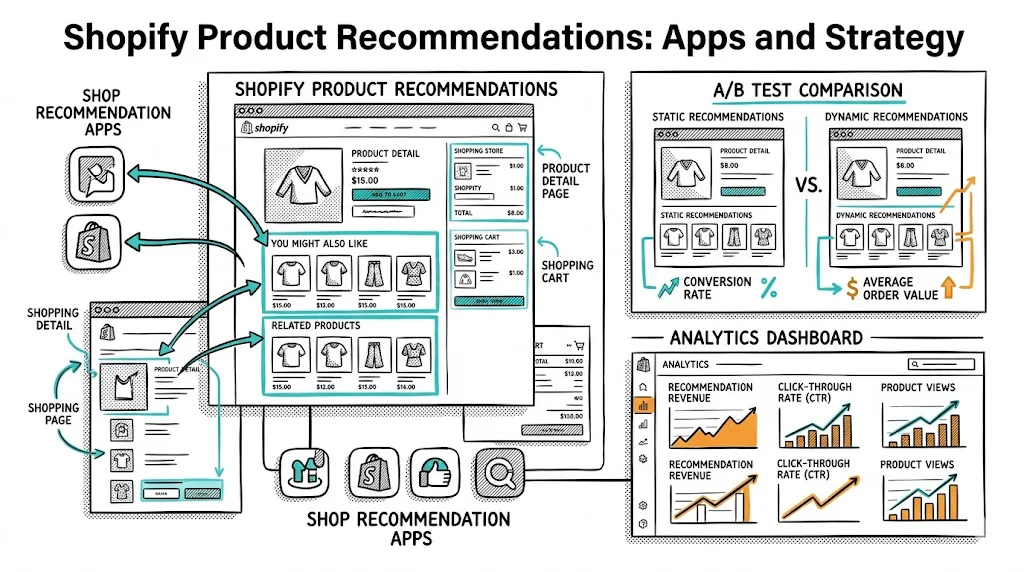
Shopify's native product recommendations are a starting point, not a strategy. The default "frequently bought together" algorithm shows the same products to every visitor regardless of who they are, where they came from, or what they've purchased before. Brands that go beyond default recommendations — testing placement, algorithm type, copy, and audience segmentation — consistently find meaningful lifts in both AOV and overall revenue. This guide covers how to do this right.
Default Shopify recommendations fail for three reasons:
1. Lack of context: "Customers also bought" is not a compelling reason to add a product. "Complete your morning skincare routine" is.
2. Algorithmic mismatches: Shopify's algorithm optimizes for what's frequently purchased together across all buyers. But what the average buyer purchases with your bestselling moisturizer may not be what your current visitor needs.
3. Poor placement timing: Showing recommendations immediately on the product page (before the buyer has decided they want the primary product) puts the cart before the horse. The right time to recommend is after the primary purchase decision is made.
Products that complement what the buyer is currently viewing or purchasing. Best served after purchase intent is established.
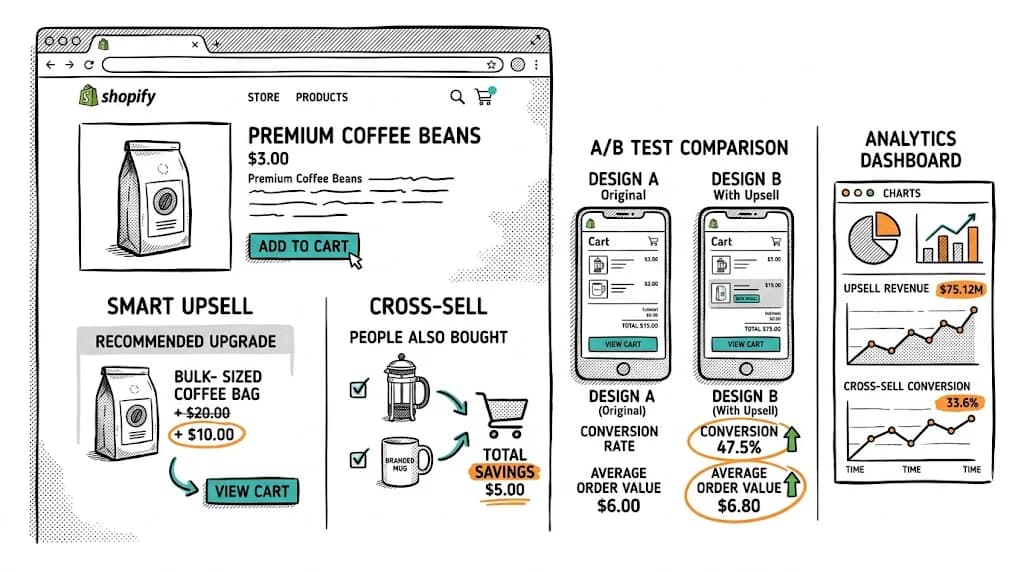
Cross-sells increase AOV by expanding the purchase to include complementary items.
A premium version of the product the buyer is considering. Best served on the product page itself, before the buyer commits.
Upsells increase AOV by shifting the buyer to a higher-value option.
Products that are commonly purchased in the same order. Shopify's native algorithm handles this — but you can manually curate these sets for products where the algorithm underperforms.
Bundle presentation ("Buy together and save ₹200") is more compelling than separate recommendation blocks.
A functional navigation aid — shows buyers what they've already looked at, helping them return to products they were considering. Useful for stores with large catalogs.
"More from [collection]" shows products in the same category. Low relevance (the buyer already saw the collection) but useful as a fallback when other recommendation types aren't available.
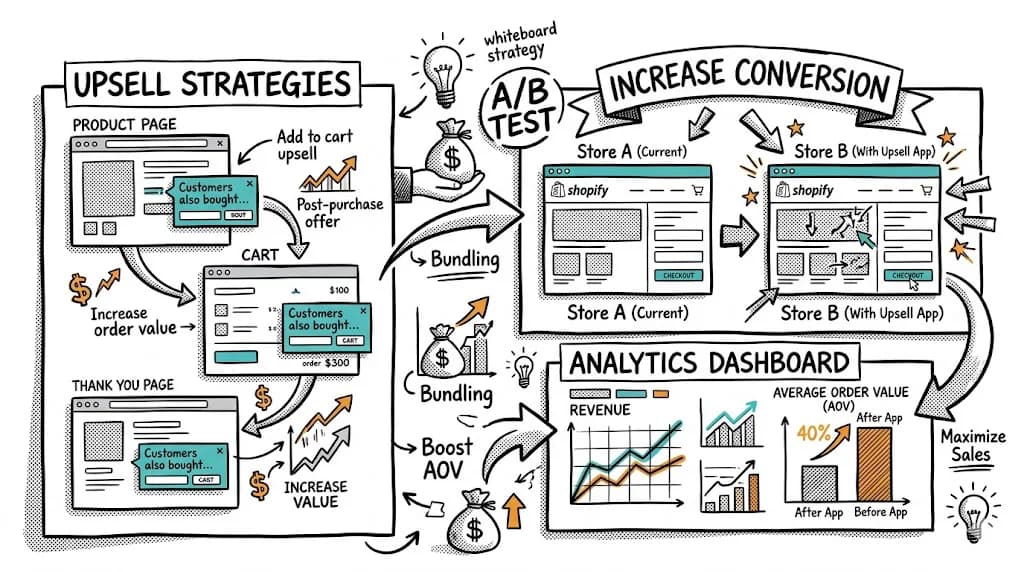
Placement timing relative to purchase decision dramatically affects recommendation performance.
Use case: Upsells — show a premium version or larger size before the buyer commits to the standard option.
Works when: The buyer is still deciding which version to buy.
Doesn't work when: Used for cross-sells — the buyer hasn't committed to the primary product yet and cross-sells at this stage create distraction.
Use case: Cross-sells — show complementary products after the buyer has added the primary item.
Implementation: Some themes show a cart drawer after add-to-cart. Include cross-sell recommendations in the cart drawer at this moment.
Conversion note: This is typically the highest-converting cross-sell placement. The buyer is in "purchasing mode" having just made a decision.
Use case: Last-chance cross-sells before checkout.
Works when: The recommendation is genuine, low-friction (small add, clear value), and relevant to cart contents.
Caution: Too many recommendations in the cart create noise and can reduce checkout initiation. Limit to 2–3 highly relevant recommendations maximum.
Use case: The buyer just completed a purchase — they're in peak trust and buying mode. Show a complementary product with a "Add to your order" CTA (using Shopify's post-purchase extension, no additional checkout required on Plus).
Expected impact: 10–18% add-on purchase rate for well-selected, relevant recommendations.
For fashion, home decor, and lifestyle brands, a curated "Complete the set" section on the product page — showing a styled, cohesive bundle — converts better than algorithmic "you might also like" blocks.
Does the recommendation block perform better above vs below the fold? In the cart drawer vs cart page? After add-to-cart vs before?
Run A/B tests with identical recommendation content but different placement. Most brands find post-add-to-cart (cart drawer) significantly outperforms pre-add-to-cart (product page below content).
Test Shopify's algorithmic recommendations against manually curated product sets:
Many brands find manual curation outperforms algorithms for niche categories or newer stores with limited purchase data.
Test presenting recommendations as:
Bundle framing typically outperforms individual product lists for AOV because it reduces decision fatigue.
More recommendations ≠ more revenue. Test:
For most categories, 2–4 recommendations performs better than 6+. Too many choices causes decision paralysis.
Default Shopify recommendations are not personalized — they show the same products to every visitor. CustomFit.ai enables audience-segmented recommendations:
This segmentation typically lifts recommendation click rates by 20–40% compared to non-personalized defaults.
Related reading: Shopify Collection Page A/B Testing | A/B Testing Shopify Cart | Shopify CRO Pillar