From the conversion glossary
Concepts referenced in this article, defined.
Concepts referenced in this article, defined.
Run rigorous A/B tests and personalize every visit on Shopify or any storefront — no engineers required.
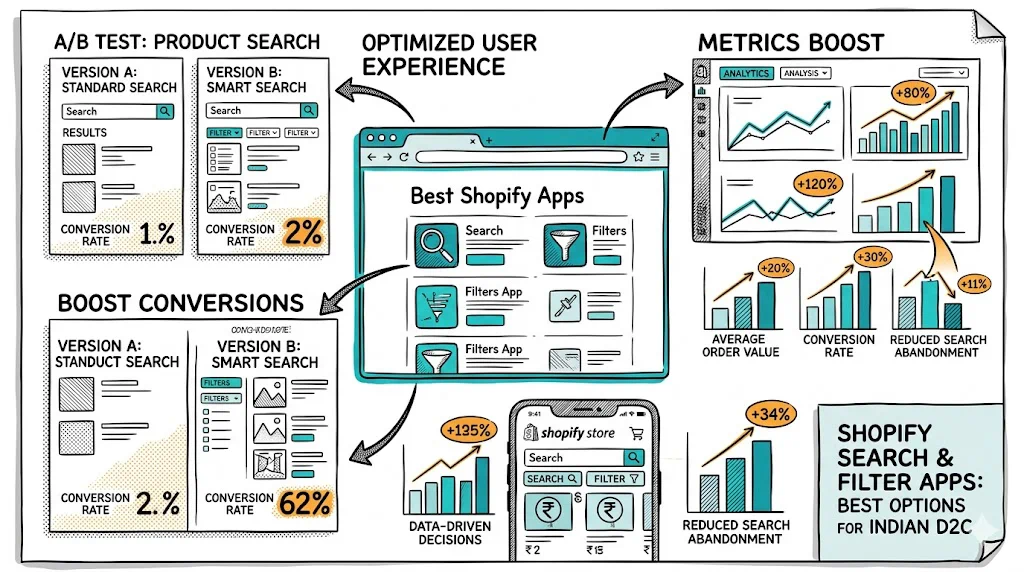
Shopify's built-in search and filtering tools are functional but limited — they miss typos, don't handle synonyms, and offer rigid faceted filtering that can't handle complex product attributes like skin concern, dietary preference, or occasion. For Indian D2C brands with growing catalogs (50+ SKUs), search and filter apps are among the highest-ROI investments available because customers who use search convert at 2–3x the rate of those who browse. This guide compares the best options and explains how to configure them for Indian market specifics.
Indian customers searching on D2C stores face several challenges that Shopify's native search doesn't address:
Language variation: A customer might search "moisturiser" (British spelling), "moisturizer" (American), or "face cream" or "day cream" — all for the same product category. Native Shopify search treats these as different queries and may return no results for variant spellings.
Ingredient-based searching: Personal care customers increasingly search by active ingredient ("niacinamide serum", "retinol cream", "vitamin B5 moisturiser"). Native search needs exact title matches; ingredient tags require separate search indexing.
Voice search phrasing: As voice search grows on Indian mobile, queries become conversational: "best serum for oily skin India" or "face wash for acne prone skin." These long natural language queries need semantic search to handle correctly.
Transliteration: Hindi product names searched in English transliteration ("ubtan face wash" vs "उबटन face wash") require phonetic matching that native search doesn't provide.
The business impact: stores with 15–20% "no results" search rates are losing a significant chunk of high-intent visitors before they ever reach a product page.
Before comparing apps, the evaluation criteria:
Best for: Brands with large catalogs and complex filter requirements
What it does well: Boost Commerce is a comprehensive search and filter solution. Its filter builder supports any product tag, metafield, or variant — enabling filters like "skin type," "concern," or "dietary restriction" that native Shopify collections can't provide.
Key features:
Pricing: From $19/month (up to 5,000 products); $29/month (up to 10,000); enterprise tiers available
Speed impact: ~70–90KB on collection pages
Strengths for India:
Weaknesses: The setup requires more time investment than simpler apps. Full synonym configuration for an Indian catalog takes several hours to do properly.
Best for: Mid-size stores wanting AI-powered search without complex configuration
What it does well: Searchie uses AI to understand query intent rather than requiring manual synonym setup. The AI model learns from search behavior — if customers search "glow face wash" and click on the "brightening foam cleanser," Searchie associates these terms automatically.
Key features:
Pricing: From $14/month; scales with catalog size
Speed impact: ~50–65KB
Strengths for India:
Weaknesses: Less control over merchandising than Boost Commerce — if you need to pin specific products to specific searches, the manual rules are more limited.
Best for: Stores wanting fast, lightweight search improvement without complex filtering
Key features:
Pricing: Free plan available; paid from $9.99/month
Speed impact: ~35–50KB — lightest of the dedicated search apps
Strengths for India:
Weaknesses: Less powerful than Boost Commerce for complex filter taxonomies. No AI learning — relies on manual synonym configuration.
For stores under 30 SKUs with consistent, clear product naming, native Shopify search may be adequate. The criteria for staying native:
For most Indian D2C brands above 30 SKUs or in complex categories (skincare, supplements, apparel), a dedicated search app pays for itself within weeks.
Whichever app you choose, these configuration steps are essential:
Build a synonym dictionary for your category:
Set up zero-results redirects: When a search query gets zero results, redirect to a relevant collection page rather than showing an empty "no results" screen. "Face mask" with zero results should redirect to the face care collection.
Create merchandised search rules for key terms: "Best seller" → show your top 5 SKUs by revenue "Gift" → show curated gift sets "Festive" → show Diwali/Holi specific products
A/B test search result layouts: Does a 2-column grid or 3-column grid convert better? Does showing product ratings in search results improve click-through? CustomFit.ai can run these tests on collection and search result pages without developer involvement, letting you optimize the full discovery-to-purchase funnel.
Related reading: Shopify Collection Page Optimization | Shopify Store Architecture | Shopify CRO Audit | Bounce Rate | Conversion Rate | User Experience