From the conversion glossary
Concepts referenced in this article, defined.
A/B testing compares two page versions; multivariate testing tests multiple elements simultaneously. Learn when to use each for your ecommerce store.
Concepts referenced in this article, defined.
 ab testing
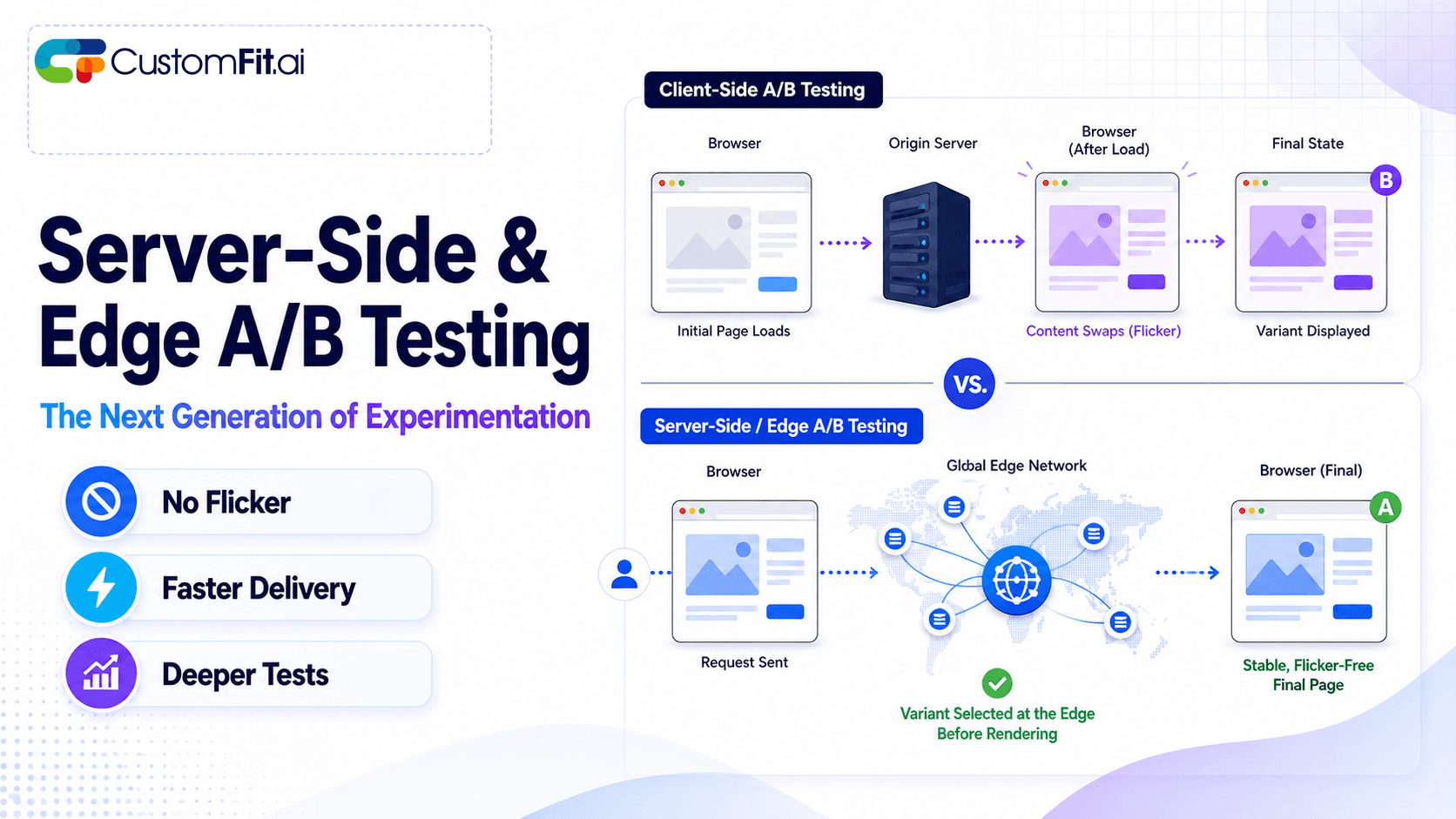
Server-side A/B testing and edge experimentation explained - how they eliminate flicker, improve speed, and where they fit vs client-side testing.
 ab testing
How to run cookieless A/B testing correctly in 2026 - first-party data, GDPR compliant methods, and what actually changed with third-party cookies.
 ab testing
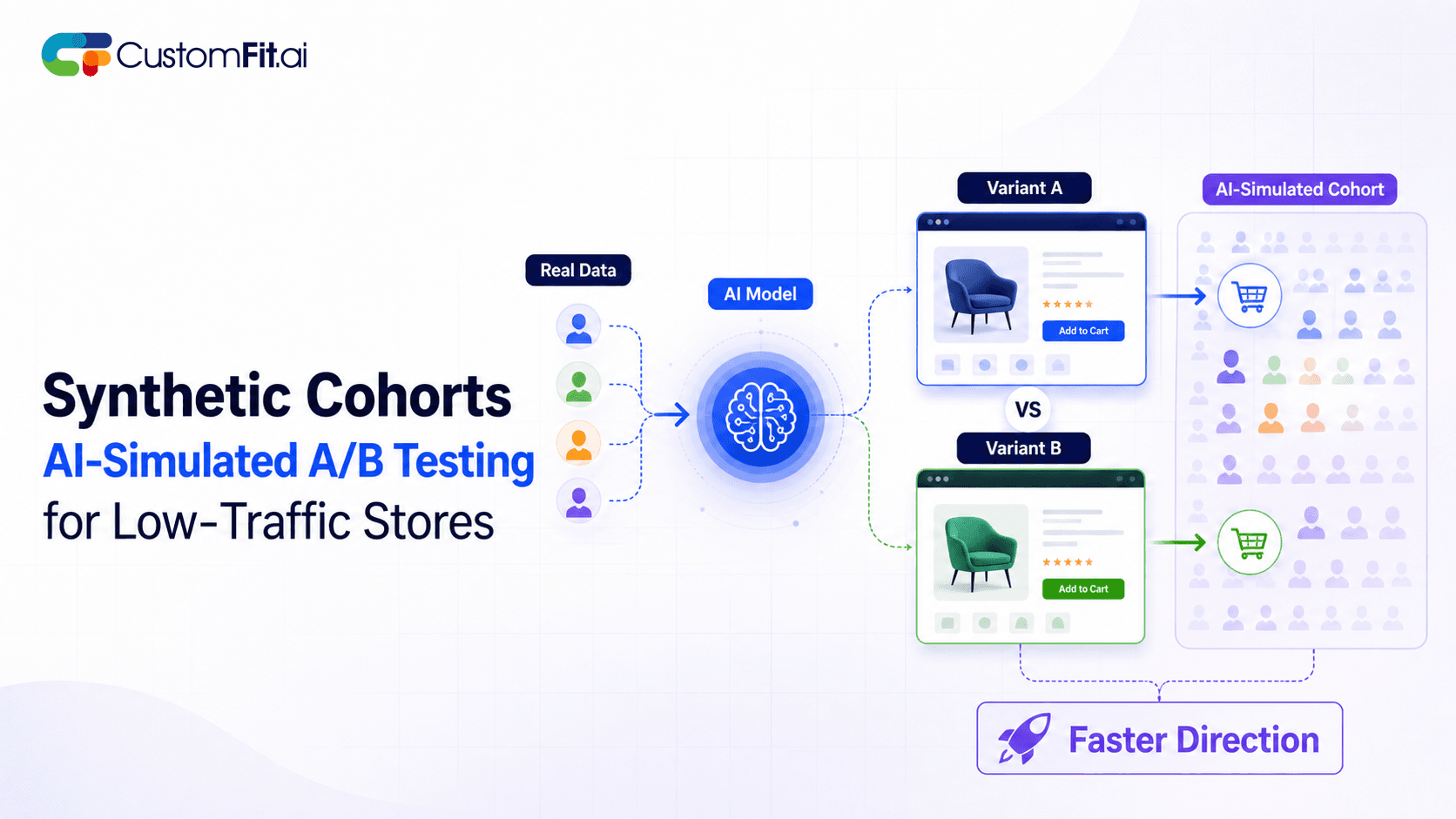
Not enough traffic to A/B test properly? Here's how synthetic cohort testing and AI-simulated experimentation help low-traffic stores test with confidence.
Run rigorous A/B tests and personalize every visit on Shopify or any storefront — no engineers required.
A/B testing compares two versions of a single page element to find which performs better. Multivariate testing (MVT) simultaneously tests multiple elements and every combination of their variations. For most Indian D2C brands, the practical difference comes down to this: A/B testing is faster, needs far less traffic, and gives you clear answers. Multivariate testing does more, but it demands traffic volumes that most ecommerce stores simply don't have.
If you're running a Shopify store doing under ₹5 crore a month, A/B testing is almost certainly the right tool. The sections below explain why, and when MVT actually makes sense.
A/B testing (also called split testing) divides your website traffic between two versions of a page and measures which version drives more conversions. Version A is your control group, the existing page. Version B is your variant, the page with a single change made to it.
The test runs until both versions collect enough data to reach statistical significance, typically a 95% confidence level. At that point you can say with confidence that one version genuinely outperforms the other, rather than the difference being random noise.
The core entities in any A/B test:
A/B testing is clean and interpretable precisely because you change one thing at a time. You always know what caused the improvement.
Multivariate testing (MVT) tests multiple page elements at once. Instead of choosing between two versions of your headline, you test several headlines, several images, and several CTAs together, and let the algorithm find which combination performs best.
Say you're testing:
That's 2 × 2 × 2 = 8 combinations, all running at the same time. Each combination needs the same sample size as a standalone A/B test to reach statistical significance. Your traffic requirement just multiplied by 8.
MVT answers a different question than A/B testing. Rather than "does this headline work better?", it answers "what combination of headline, image, and CTA produces the best result?" It can also reveal interaction effects. For example, whether Headline A works better with Image B than with Image A, even if Headline A wins overall.
| Factor | A/B Testing | Multivariate Testing |
|---|---|---|
| Elements tested | One at a time | Multiple simultaneously |
| Variations | 2 (A and B) | 4 to 16+ combinations |
| Traffic required | Moderate (5,000 to 10,000/month per page) | Very high (50,000 to 100,000+/month per page) |
| Test duration | 2 to 4 weeks typically | 4 to 12 weeks typically |
| Complexity | Low | High |
| Actionability | Clear (one variable changed) | Complex to interpret |
| Reveals interactions | No | Yes |
| Best for | Most ecommerce stores | Large-traffic portals |
| Setup difficulty | Easy | Requires CRO expertise |
The headline stat: multivariate testing needs 5 to 10x more traffic than an equivalent A/B test. This is not a minor difference. It's the single most important factor in your decision.
A/B testing is the right tool in the vast majority of ecommerce scenarios. Use it when:
You have a clear hypothesis about one element. You've reviewed your heatmaps and session recordings and noticed users aren't clicking your main CTA. You believe changing the button copy from "Shop Now" to "Get Yours Today" will improve clicks. That's a clean, testable hypothesis. Run an A/B test.
You're under 500K monthly visitors. Most Indian D2C brands on Shopify, even successful ones doing ₹2 to 10 crore a month, simply don't have enough per-page traffic for MVT to reach significance in a reasonable time.
You need fast results. A/B tests on high-traffic pages can reach significance in 2 to 3 weeks. MVT on the same page might take 2 to 3 months. Shipping cycles, seasonal campaigns, and investor reviews don't wait.
You're iterating from a baseline. Early-stage optimization is about finding big wins, the 20 to 40% improvements that come from fixing obvious friction. A/B testing is built for this. MVT is for later-stage fine-tuning.
Real D2C examples where A/B testing is the obvious choice:
These are focused, single-variable tests. A/B testing handles all of them cleanly.
MVT has a genuine use case. It isn't just a more complicated version of A/B testing. Consider MVT when:
You have very high, consistent traffic. If a specific product category page or landing page receives 10,000+ unique daily visitors, you have enough volume to run MVT in a reasonable time. Marketplaces like Nykaa, Myntra, or large D2C players like Mamaearth have this volume. Most others don't.
You suspect interaction effects matter. If you believe certain headline and image combinations work differently than either element alone, MVT is the only way to measure that. "Does our founder's face in the hero image work better with an emotional headline or a feature-driven one?" MVT can answer that.
You have a mature optimization program. If you've already run 50+ A/B tests and squeezed most single-element gains, MVT is a way to find combination effects that individual tests can't surface.
You have dedicated CRO expertise. MVT results are harder to interpret. Interaction effect analysis requires statistical literacy. Without someone who can read the data correctly, you risk making decisions based on misleading results.
Be honest with yourself: most Indian ecommerce brands, including well-funded D2C startups, are better served running 12 focused A/B tests per year than one multivariate test that takes 3 months and may not reach significance.
This is where A/B testing vs. multivariate testing becomes a practical, numbers-based decision.
For a standard A/B test to detect a 5% improvement in conversion rate at 95% confidence:
| Baseline CVR | Required visitors per variant | Total visitors needed |
|---|---|---|
| 1% | ~7,800 | ~15,600 |
| 2% | ~3,900 | ~7,800 |
| 3% | ~2,600 | ~5,200 |
| 5% | ~1,500 | ~3,000 |
Now apply those requirements to multivariate testing. A test with 3 elements, 2 variations each = 8 combinations. Using the 2% baseline example:
If that page gets 3,000 visitors a month, your A/B test runs in about 2.5 months. Your MVT test runs in over 20 months, by which time your business has changed entirely.
The rule of thumb: if your target page gets under 10,000 visitors per day, default to A/B testing. It will give you cleaner, faster, more actionable results.
Use A/B testing. Full stop.
At this traffic level, even a well-configured A/B test needs 3 to 6 weeks to reach significance on many pages. Multivariate testing is not feasible. Your priority should be building a systematic A/B testing program: running 1 to 2 tests per month on your highest-traffic pages (typically home page, product listing page, product detail page, and checkout).
Focus on high-impact single elements: headline copy, hero imagery, CTA text, price display, trust signals, and shipping thresholds. These individual wins compound quickly. Brands using CustomFit.ai have achieved 9 to 11% CVR lifts within months of building this kind of cadence.
Consider MVT selectively, for specific high-traffic pages.
Even at 500K monthly visitors, that traffic isn't uniformly distributed. Your homepage may get 200K visits while your category pages get 50K each. Identify the 2 to 3 pages with the highest sustained traffic and consider whether interaction effects are likely enough to justify the longer test duration.
The practical approach for large-scale D2C brands: run A/B tests as your default, and deploy MVT only on pages where you have a specific hypothesis about element interactions and enough traffic to get results within 6 weeks.
The decision tree is simple:
The biggest mistake in CRO is choosing a testing method based on ambition rather than traffic reality. Multivariate testing sounds more sophisticated, but an A/B testing program that runs 24 focused tests a year will outperform an MVT program that completes 2 inconclusive tests in the same period.
Start with the test you can finish.
Related reading:
Start A/B Testing Your Store Today
1,000+ D2C brands use CustomFit.ai to run A/B tests, without code and without developer tickets.
14-day free trial · No credit card required · Setup in under 30 minutes.