From the conversion glossary
Concepts referenced in this article, defined.
Concepts referenced in this article, defined.
 cro
croPre-order waitlist CRO strategies that convert hype into real revenue - how to design waitlist and pre-order pages that don't lose momentum before launch.
 cro
croFirst purchase experience optimization - practical strategies to turn first-time visitors into buyers, from welcome offers to a smarter new customer funnel.
 cro
croRetail media CRO explained - how to monetize on-site ads and sponsored placements without tanking your conversion rate. A practical balance guide.
Run rigorous A/B tests and personalize every visit on Shopify or any storefront — no engineers required.
A failed A/B test is a data point, not a setback. Every test that loses or comes back inconclusive contains information that makes your next test better. The brands with the highest win rates have run the most failed tests and learned from each one. Here's how to turn a losing test into a useful hypothesis.
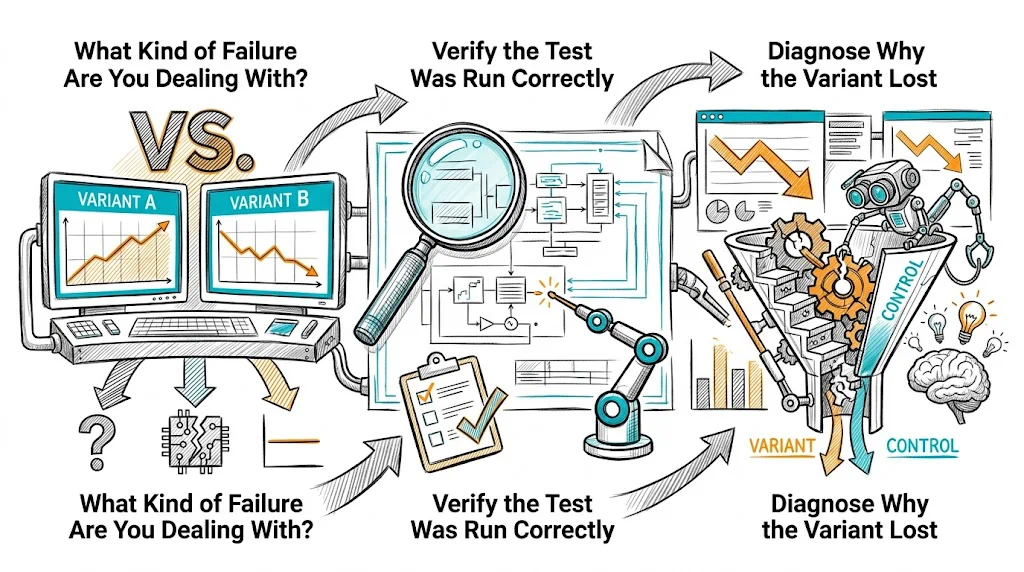
Not all A/B test failures are the same. Diagnosing the type of failure determines what you do next.
Your challenger version performed worse than the original. Clear loser. Keep the control.
This is useful failure. It tells you what doesn't work, and your job is to understand why.
After running for the required duration with sufficient traffic, neither variant reached 95% confidence. The difference observed could be random.
This happens when the effect size is smaller than your test was powered to detect, or when the hypothesis was weak and the change you tested didn't matter enough to users to show up in the data.
The test ran but had problems: sample contamination, JavaScript errors, redirect loops, cookie tracking issues, or early termination from peeking.
Technical failures give you no real data about user behavior. Fix the issue and re-run.
Before drawing any conclusions from a failed test, check these:
Sample size: Did you reach your pre-calculated minimum sample size? If you ended the test early because one variant looked better or worse, the result may not be reliable.
Duration: Did the test run for at least 2 full business weeks? Tests shorter than this can be skewed by day-of-week behavioral patterns.
Traffic distribution: Were variants receiving equal traffic (50/50)? Check your testing tool's QA report.
No novelty effect: Did the variant show an initial spike that then normalized? The novelty effect, where users click on something because it's new, can inflate early variant performance.
No external events: Was there a major sale, PR mention, or traffic surge during the test that could have affected results? A Diwali sale in the middle of your test period will skew your data.
If any of these checks flag a problem, the test result is unreliable. Don't draw hypotheses from bad data.
See also: A/B Testing glossary | Conversion Rate Optimization glossary | Statistical Significance glossary
If the test was technically sound but the variant lost, work through these questions:
Was the hypothesis specific enough? "A bigger button will improve CVR" is weak. "Making the Add to Cart button sticky on mobile will increase conversions for visitors who scroll below the fold before deciding" is strong. Vague hypotheses produce inconclusive results.
Was the change visible enough? Sometimes a variant change is so subtle that users don't notice it. If you moved a trust badge from the footer to below the CTA but most users converted from above the fold and never saw either position, the test can't show a difference.
Did the change address a real user concern? The best A/B tests fix something users are actually confused or concerned about. If your test was based on "this looks better to us" rather than "users told us X is unclear," it's unlikely to win.
Was the variant actually worse for a specific segment? Check test results by device (mobile vs. desktop), by traffic source, and by new vs. returning visitors. A losing variant overall may have won for a specific segment, which points to a more targeted hypothesis.
Did the variant introduce new friction? Sometimes a variant improves one thing but accidentally breaks another. A checkout redesign that makes payment easier might increase payment errors if input field types change. Check the full funnel, not just your primary metric.
Every A/B test, win or loss, should produce a documented learning. Record:
What you tested: The exact change(s) made in the variant What you expected: Your hypothesis and why you believed it What happened: The result (CVR change, significance level, duration, sample size) Why you think it happened: Your best interpretation of why the variant lost What to test next: The follow-up hypothesis this result suggests
A documented losing test is worth as much as a documented win over time. The brands with the best CRO programs treat every test outcome as institutional knowledge, not something to file away and forget.
See also: Bounce Rate glossary | Session Recording glossary | User Behavior glossary
A failed test points toward a better next test. Here are common failure patterns and their follow-up strategies:
Variant lost + hypothesis was about copy: Run user surveys or 5-second tests to check whether the copy change was even noticed. Then test a more dramatic copy change grounded in user language.
Inconclusive + small effect size: Either the change doesn't matter to users, or the effect is too small for your traffic level to detect. Try a bigger change. Don't test a slightly different headline; test a completely different value proposition.
Lost on desktop but unknown on mobile: Run a mobile-only variant of the test. Mobile and desktop users have different needs. A lost desktop test may win on mobile with the same change.
Lost because of friction introduction: Redesign the variant to preserve the goal while removing the new friction. If a popup trust overlay increased abandonment, test an inline trust section instead.
Inconclusive because segment was too broad: Run the test for a specific segment, such as only first-time visitors from paid social or only users who have viewed more than 3 products. Narrower segments often show cleaner signals.
Don't peek early and conclude it's failing. Stopping a test early because it looks like it's losing is called "peeking" and produces unreliable results. Set your test duration before you start and respect it.
Don't throw away the variant data without checking segments. A global loser can be a winner for a specific audience segment. Always run a segment breakdown before closing a test.
Don't stop testing because of a losing streak. Three failed tests in a row is discouraging but statistically normal. A 30% win rate is good, meaning most tests should fail. The discipline is to keep testing while improving hypotheses.
Don't change the test parameters mid-run. If a test isn't going the way you expected, don't change the sample size, end date, or traffic allocation. Let it run to its conclusion.
Don't ship a losing variant. Occasionally, teams ship a losing variant because "it looks better" or "leadership prefers it." This discards your test data. Keep the control until you have a winning variant.
High-performing CRO programs have a structured process for handling test failures:
This loop means no test ever truly ends; it feeds into the next iteration. After 50 tests, your hypothesis quality will be much higher than after 5 tests, precisely because you've learned from so many failures.
A wellness D2C brand tests moving their "COD Available" badge from below the buy button to above it on the product page. The test runs for 3 weeks with 15,000 visitors per variant. Result: inconclusive (0.3% CVR improvement, 72% confidence).
What they learned: The position of the badge didn't matter, or the badge itself wasn't the right signal for their audience. A follow-up survey revealed that many users didn't understand what "COD" meant as an abbreviation (they knew "Cash on Delivery" from usage but the short form was unclear).
Follow-up test: Replaced "COD Available" badge with "Pay when delivered, Cash on Delivery" with a small truck icon. Result: 8% CVR improvement at 96% confidence.
The failed test led directly to the winner by teaching them it was a clarity problem, not a position problem.