From the conversion glossary
Concepts referenced in this article, defined.
Concepts referenced in this article, defined.
 cro
croPre-order waitlist CRO strategies that convert hype into real revenue - how to design waitlist and pre-order pages that don't lose momentum before launch.
 cro
croFirst purchase experience optimization - practical strategies to turn first-time visitors into buyers, from welcome offers to a smarter new customer funnel.
 cro
croRetail media CRO explained - how to monetize on-site ads and sponsored placements without tanking your conversion rate. A practical balance guide.
Run rigorous A/B tests and personalize every visit on Shopify or any storefront — no engineers required.
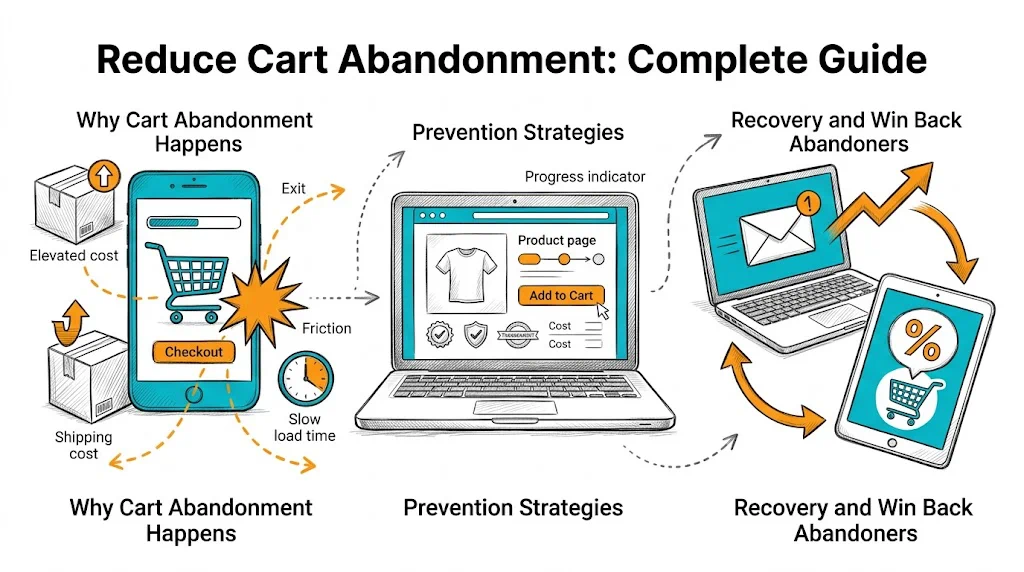
Cart abandonment rate averages 70–75% globally — meaning 7 out of every 10 shoppers who want to buy from you, don't. For Indian D2C brands spending ₹50K/mo or more on ads, that's a massive revenue leak that's happening downstream of your marketing investment. Reducing cart abandonment is one of the highest-ROI CRO activities because it targets the most qualified visitors — people who have already chosen a product and begun the purchase process. This guide covers both prevention (reducing abandonment before it happens) and recovery (winning back abandoners after they've left).
Before building solutions, understand the root causes. Baymard Institute's research identifies the top reasons:
| Reason | % Citing This |
|---|---|
| Extra costs too high (shipping, taxes) | 48% |
| Required to create account | 24% |
| Delivery too slow | 22% |
| Payment security concerns | 18% |
| Complex/lengthy checkout | 17% |
| Couldn't see/calculate total upfront | 16% |
| Website had errors | 12% |
| Return policy unsatisfactory | 11% |
| Not enough payment options | 9% |
| Credit card declined | 6% |
India-specific additions:
The most common abandonment trigger is discovering unexpected shipping costs at checkout. Prevent this by:
A/B test idea: Control = shipping cost revealed at checkout step 2. Variant = "Estimated shipping: ₹49" shown on cart page. Measure checkout start rate.
Requiring visitors to create an account before purchasing is the second-biggest abandonment driver. Fix:
For Indian D2C brands, uncertainty about payment options is a major abandonment trigger. Shoppers who prefer COD or UPI will abandon if they don't know these options are available until the final checkout step.
Fix:
"5–7 business days" is anxiety-inducing. "Estimated delivery: Thursday, March 27" is reassuring. Specific delivery dates reduce uncertainty-driven abandonment.
Implementation:
Count your required fields. Every additional required field beyond the minimum increases abandonment by 5–8%.
Target minimum fields: Name, email, phone, address line 1, city, state, pincode, payment.
Quick wins:
The checkout page is where trust concerns crystallize. Add trust signals at the top of checkout:
A visible coupon code field sends 10–15% of visitors to Google to search "Brand name discount code" — most don't return. Collapse it:
When a user shows exit intent (moving cursor to close the browser on desktop, or after 3+ minutes of inactivity on mobile), show a targeted message:
CustomFit.ai can trigger these overlays based on exit intent and page location without developer work.
The most effective cart recovery channel. Send the first email within 1 hour of abandonment:
Email 1 (within 1 hour): Simple reminder
Email 2 (24 hours): Add trust signals
Email 3 (72 hours): Offer if needed
Expected recovery rate: 5–15% of abandoned carts complete purchase via email recovery.
WhatsApp open rates in India reach 85–95% — far higher than email (25–45%). For Indian D2C brands, WhatsApp cart recovery is often the highest-ROI recovery channel.
Setup:
Brands like Mamaearth and The Man Company report WhatsApp recovery rates of 8–20%.
Facebook/Instagram retargeting ads showing the exact abandoned product, with social proof (review quote, customer count), re-engage abandoners who don't respond to email.
Retargeting sequence:
SMS has high open rates but feels intrusive if overused. Use one SMS 2–3 hours after abandonment for high-value cart abandonment only (above ₹1,500). Keep it short: "Hi [Name], your cart at [Brand] is waiting. Complete your order: [link]"
In Shopify Analytics:
For more granular data, use Shopify's "Checkout abandonment" report to see at which step abandonment happens most.
Don't assume your recovery flow is optimized. Test:
| Recovery Channel | Typical Recovery Rate |
|---|---|
| Email (3-step sequence) | 5–15% |
| WhatsApp (India) | 8–20% |
| SMS | 3–8% |
| Retargeting ads | 2–5% |
| Exit-intent popup | 3–10% |
| All combined | 12–30% |
Week 1–2 (Prevention):
Week 3–4 (Recovery Setup):
Month 2 (Testing):
Month 3 (Optimization):