From the conversion glossary
Concepts referenced in this article, defined.
Concepts referenced in this article, defined.
 cro
croPre-order waitlist CRO strategies that convert hype into real revenue - how to design waitlist and pre-order pages that don't lose momentum before launch.
 cro
croFirst purchase experience optimization - practical strategies to turn first-time visitors into buyers, from welcome offers to a smarter new customer funnel.
 cro
croRetail media CRO explained - how to monetize on-site ads and sponsored placements without tanking your conversion rate. A practical balance guide.
Run rigorous A/B tests and personalize every visit on Shopify or any storefront — no engineers required.
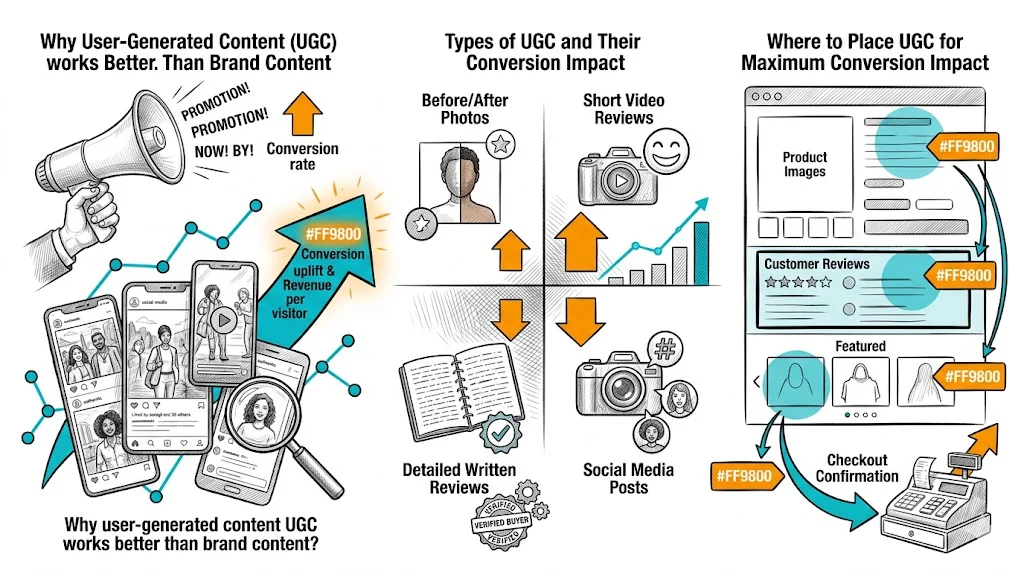
User-generated content (UGC) converts better than professional marketing content because it answers the question every buyer has: "Does this actually work for people like me?" A before/after photo from a customer with similar skin tone, a short video review from someone with the same fitness goals, or a detailed written review from a verified buyer in Mumbai — these create proof that no professional photography or copywriting can replicate. Brands that systematically collect, place, and test UGC on their product pages consistently outperform those that rely entirely on brand-produced content.
mCaffeine built brand trust in a crowded skincare market partly through authentic UGC. Mamaearth's early growth was driven by customer review content that built SEO traffic and on-page conversion simultaneously. This guide gives you the framework to do the same.
Authenticity signals: Professional photography is beautiful but expected. Real customer photos, even imperfect ones, signal that the product has been used and has produced results worth photographing.
Identity matching: Customers ask "will this work for me?" When they see a review from someone with their skin tone, body type, or lifestyle context, the answer becomes credible. A brand image showing an aspirational model answers a different question than a customer photo.
Specificity of proof: "I used this serum for 6 weeks, here's my before/after with uneven skin tone, and here's how it changed" is vastly more credible than "visibly reduces dark spots in 21 days" in a brand headline.
Volume of proof: 500 reviews with photos says something that 5 professional product images can't — that hundreds of real people chose this product and were satisfied enough to photograph it.
High-converting review characteristics:
Conversion impact: Reviews with these details convert at 2–3× the rate of generic positive reviews ("Great product! Highly recommend!").
How to elicit detailed reviews: Your post-purchase email/WhatsApp request matters enormously. Instead of "Rate us on a scale of 1–5," ask: "How long have you been using [product]? What specific changes have you noticed? What's your skin/hair type?"
The most powerful single UGC type for beauty, skincare, fitness, and health products.
Before/after photos: When authentic (timestamped, consistent lighting, visible results), before/after UGC photos can be the highest-converting element on a product page. Test placing them in the product gallery, not just in the review section.
Lifestyle photos: Customers photographing products in their bathroom shelf, morning routine, or daily bag. These normalize product ownership and make purchase feel familiar.
Unboxing photos: Popular in Indian beauty and D2C communities. "First impressions" content showing product quality signals value before use.
15–30 second authentic customer videos showing results or demonstrating use.
Where to display: First in the product gallery (as an autoplay loop) or as a dedicated "Customer Stories" section on the product page.
Collection method: Post-purchase WhatsApp or email request: "We'd love to see your results — share a 30-second video of [product] in your routine for 10% off your next order." Make the CTA and incentive clear.
For Indian D2C brands, Instagram and YouTube Shorts reviews from micro-influencers (10K–100K followers) function as high-quality UGC when displayed on product pages.
Embedding Instagram posts: A curated Instagram gallery on the product page showing tagged posts from customers. Brands like Plum and Pilgrim use this effectively.
Important: Always get explicit permission to use customer social content on your product pages. Tagged posts don't automatically give you display rights.
Placement test priority:
1. Product image gallery (highest impact) Moving UGC photos from the review section into the product image gallery makes them visible above the fold on many mobile layouts. Test showing UGC as the 2nd or 3rd image in the gallery.
2. Above the CTA ("Customer Results" section) A 3-image grid of before/after UGC photos just above the "Add to Cart" button. This is particularly effective for skincare and supplement brands where results skepticism is the primary purchase barrier.
3. Social proof ticker A horizontal scrolling bar with customer photos and 1-sentence reviews. Works well just below the product hero section.
4. Exit intent popup When a visitor is about to leave, showing a UGC before/after photo with a customer quote and the offer to try can recover abandoning visitors more effectively than a generic discount.
5. Homepage A "Real Customer Results" section on the homepage, featuring diverse customer photos, builds category-level trust before visitors even reach a product page.
Step 1: Post-purchase WhatsApp/email request Send a review request 7–14 days after delivery (enough time for customers to see results for skincare, supplements, and wellness products). Personalize with the product name.
Step 2: Make submission easy Provide a direct link to your review platform. For photo/video submission, create a simple form (Google Form or dedicated review platform) that doesn't require app download or account creation.
Step 3: Incentivize meaningfully For Indian consumers, the most effective incentive is product-related: "Share your results photo for ₹200 store credit toward your next order." This filters for customers who want to stay in the brand ecosystem.
Step 4: Create a branded hashtag A simple, memorable hashtag (e.g., #plumresults, #mcaffeineglow) makes it easy for customers to share and for you to find their content. Promote it in packaging inserts and post-purchase communications.
Step 5: Respond to UGC publicly Brands that respond to and acknowledge customer reviews and social posts generate more future UGC. The social signal that the brand is listening encourages others to share.
Test 1: UGC in gallery vs. not
Metric: Add-to-cart rate. Expected lift: 10–25% for beauty and health products.
Test 2: UGC placement — gallery vs. below fold
Metric: Add-to-cart rate + image gallery engagement rate.
Test 3: Review sorting — most helpful vs. most recent vs. UGC-first
Metric: Scroll depth to review section, add-to-cart rate. Reviews with photos tend to be more persuasive — surfacing them first captures more visitor attention.
Test 4: UGC in exit intent
Metric: Exit intent conversion rate, recovery rate.
Not all UGC is worth displaying. Moderate for:
Authenticity: Does the photo show a real result, or is it a filter-heavy stock image? Overly polished UGC triggers skepticism.
Diversity: Show UGC from customers representing different skin tones, body types, and contexts. A gallery of only fair-skinned customers for an "all skin types" product undermines credibility.
Relevance: Use UGC that shows the specific product and its relevant benefit. A generic "nice packaging" photo doesn't help the conversion decision the way a results photo does.
Legal permission: Always get explicit permission to use customer content on your website and in paid ads.
Request UGC 7–14 days post-purchase — for most skincare and wellness products, this is when customers first see meaningful results and are most enthusiastic.
Make the submission flow frictionless — a single-link Google Form or review platform is better than asking customers to navigate to your site, log in, and find the review section.
Feature diverse customer UGC — ensure your displayed UGC represents the skin tones, body types, and contexts of your actual customer base.
Integrate UGC into product gallery early — moving UGC photos above the fold into the product gallery is consistently one of the highest-lift placement tests.
Use WhatsApp for UGC collection — a WhatsApp template message requesting a review with a direct submission link outperforms email for response rate in Indian D2C brands.
A/B test UGC type — before/after photos vs. lifestyle photos vs. video testimonials have different impacts by category. Test which type drives the most add-to-cart for your specific products.
Repurpose winning UGC in paid ads — the UGC that increases conversion on your product page is likely to improve paid ad performance too. Test your top UGC photos as ad creatives.
Related reading: A/B Testing Social Proof | A/B Testing Images | Heatmaps for CRO | Conversion Rate Optimization | CRO Pillar Guide