From the conversion glossary
Concepts referenced in this article, defined.
Concepts referenced in this article, defined.
Run rigorous A/B tests and personalize every visit on Shopify or any storefront — no engineers required.
Home decor is one of the highest-aspiration, highest-consideration categories in Indian D2C. Buyers spend 3–7 days researching a single décor purchase, browse Instagram for room inspiration, and then hunt for the exact piece across 5–8 websites before buying. The brands that win aren't necessarily the cheapest or the most marketed — they're the ones that make the purchase decision feel easy, confident, and exciting. This guide covers the ecommerce strategies that actually move the needle for home decor D2C brands in India.
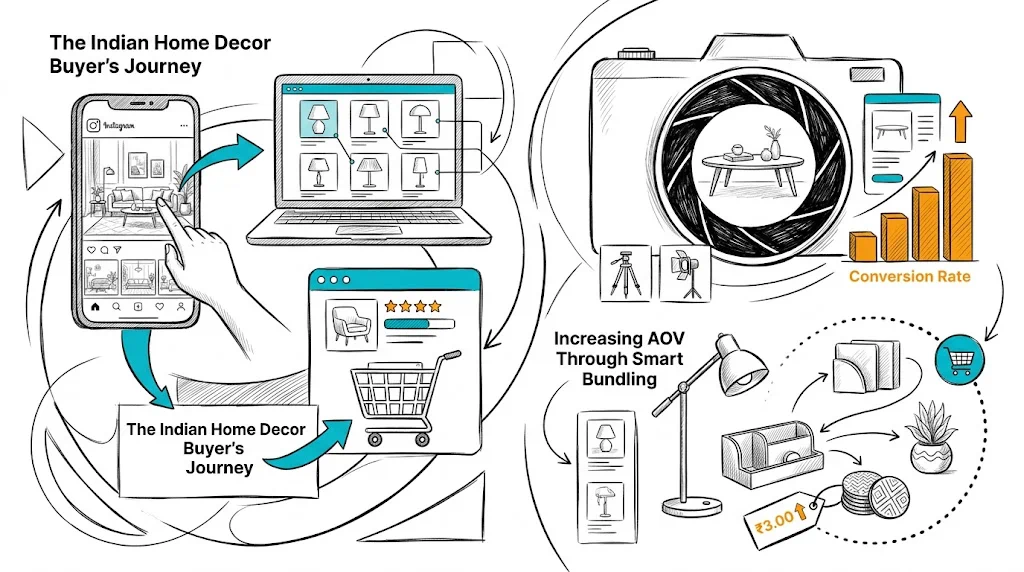
Understanding why home decor has a longer conversion cycle is the first step to optimizing for it:
Inspiration phase: Pinterest, Instagram, and YouTube home tours drive initial discovery. This is where aesthetics and brand identity matter most.
Research phase: Buyers check dimensions, materials, quality reviews, and return policies obsessively. One missing detail (a wrong measurement, unclear material) is enough to abandon the cart.
Decision phase: Price comparison across platforms (Amazon, Flipkart, brand website), shipping timeline, and payment flexibility determine where the final purchase happens.
Post-purchase phase: Unboxing experience, product quality matching expectations, and ease of exchange/return determine repeat purchase and word-of-mouth.
Your ecommerce strategy needs to address every phase, not just the transaction moment.
For home decor, photography is not a creative luxury — it's a conversion tool. The difference between 1% and 3% CVR often comes down entirely to how products are presented.
What works:
Test different hero image styles on your PDPs — lifestyle room shots vs. product-focused clean shots vs. flat lays. The winner varies by product category and audience.
Average order value is the biggest lever for home decor profitability, given that shipping costs eat into margins on individual items.
Room-based bundles: "Complete your living room" sets that combine cushions, a throw, a vase, and candles at a 10–15% bundle discount outperform individual product upsells consistently. Buyers can imagine the whole look, which reduces decision fatigue.
Free shipping thresholds: Set your free shipping threshold 15–20% above your current AOV. If your AOV is ₹1,200, set free shipping at ₹1,400. Add a cart progress bar ("₹200 more for free shipping") — this tactic alone lifts AOV 8–12%.
Complementary product recommendations: "Complete the look" sections on PDPs with 3–4 complementary items (matched by color palette, style, or room) drive cross-category exploration and higher basket values.
Gifting sets: Home decor is India's second-most popular gifting category (after apparel) for occasions like Griha Pravesh, Diwali, and weddings. Curated gift sets at ₹999, ₹1,499, and ₹2,499 price points with premium packaging cater to high-intent, price-insensitive gifters.
Customer acquisition for home decor is expensive if you cast a wide net. Here's how to acquire efficiently:
Pinterest and Instagram shopping: Home decor is a visual-first category. Pinterest drives high purchase intent traffic that converts 2–3x better than general social traffic. Tag every product in your Instagram posts and stories.
Google Shopping with room/style keywords: Searchers looking for "Bohemian cushion covers India," "minimalist wall art India," or "handmade ceramic vase India" have specific buying intent. Invest in product listing ads with strong imagery and accurate pricing.
YouTube home styling content: Partner with Indian home tour and interior styling channels (even micro ones with 10K–50K subscribers). A 5-minute room transformation video featuring your products can drive sustained organic traffic for months.
Influencer home tours: Home decor is one category where a styled home tour video from the right creator (urban, aspirational, aesthetic-aligned with your brand) drives extraordinary conversions. The viewer sees the product in a complete room context — which is exactly what drives the buying decision.
Diwali (October–November): The biggest home decor moment in India. Start campaigns 6 weeks early. Focus on diyas, lanterns, cushion covers, table runners, and festive wall art. Bundle "Diwali Home Refresh" sets and test gift box packaging.
Griha Pravesh (year-round): Housewarming is a constant gifting occasion in India. Create a permanent "housewarming gift" collection and optimize for "housewarming gift India" searches.
Summer refresh (April–May): Lighter fabrics, brighter colors, new season collection launches. Market to buyers who "refresh" their homes seasonally.
Wedding season (November–February): Registry-style gifting and home setup for newly married couples. High AOV, high gift bundle potential.
Run A/B tests on your seasonal landing pages 3–4 weeks before peak season. Test: hero messaging, bundle configurations, discount type (percentage vs. flat amount vs. free gift), and urgency copy.
Website personalization has outsized impact in home decor because buyers have very specific style preferences:
Style preference personalization: A quick "What's your style?" quiz (Boho / Minimalist / Traditional / Eclectic) on first visit lets you personalize the homepage, collection pages, and email recommendations. Buyers who see style-matched products convert at 2x the rate of those shown a generic catalog.
Returning visitor experience: A buyer who browsed the living room collection but didn't purchase should see those exact products on their next visit, with additional social proof or a nudge offer.
Location-based content: Buyers in metro cities respond to aspirational, design-forward messaging. Tier 2/3 city buyers respond to value-for-money framing and COD availability.
Festive personalization: During Diwali, all visitors see festive collection banners. Post-Diwali, shift immediately to winter/wedding season themes.
Home decor has a unique trust challenge: the product might look different in person than online. Address this proactively:
A generous but clearly-stated return policy reduces hesitation without increasing actual return rates — most buyers won't use it, but knowing it exists is enough to click "Buy."
Related reading: D2C Brand Growth Pillar | Pet Care D2C India | Product Badges and Labels That Boost Sales