From the conversion glossary
Concepts referenced in this article, defined.
Concepts referenced in this article, defined.
 d2c ecommerce
Quick commerce conversion optimization for D2C brands selling on Blinkit, Zepto, and Instamart - how 10-minute delivery changes the CRO playbook.
 d2c ecommerce
 d2c ecommerce
Run rigorous A/B tests and personalize every visit on Shopify or any storefront — no engineers required.
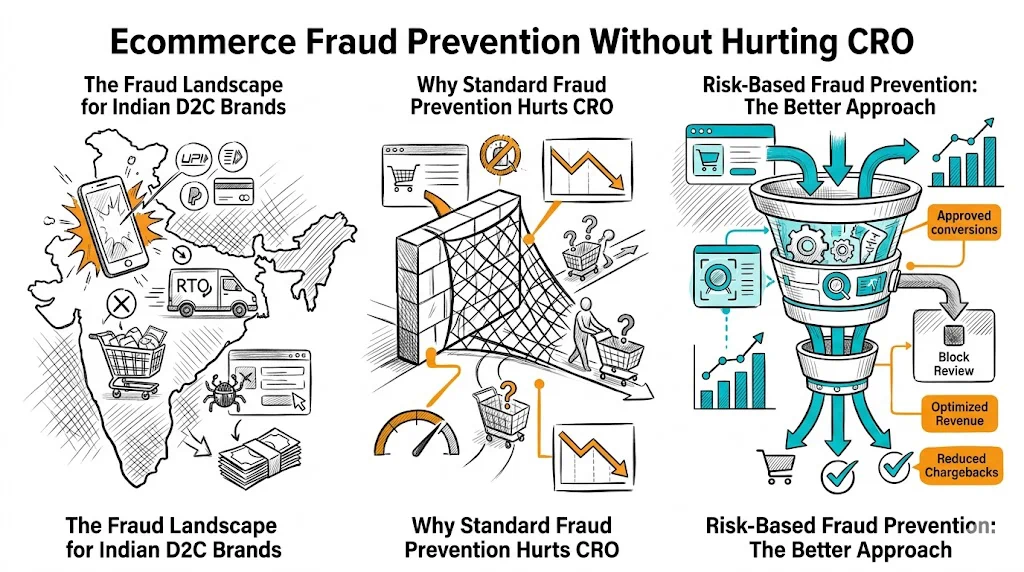
Fraud prevention and conversion rate are often treated as opposing forces: tighten security and you lose sales; relax it and you lose money to fraud. For Indian D2C brands, this tradeoff is very real—but it is also largely avoidable. The brands that manage fraud well apply friction precisely where risk is high and keep the path clear for legitimate customers. The result is lower fraud losses and higher conversion rates simultaneously.
Indian D2C ecommerce has a different fraud profile than Western markets:
Fake COD orders are the dominant problem. Customers place orders with no intent to receive them—sometimes to test logistics, sometimes as mischief, sometimes by confused elderly family members. The brand bears full round-trip shipping costs.
Coupon and promo abuse is rampant during festive sales. A single customer creates multiple accounts to claim the "new user" discount repeatedly, or shares coupon codes across WhatsApp groups.
Card-not-present fraud is growing as prepaid adoption increases. Stolen card data used to make purchases, with fraudsters claiming non-delivery of expensive items.
Friendly fraud involves customers claiming non-delivery or "wrong product" to get refunds while keeping the product. This is harder to detect and disproportionately affects premium categories.
Each type requires different prevention approaches, and the cost of getting it wrong—either through too little prevention or too much—is significant.
Most generic fraud prevention tools were built for Western card-present and card-not-present fraud. They score risk based on signals like VPN usage, device fingerprinting, and mismatched billing/shipping addresses—signals that fire frequently for legitimate Indian shoppers:
When these tools block or add friction to legitimate orders, brands lose real revenue. Studies from markets with heavy fraud filter deployment show false positive rates of 2–5%—meaning 2–5 out of every 100 legitimate orders face unnecessary friction or are blocked entirely.
Instead of applying the same friction to every customer, assess risk per order and apply friction proportionally.
Assign points for risk indicators:
| Signal | Risk Weight |
|---|---|
| First-time buyer | +2 |
| COD payment | +3 |
| High-RTO PIN code | +3 |
| Order placed 11 PM–3 AM | +1 |
| AOV 3x+ above category average | +2 |
| 3+ orders same day, same address | +4 |
| Returning customer, no prior RTO | -3 |
| Prepaid payment | -2 |
| Customer account age > 6 months | -1 |
Orders below a threshold proceed normally. Medium-risk orders get soft friction (OTP, address confirmation). High-risk orders require prepaid or manual review.
This approach keeps checkout clean for 85–90% of customers while focusing friction where it actually prevents fraud.
Rather than applying OTP to all COD orders, trigger it only for orders above a risk threshold. The message "Confirm your order #12345 – tap to verify you placed this order" screens out fake COD orders with minimal impact on real customers.
Brands using targeted OTP report 30–45% reduction in fake COD orders with less than 2% drop in COD conversion from legitimate customers.
To prevent multi-account coupon abuse:
For festive sales, move high-value coupons to logged-in-user-only access, which requires a verified account.
Validate phone numbers via OTP at account creation—not at checkout. A verified phone number is one of the strongest fraud prevention signals for COD orders. Accounts with verified phones and purchase history are very low-risk.
Real-time address validation (format check, PIN code serviceability check) at checkout reduces both fraud and RTO from address errors.
Some fraud prevention measures actually improve conversion:
Order status transparency: Showing customers exactly where their order is builds trust and reduces "friendly fraud" claims of non-delivery. When you have timestamped delivery photos from your courier, frivolous refund claims drop sharply.
Easy, fair return policy: Paradoxically, a generous return policy reduces fraud. Customers who know they can legitimately return a product do not need to commit friendly fraud to get their money back.
Trust signals at checkout: Displaying "100% secure payment," accepted payment logos, and customer review counts near the payment section reduces cart abandonment caused by trust anxiety—a real CRO win that has nothing to do with fraud but is part of the same checkout psychology.
Personalized checkout for trusted customers: Returning customers with clean order history get a streamlined checkout with saved addresses and payment methods. CustomFit.ai can recognize these customers and present a simplified, friction-free checkout while applying stricter flows to new, unverified buyers.
Non-delivery claims: Use delivery confirmation photos and GPS timestamps from your logistics partner. For high-value orders, require signature confirmation. For disputed claims with delivery proof, escalate to the courier's dispute process before issuing refunds.
Wrong product claims: Require a photo of the received product before processing the return. This single step reduces fraudulent wrong-product claims by 60–70% because fraudsters cannot produce the product they claim to have received.
Chargebacks: Respond to every chargeback with delivery proof, order confirmation, and IP/device data from the time of order. A structured chargeback response process recovers 40–60% of initially disputed amounts.
Related reading: Conversion Rate Optimization | Cart Abandonment | A/B Testing | COD vs Prepaid | RTO Prevention
See also: D2C & Ecommerce Growth Pillar | CRO Pillar