From the conversion glossary
Concepts referenced in this article, defined.
Concepts referenced in this article, defined.
Run rigorous A/B tests and personalize every visit on Shopify or any storefront — no engineers required.
A loyalty program that increases repeat purchases is one that gives customers a clear, compelling reason to buy from you again rather than a competitor. Most loyalty programs fail because they're complicated, the rewards feel meaningless, or customers forget they're enrolled. The programs that drive measurable repeat purchase growth are simple, generous enough to matter, and tied tightly to actual buying behavior. Here's how to build one.
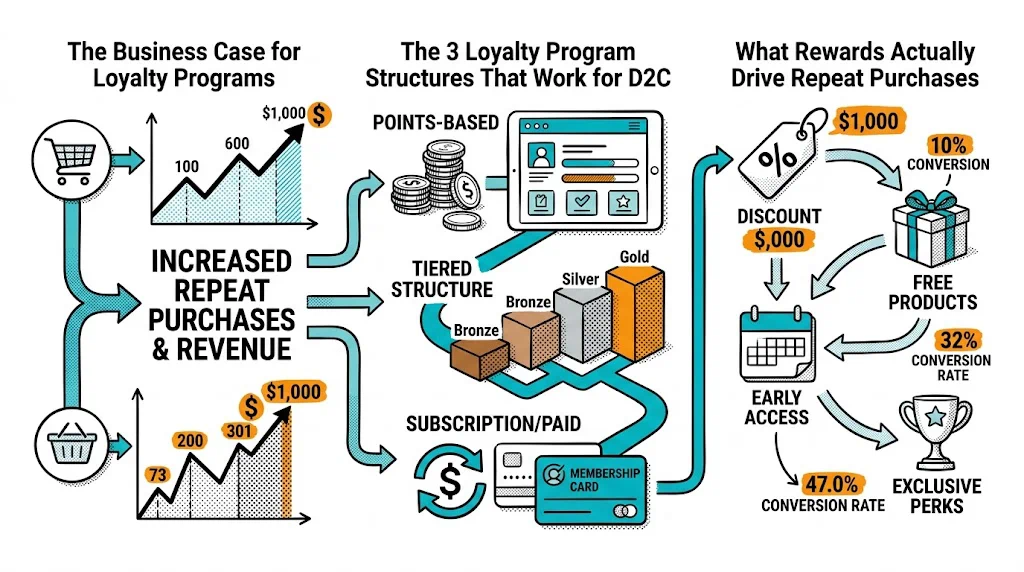
Repeat purchases are the most capital-efficient revenue in D2C. You've already paid to acquire the customer. You've established trust through the first order. Bringing them back costs a fraction of acquisition.
The math: if your CAC is ₹500 and your average order is ₹800, your first-order margin is thin after shipping, COGS, and returns. If that same customer buys twice more (at ₹800 each with near-zero acquisition cost), your total revenue from this customer is ₹2,400 with a significantly better margin profile.
A loyalty program that improves your repeat purchase rate from 20% to 28% doesn't just increase revenue—it fundamentally changes your unit economics.
The most common and most flexible structure. Customers earn points for purchases (and optionally for reviews, referrals, social shares) and redeem them for discounts or free products.
What works:
What kills participation:
Indian context: WhatsApp-based points balance notifications work dramatically better than email for most Indian D2C audiences. If your loyalty tool supports WhatsApp notifications, use them. The open rate difference is 3–5x.
Tiered programs create aspirational status. Customers progress from Silver to Gold to Platinum by reaching spend milestones, unlocking better rewards at each tier.
Example structure:
| Tier | Annual Spend | Benefits |
|---|---|---|
| Silver | ₹0–₹2,499 | 2% cashback, birthday discount |
| Gold | ₹2,500–₹7,499 | 4% cashback, early access to sales, free returns |
| Platinum | ₹7,500+ | 6% cashback, priority support, free shipping always, exclusive products |
What works:
What kills it:
Amazon Prime-style paid memberships are growing in D2C. Customers pay a fee (monthly or annual) for premium benefits: free shipping, exclusive discounts, early access to new products.
This model works when:
Indian examples: Nykaa, Tata 1mg, and Blinkit-style subscription models. In D2C, brands in the supplements and beauty space are experimenting with ₹199–₹499/year memberships that include free shipping and exclusive member pricing.
The risk: if your member benefits aren't compelling, the paid model creates a different kind of churn — membership cancellations instead of purchase churn.
Not all rewards are equal. Research consistently shows:
High-motivation rewards:
Low-motivation rewards:
For D2C brands selling consumables (nutrition, skincare), subscription discounts as a loyalty reward are particularly powerful. Offer Platinum customers a 15% discount on subscriptions — this converts one-time buyers to recurring revenue.
Loyalty programs only drive behavior if customers know they exist. Most brands enroll customers and never mention it again.
Email integration:
On-site integration with CustomFit.ai: Show logged-in loyalty members a personalized header with their points balance and tier status. When a member is close to a tier upgrade, display a banner: "You're ₹350 away from Gold status — add another item to your cart." This kind of contextual nudge on the product page or cart page drives meaningful AOV lifts.
Returning members who aren't logged in can be prompted to log in with "See your [X] points waiting for you." This improves account engagement and gives you behavioral data for better personalization.
See how CustomFit.ai personalizes loyalty program experiences on-site →
A common mistake: using a loyalty program as a discount delivery mechanism that trains customers to always wait for offers before buying.
Signs you've fallen into the discount trap:
To avoid this:
The metrics that matter:
Enrollment rate: What percentage of buyers join the program? Under 30% is low — your sign-up process or value proposition needs work.
Active participation rate: What percentage of enrolled members have earned points in the last 90 days? Under 40% means the program isn't staying top-of-mind.
Repeat purchase rate, members vs. non-members: The core metric. If loyalty members don't buy more frequently than non-members, the program isn't working.
AOV, members vs. non-members: Members should have higher AOV if tier benefits and redemption structures are working correctly.
Redemption rate: Low redemption (under 15%) means rewards aren't compelling or the process is too complicated. Very high redemption (over 60%) may indicate you're too generous.
NPS for members: Loyalty program members should have a noticeably higher NPS than non-members. If not, the program isn't creating emotional loyalty.
Integrate with WhatsApp: Most Indian D2C customers are more responsive to WhatsApp than email. Points notifications, tier upgrades, and redemption reminders via WhatsApp Business API outperform email for this audience.
COD and loyalty: COD customers can participate in loyalty programs — track orders by phone number or account, not by payment method. But ensure your platform doesn't accidentally deny points for COD orders (a common integration bug).
Festive season multipliers: 2x or 3x points during Diwali, Holi, or Raksha Bandhan drives purchase behavior during high-intent periods and rewards customers who shop with you during the most competitive windows.
Regional language rewards communications: For vernacular audiences (Tamil Nadu, West Bengal, Maharashtra), loyalty notifications in regional languages have meaningfully higher engagement. If you have the capability, segment by language preference.