CustomFit.ai โ€” Website personalization, A/B testing and CRO for Shopify and D2C
Product
Features
โœฑ
Website Personalization
Adapt to each visitor's behavior & intent
โง–
A/B & Multivariate Testing
Rigorous experimentation
โœจ
AI CopilotNEW
Personalize with a prompt
๐Ÿค–
AI WingmanNEW
Auto-optimize toward winners
๐ŸŽฏ
AI Conversion OptimizerNEW
GPT-grade test ideas
โœŽ
No-Code Visual Editor
Drag-and-drop edit any element
โ–ฆ
Product Recommendations
Personalized recs that lift AOV
โš‘
Feature Flags
Ship safely with kill-switches
โ—ง
Chrome Extension
Edit your store in the browser
โง‰
Shopify, WooCommerce & more
All platform integrations
View all features โ†’
Use Cases
$
Price A/B Testing
Test price points to maximize revenue
โ–ฆ
Theme A/B Testing
Compare whole layouts & designs
๐Ÿ—‚
Template A/B Testing
Test whole PDP/PLP templates
๐Ÿท
Discount A/B Testing
Find the offer that converts
๐Ÿšš
Shipping A/B Testing
Thresholds, speed & copy
โœ
Content A/B Testing
Copy, images & reviews
๐Ÿ’ณ
Checkout Gateway A/B
Payments & one-click
โŒ–
Geo-Based Personalization
Per-location content & offers
โšก
Buyer-Intent Nudges
Exit-intent & retargeting
โ†”
Split-URL / Redirection
Full-page redirect tests
View all use cases โ†’
Solutions & Guides
โคข
Conversion Rate Optimization
The complete CRO guide
โง–
A/B Testing Software
Buyer's guide for D2C
๐Ÿ›’
Cart Abandonment Recovery
Win back lost carts
๐Ÿ“ฐ
Landing Page Optimization
Convert more paid traffic
S
Shopify A/B Testing
Test your store, no code
S
Shopify Personalization
Tailor the store per shopper
โ—”
First-Time Visitor Offers
Convert new shoppers with trust & offers
โ˜…
Repeat-Customer Experiences
Reward and re-engage loyal buyers
โ—Ž
Campaign-Matched Pages
Match the landing page to the ad
โŒ–
Location-Based Experiences
Currency, language & regional offers
Explore CRO โ†’
Customer stories
GIVA
+32%
conversion via personalized recs
GIVA
Mamaearth
+18%
revenue lift from PDP A/B tests
ME
The Sleep Company
+24%
AOV from product recommendations
TSC
Read customer stories โ†’
Integrations
SWsfGA+15
โœฆ
Not sure where to start?
Let AI Copilot pick your first tests

โ€œWe wake up to evidence-backed tests ready to deploy โ€” not a backlog of maybe ideas.โ€

AN
Anirudh S.
Growth ยท Chargebee
โ˜…โ˜…โ˜…โ˜…โ˜…4.8on G2 ยท 2,400+ brands
Talk to our team โ†’
Widgets
Integrations
Ecommerce & Checkout
Shopify
Shopline
Shoplazza
GoKwik
ShopFlo
Razorpay Magic Checkout
Breeze
Shiprocket
View all integrations โ†’
Analytics & Behavior
Google Analytics 4
Microsoft Clarity
Hotjar
Mixpanel
Amplitude
Heap
Adobe Analytics
Segment (CDP)
View all integrations โ†’
Engagement, CRM & More
Klaviyo
MoEngage
CleverTap
WebEngage
HubSpot
Salesforce
Slack
Meta Ads
View all integrations โ†’
CustomersPricing
Resources
CRO
โ–ค
Playbooks
Proven strategies to boost conversions
๐ŸŽ™
Interviews
D2C leaders & marketing experts
โ–ถ
Webinars
Live deep dives & product sessions
Learn
โœŽ
Blog
Tips, experiments & best practices
๐Ÿ“•
Free E-Books
Mastering personalization
๐Ÿ“–
Conversion Glossary
Every CRO term, defined
โœฆAI CopilotNEWLog inBook a demo
Start free trial
Select your platform โ€” Install in 2 minsWe'll tailor the setup
โšก Risk-free 14-day trial ยท No credit card ยท Cancel anytime
S
Shopify
Install from Shopify App Store
โ€บ
W
WooCommerce
Install the WooCommerce plugin
โ€บ
B
BigCommerce
Install from BigCommerce App Marketplace
โ€บ
SL
Shopline
Install from Shopline App Store
โ€บ
M
Salesforce / Magento
Install from the marketplace
โ€บ
SZ
Shoplazza
Install from Shoplazza App Store
โ€บ
WP
WordPress / Webflow
Install plugin or paste the script
โ€บ
โ—ง
Others
Custom-built on React, Next.js, etc.
โ€บ
Tip: pick your platform โ€” we handle the restBook a demo โ†’
Product
Website PersonalizationA/B & Multivariate TestingAI CopilotAI WingmanAI Conversion OptimizerNo-Code Visual EditorProduct RecommendationsFeature FlagsView all features โ†’
Use Cases
Price A/B TestingTheme A/B TestingTemplate A/B TestingDiscount A/B TestingShipping A/B TestingContent A/B TestingCheckout Gateway A/BGeo-Based PersonalizationBuyer-Intent NudgesSplit-URL / Redirection
Solutions & Guides
Conversion Rate OptimizationA/B Testing SoftwareCart Abandonment RecoveryLanding Page OptimizationShopify A/B TestingShopify Personalization
Explore
WidgetsIntegrationsCustomersPricing
Resources
BlogPlaybooksWebinarsInterviewsE-BooksConversion Glossary
Platforms
ShopifyShoplineShoplazzaChrome ExtensionAll integrations
Start free trialBook a demo
Homeโ€บBlogโ€บexperimentationโ€บCRO + Product Management: Working Together

CRO + Product Management: Working Together

SJSapna JoharHead of Growth & CRO, CustomFit.aiJanuary 15, 20258 min read
On this page
  1. Where CRO and Product Overlap
  2. The Ownership Framework
  3. Shared Infrastructure: The Experiment Registry
  4. How Product Teams Can Adopt CRO Practices
  5. How CRO Teams Can Work Better with Product
  6. Metrics Alignment
  7. Running Joint Experimentation Reviews
  8. When to Escalate Disagreements
  9. Key Takeaways
0%
CRO + Product Management: Working Together

From the conversion glossary

Concepts referenced in this article, defined.

Definition
What Is Experiment? Definition, Formula & Guide
Definition
What Is Hypothesis? Definition & Guide
Definition
What Is Friction? Definition & Guide
Definition
What Is North Star Metric? Definition & Guide
Definition
What Is Social Proof? Definition & Guide
โ† Back to Experimentation guide
Try CustomFit.ai

Run A/B tests and personalize your store without code. 14-day free trial, no credit card.

Start free trial โ†’
Share
XLinkedInEmail

Related articles

experimentation

Testing Velocity: How Many Tests Should You Run?

Sapna Joharยท 8 min read
experimentation

Testing Culture: Getting Buy-In from Leadership

Sapna Joharยท 8 min read
experimentation

Quarterly CRO Review: What to Measure

Sapna Joharยท 8 min read

Start lifting conversions today.

Run rigorous A/B tests and personalize every visit on Shopify or any storefront โ€” no engineers required.

Start free trialBook a demo

Built for every D2C category

๐Ÿงด
Skincare
๐Ÿ’„
Beauty
๐ŸŒฟ
Wellness
โ˜•
F&B
๐Ÿ‘Ÿ
Apparel
๐Ÿ’
Jewelry
๐Ÿ›‹๏ธ
Home
๐Ÿผ
Baby
Live ยท Right now
Mamaearth โ€” free-shipping band +12.4% AOVGIVA โ€” festive collection page +34% revenueBellavita โ€” PDP CTA test +27.4% CVRKapiva โ€” Quiz-driven recs +9.48% CTRThe Sleep Co โ€” landing personalized 2ร— capturesPlum โ€” Returning shopper swap +18.2% CVRMamaearth โ€” free-shipping band +12.4% AOVGIVA โ€” festive collection page +34% revenueBellavita โ€” PDP CTA test +27.4% CVRKapiva โ€” Quiz-driven recs +9.48% CTRThe Sleep Co โ€” landing personalized 2ร— capturesPlum โ€” Returning shopper swap +18.2% CVR
Get in touch

Tell us about your store.

We reply within an hour during business hours. No sales pitch, no spam โ€” just answers from someone who's seen 2,400+ D2C stores.

โœ“ Reply within 1 hourโœ“ No spam, everโœ“ Free demo & setup help
โœ“ Thanks! We'll be in touch shortly.
CustomFit.ai

The all-in-one website personalization, A/B testing & CRO platform for high-growth D2C brands. Made by marketers, fueled by coffee.

in๐•โ—Žโ–ถf
Product
  • Features
  • A/B Testing
  • Personalization
  • AI Copilot
  • AI Wingman
  • AI Conversion Optimizer
  • Feature Flags
  • Widgets
  • Integrations
  • ROI Calculator
Platforms
  • Shopify
  • Shopline
  • Shoplazza
  • Salesforce
  • Chrome Extension
  • All Integrations
Resources
  • Blog
  • Playbooks
  • Webinars
  • GrowthFit Interviews
  • Free E-Books
  • Conversion Glossary
  • Case Studies
Compare
  • vs VWO
  • vs Optimizely
  • vs Google Optimize
  • vs Mutiny
  • vs Intelligems
  • vs Shoplift
  • vs AB Tasty
  • vs Convert
  • vs Kameleoon
Company
  • About Us
  • Partners
  • CustomFit Awards
  • Recognition
  • Contact
  • Privacy Policy
  • Terms & Conditions
ยฉ 2026 CustomFit.ai ยท Valley Monks Pvt Ltd ยท Made by marketers, fueled by coffee, and obsessed with conversions.
SOC 2 Type II ยท GDPR ยท CCPA ยท ISO 27001

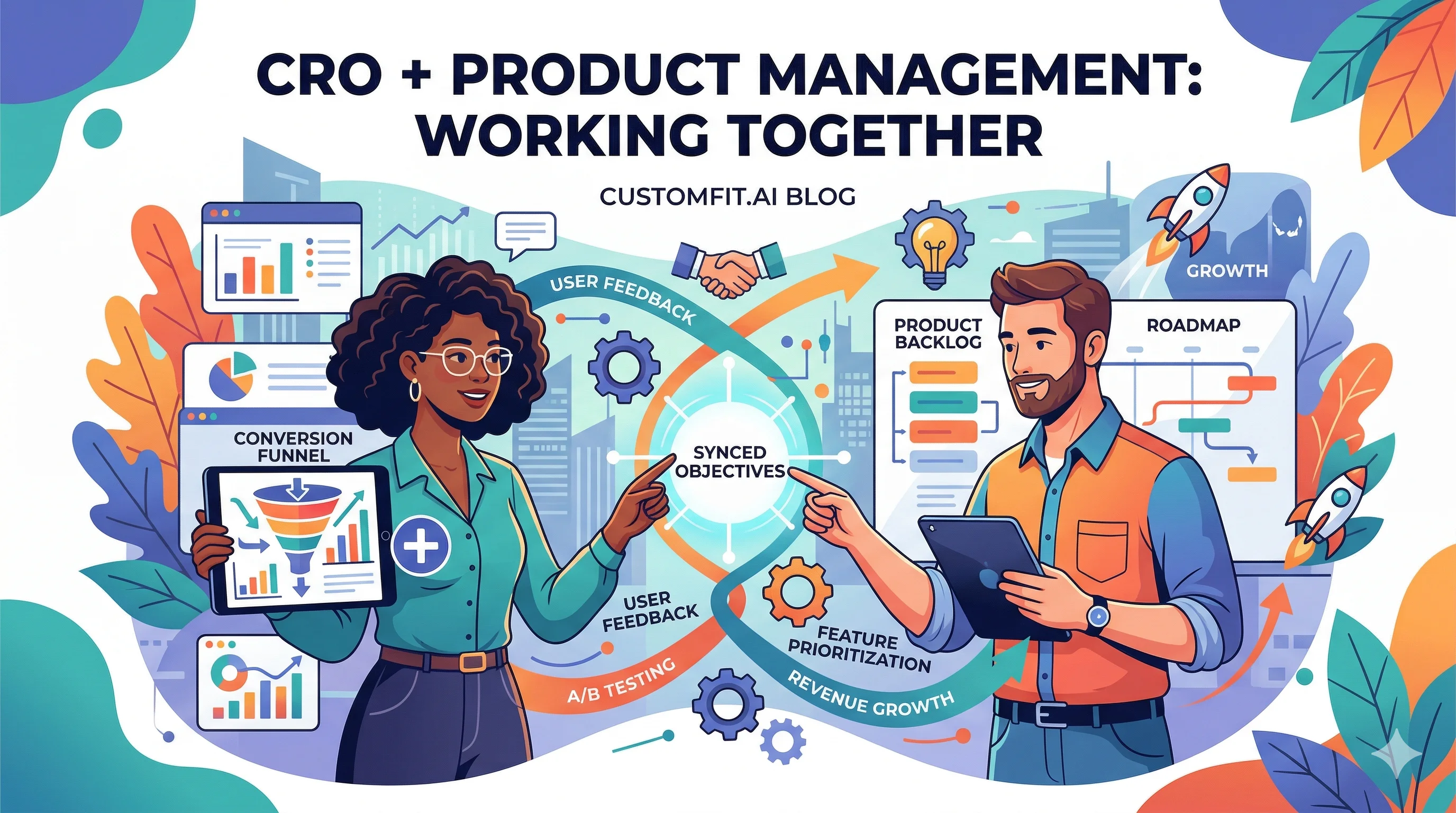
CRO and product management overlap more than either team typically acknowledges โ€” both run experiments, both care about user behavior, and both make decisions that affect the same pages and journeys. When these teams work in silos, they create conflicting experiments, duplicate work, and miss opportunities to compound their learnings. When they collaborate with clear ownership boundaries and shared measurement, they produce better experiments, ship higher-converting features, and build a genuine testing culture across the organization.

Where CRO and Product Overlap

Consider a D2C Shopify brand's product detail page (PDP). Who owns tests on this page?

CRO team perspective: PDP is the highest-impact page for conversion. They want to test CTA copy, image order, trust badges, pricing presentation, and social proof positioning.

Product team perspective: The PDP is a core product surface. They're building a new ingredient visualization feature for supplement products, a new size recommendation tool, and improving mobile image loading performance.

Both teams have legitimate interests in the PDP. Without coordination, you get:

  • CRO testing CTA copy while product is simultaneously rolling out the new size tool
  • Experiments that contaminate each other's results
  • Conflicting design decisions (CRO wants fewer elements; product is adding more)
  • No unified picture of what's actually driving conversion changes

The solution is coordination, not consolidation.

The Ownership Framework

Establish clear ownership based on the type of change:

CRO owns:

  • Copy and messaging changes (headlines, descriptions, CTAs)
  • Visual/design variations (image order, color, layout of existing elements)
  • Trust signal placement (reviews, badges, social proof)
  • Urgency and pricing presentation
  • Email capture and pop-up optimization

Product owns:

  • New features and capabilities (size recommenders, ingredient viewers, loyalty dashboards)
  • Navigation and information architecture changes
  • Performance improvements (page speed, mobile optimization)
  • Checkout flow changes
  • New product recommendation algorithms

Joint ownership (requires both teams):

  • Major page redesigns
  • New funnel steps that affect conversion
  • Personalization systems that span marketing and product surfaces

Document this in a shared "Who tests what" agreement. Review it annually as both teams evolve.

Shared Infrastructure: The Experiment Registry

The most important operational tool is a shared experiment registry โ€” a central record of all active and planned experiments.

Every experiment entry should include:

  • Test owner (CRO team or product team)
  • Test description (one sentence)
  • Pages/surfaces affected
  • Audience segment affected
  • Start date and estimated end date
  • Primary metric

Before launching any experiment: check the registry for conflicts. A conflict exists when:

  • Two tests affect the same page simultaneously
  • Two tests use overlapping audience segments
  • One test might influence the metric being tracked in another test (e.g., a CTA change on the PDP affects checkout initiation, which a checkout test is also measuring)

Resolution process: When a conflict is identified, the experiment owners meet, review priorities, and decide who runs first or whether the tests can run sequentially.

A simple Notion or Airtable database works well for this. The important thing is that all teams use it consistently.

How Product Teams Can Adopt CRO Practices

Many product managers think of features in terms of "ship, then monitor" rather than "form hypothesis, test, then ship verified improvements." CRO methodology significantly improves product decision quality.

Hypothesis-driven feature development:

Instead of: "We're adding a size recommendation tool to the PDP."

Write: "Because 30% of apparel returns are due to wrong sizing (evidence from support tickets), we believe adding a size recommendation tool will reduce return rate by 15% and increase PDP-to-cart conversion by 5% for buyers on their first purchase (audience)."

This forces the product team to define what success looks like before building, making post-launch measurement unambiguous.

A/B testing before full rollout:

Large feature launches often go straight to 100% of users with no experiment. This means:

  • You don't know if the feature improved or hurt the metrics it was supposed to improve
  • If it causes problems, you can't isolate the cause
  • You can't claim the revenue impact of the feature with confidence

Instead: use feature flags to roll out to 50% of users first. Measure the impact against the hypothesis. Ship to 100% only when the improvement is verified.

Holdout groups for long-term feature measurement:

Some features have delayed impact โ€” a size recommendation tool might reduce returns 30 days after purchase, not immediately in session. Use holdout groups to measure the full lifecycle impact of features, not just in-session conversion.

How CRO Teams Can Work Better with Product

CRO teams sometimes operate in isolation โ€” testing surface changes without understanding the product roadmap. This leads to tests that are invalidated by upcoming product changes.

Get on the product roadmap:

Meet monthly with the product team to review the upcoming development roadmap. If product is launching a new checkout flow in 6 weeks, don't run CRO tests on the checkout page this month โ€” your results will be invalidated by the product change.

Input to product requirements:

CRO teams often have the best qualitative and quantitative data on user behavior friction. This data should inform product requirements, not just run as standalone A/B tests.

Example: CRO data shows 40% of mobile users try to zoom in on product images, indicating current image quality is insufficient. This isn't just a CRO test opportunity โ€” it's a product requirement input. The product team should address image loading quality; CRO can test the optimal implementation.

Collaborate on research sprints:

Qualitative user research (session recordings, user interviews, usability testing) benefits both CRO and product. Running joint research sprints โ€” where both teams observe user sessions and generate hypotheses together โ€” is more efficient and produces richer insights.

Metrics Alignment

CRO and product teams sometimes optimize for different metrics, which creates organizational friction.

Common misalignment:

  • CRO optimizes for CVR (sessions โ†’ purchases)
  • Product optimizes for engagement (DAU, session depth, feature adoption)
  • These goals can conflict (a feature that increases engagement may not increase CVR)

Solution: Agree on a north star metric.

For most D2C ecommerce brands, the right north star is revenue per visitor (total revenue / total sessions). This metric captures both CVR and AOV, and it's what the business actually cares about.

Secondary metrics can differ by team (product may care about feature adoption; CRO may care about bounce rate) but both teams should agree that revenue per visitor is the ultimate arbiter of success.

Shared measurement infrastructure:

Both teams should use the same analytics setup and agree on how metrics are calculated. If CRO uses one CVR definition and product uses another, you'll have arguments about results rather than productive learning from them.

Running Joint Experimentation Reviews

Monthly joint review between CRO and product:

  • What tests ran last month? (Both teams share results)
  • Are there any conflicts to resolve for next month?
  • What did this month's user research reveal that affects both teams' priorities?
  • Are there product changes coming that CRO should know about?

This meeting doesn't need to be long โ€” 30โ€“45 minutes monthly prevents the coordination problems that take much longer to untangle.

When to Escalate Disagreements

Disagreements between CRO and product teams are inevitable. Common friction points:

Design conflict: CRO wants fewer elements on the PDP; product wants to add a new feature. Resolution: Run the test. If adding the feature hurts CVR, the data decides.

Priority conflict: CRO wants to test checkout copy; product wants to rebuild checkout. Resolution: Coordinate timing. Either run the CRO test first (with a 4-week timeline) or wait for the product rebuild and test variants within the new checkout.

Interpretation conflict: CRO and product interpret the same test result differently. Resolution: Agree in advance on the primary metric and significance threshold before the test starts, so interpretation is pre-defined.

If resolution isn't possible at team level, escalate to a common stakeholder (usually the Growth Lead or CMO) for a decision. Document the reasoning so learnings are captured regardless of the outcome.
Key Takeaways

  • CRO and product both run experiments on the same surfaces โ€” coordination prevents conflicts and compounds learnings
  • A shared experiment registry is the most important operational tool for cross-team coordination
  • Establish clear ownership: CRO owns surface/messaging tests; product owns feature builds; document the boundary
  • Product teams improve outcomes by adopting CRO practices: hypothesis-first development, A/B testing before full rollout, holdout groups for long-term measurement
  • Align on a shared north star metric (revenue per visitor) so both teams' optimizations point in the same direction
  • Monthly joint reviews (30 minutes) prevent the coordination issues that take days to untangle