From the conversion glossary
Concepts referenced in this article, defined.
Concepts referenced in this article, defined.
Run rigorous A/B tests and personalize every visit on Shopify or any storefront — no engineers required.
Incrementality testing measures whether your marketing spend or CRO investment is genuinely causing additional revenue — or whether those buyers would have converted anyway. For Indian D2C brands, where ad budgets often run ₹5–₹50 lakh per month, knowing whether your retargeting, performance marketing, and personalization programs are producing real incremental returns (rather than claiming credit for organic conversions) can be the difference between scaling efficiently and burning money on attribution fiction.
Consider this scenario: You run Facebook retargeting ads targeting anyone who visited your Shopify store in the last 7 days. Your attribution model shows these ads generated 300 orders last month at a ₹400 CPO (cost per order). Looks efficient.
But here's the question: How many of those 300 buyers would have returned and purchased anyway, even without seeing your retargeting ad?
If the answer is 200 — meaning only 100 orders were truly caused by the ad — your real CPO is ₹1,200, not ₹400. That changes the ROI calculation entirely.
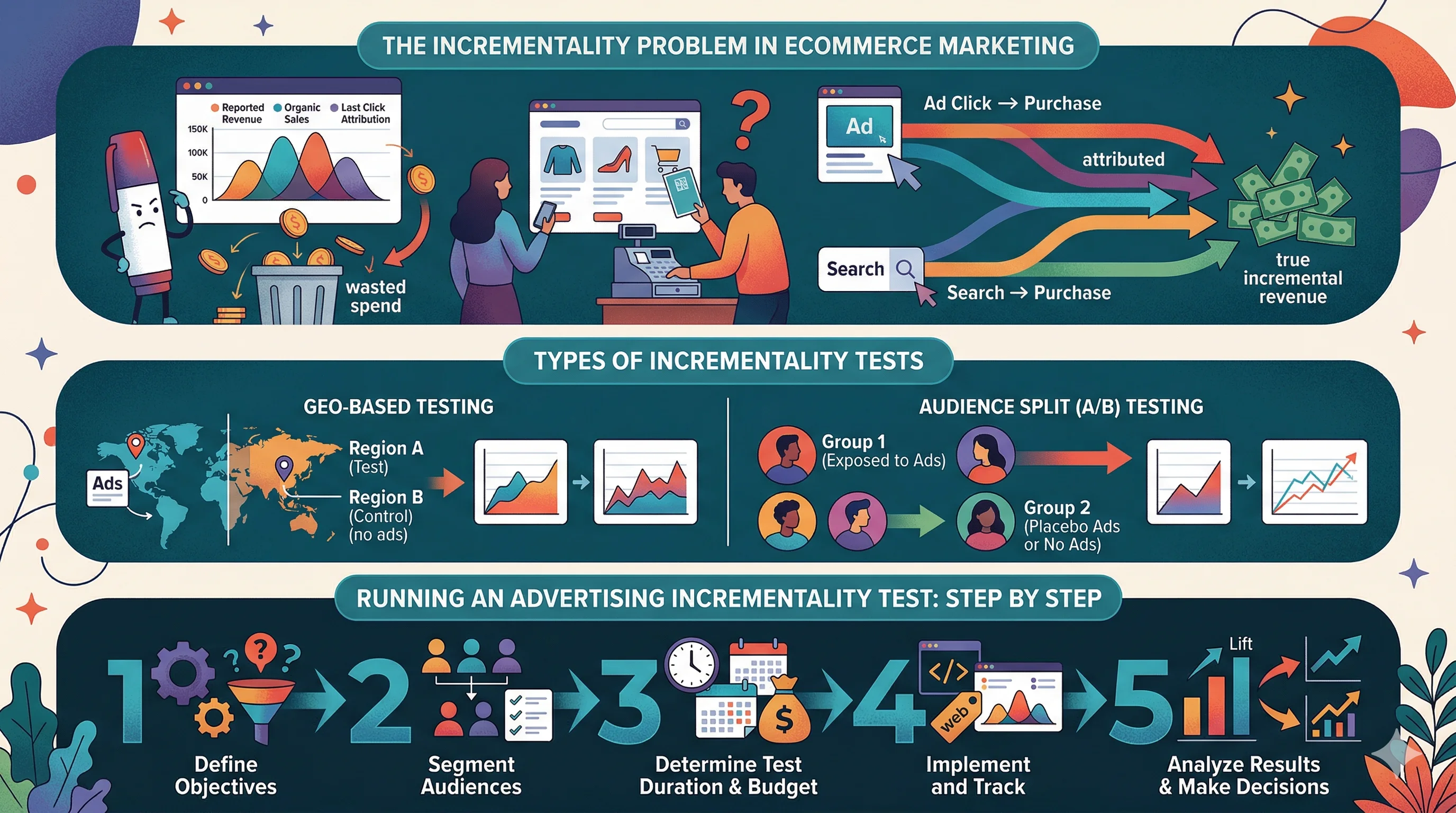
This is the incrementality problem: standard attribution (last click, first click, linear) counts conversions that happen after an ad exposure, not conversions that were caused by the ad. The difference is incrementality.
The same problem applies to on-site optimizations: did your personalization program genuinely increase conversions, or were those buyers going to convert anyway?
Tests whether a specific ad campaign, channel, or targeting strategy generates genuine additional revenue.
Methods:
Platform support:
Tests whether your personalization program genuinely converts more buyers than a non-personalized experience.
Method: Holdout group (see holdout groups) — a percentage of visitors receives no personalization while the majority receives personalized experiences. The conversion rate difference is the incremental lift from personalization.
CustomFit.ai supports holdout group configuration natively, allowing D2C brands to continuously measure the true incremental value of their personalization program.
Tests whether your overall A/B testing program is generating genuine conversion improvements vs. natural variation.
Method: Same holdout group approach applied across your entire CRO program — holdout users see the original experience while optimized users receive all test winners. Measured over 30–90 days.
Step 1: Choose the channel to test Pick one channel where you have enough volume. For a brand spending ₹10 lakh/month, Facebook retargeting is often the first to test because retargeting incrementality is frequently much lower than reported attribution suggests.
Step 2: Define your holdback percentage 10–20% holdback is standard. Too small: insufficient power to detect effects. Too large: you're withholding ads from a significant portion of your audience, which has opportunity cost.
Step 3: Set up the test In Meta Ads Manager:
In Google Ads:
Step 4: Run the test without interference Don't change your ads, budget, or targeting during the test period. External changes contaminate the measurement.
Step 5: Analyze incremental results Meta and Google both report:
Example interpretation:
If your reported attribution was 200 orders, but incrementality shows only 60 incremental orders, your true CPO is 3.3x higher than reported.
For brands that can't reach holdback sample sizes through platform tools (lower ad spend), geo-based tests are practical.
How it works:
Suitable for:
Challenges:
High incremental lift (>70% of attributed conversions are incremental): Your channel is working genuinely well. Attribution is close to reality. Scale with confidence.
Moderate incremental lift (30–70% incremental): Common for retargeting and brand-aware audiences. Adjust budgets and CPO targets to reflect true incrementality. Consider whether creative freshness or audience expansion could improve the ratio.
Low incremental lift (<30% incremental): Your channel is largely claiming credit for organic conversions. Either reduce spend significantly or change your approach (new audiences, different creative, different channel placement).
For on-site personalization: If your holdout group converts at a similar rate to your personalized majority, your personalization program isn't generating real lift. This is a signal to review your personalization logic, audience segmentation, or the relevance of your personalized content.
Testing a channel at the wrong stage: Incrementality tests for brand awareness campaigns (top of funnel) look very different from retargeting campaigns. Brand campaigns may show low incrementality in the short term but strong long-term brand recall value. Don't apply retargeting benchmarks to awareness.
Running tests that are too short: A 1-week incrementality test for an ecommerce brand with 7–14 day purchase cycles will miss many conversions that were influenced but converted after the test window. Run tests for at least 2 purchase cycles.
Not accounting for the holdback opportunity cost: The 10–15% holdback group doesn't receive your ads for the test period. If those ads genuinely drive purchases, you're temporarily sacrificing those conversions for measurement. Accept this tradeoff as the cost of honest measurement.
Conflating incrementality with attribution: Attribution models (last-click, first-click, data-driven) tell you which touchpoint to credit. Incrementality tells you whether a touchpoint generated genuinely new revenue. Both have their uses, but they answer different questions. Don't use one to proxy for the other.
Incrementality testing shouldn't be a one-time exercise. Build it into your annual CRO planning:
Q1: Run advertising incrementality test on your highest-spend channel (typically retargeting) Q2: Run personalization holdout test to measure CRO program value Q3: Festive season — avoid incrementality tests during peak (results are harder to isolate) Q4: Year-end incrementality summary comparing program-wide holdout vs. optimized
This cadence ensures you have data to defend your CRO and marketing budgets with real incremental numbers, not attribution-inflated figures.