From the conversion glossary
Concepts referenced in this article, defined.
Learn AI shopping agents optimization from schema markup to checkout readiness so ChatGPT and other AI agents can find, trust, and buy from your store.
Concepts referenced in this article, defined.
Run rigorous A/B tests and personalize every visit on Shopify or any storefront — no engineers required.
A few months ago, "shopping online" meant a person typing into Google, clicking through a few product pages, and comparing prices in different tabs.
That's changing fast.
Now there's a decent chance the person doesn't even open your website - an AI assistant does it for them.
ChatGPT can already buy things on a user's behalf. Perplexity has its own shopping flow. Google is folding agent-style buying into Gemini. This is what people are calling agentic AI in ecommerce - AI agents that browse, compare, and check out on behalf of a human, sometimes without the human ever clicking through to your site.
If your store is only built for a human with eyes and a mouse, you're invisible to a growing chunk of your future customers. This post walks through what AI shopping agents optimization actually means and what you can start fixing this week.
Think of it as a digital personal shopper. A user tells it something like "find me a pair of running shoes under $100 with good arch support," and the agent goes and does the legwork: searching, reading product pages, comparing specs and prices, and, in some cases, completing the purchase.
To do that job well, the agent needs to read your site the way a very literal, very fast robot would. It doesn't appreciate your hero banner or your brand video. It's looking for facts: price, availability, size, material, shipping time, and return policy. If those facts are buried in an image, hidden behind a "click to expand" tab, or missing entirely, the agent either skips your product or gets it wrong - and either way, you lose the sale.
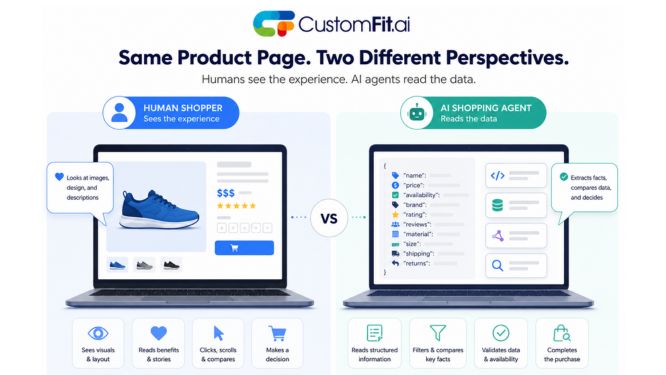
Traditional SEO is about ranking for humans who read headlines and scan pages. Agent optimization is closer to writing an API response than writing copy. An AI agent parses your page, pulls structured facts, and moves on in milliseconds. It doesn't skim - it extracts.
That means the brands that win here are the ones that treat their product data as infrastructure, not just marketing copy. This is a mindset shift more than a technical overhaul, and most stores can make real progress without touching their whole codebase. If you're already running AI-powered A/B testing on your site, agent optimization is really just the next layer of the same discipline: feeding clean, reliable data to whoever (or whatever) is reading your page.
Schema markup (Product, Offer, AggregateRating, and Availability) is how you hand an AI agent clean, machine-readable product pages instead of making it guess from your layout. If your product, price, and stock status aren't marked up in schema, you're asking the agent to interpret a webpage like a human - and it usually won't bother. Our product page optimization guide covers the layout and content fundamentals this builds on.
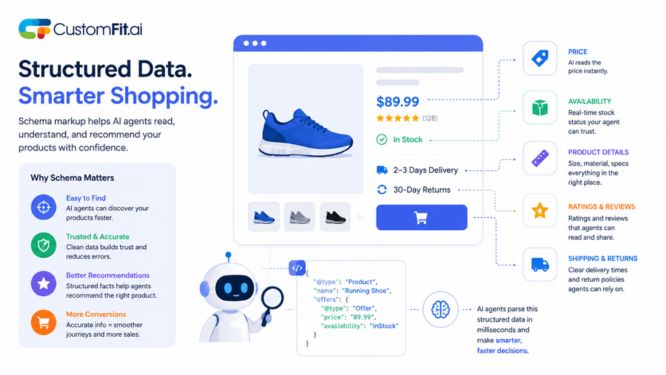
Price, size chart, material, delivery time, and return window: write these out as actual text on the page, not as an icon, not as an image, and not tucked into a PDF. Agents (and, frankly, a lot of humans) can't read text baked into a JPEG.
If you're optimizing for ChatGPT shopping or similar surfaces, your product feed - Google Merchant Center, Shopify's native feed, or whatever you use - needs to match what's actually on your site in real time. An agent that recommends an out-of-stock item or the wrong price won't get a second chance from that user.
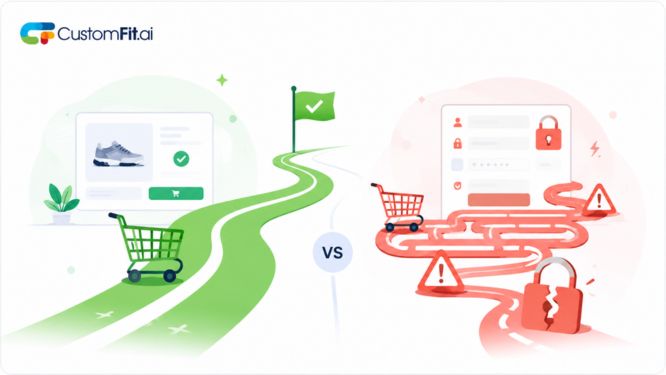
AI agent checkout readiness means fewer surprise steps. Mandatory account creation, CAPTCHA walls with no fallback, forced app downloads, or a coupon field that silently breaks the flow can all stall an agent (and plenty of impatient humans too). Guest checkout and a clean, linear flow matter more than ever. See our breakdown of guest checkout vs. account creation if you're weighing which one to default to.
Agents love FAQs, comparison tables, and clear specification lists because they can lift facts straight off the page. A vague "premium quality materials" line tells an agent nothing useful. "100% cotton, machine washable, true to size" does.
Star-rating widgets rendered purely in CSS or JavaScript animations can be invisible to a crawler. Include the actual rating and review count as text, plus a few real review snippets an agent can quote or summarize.
This one hasn't changed. Agents still have to load your page. If it's slow, blocked by robots.txt, or loaded entirely through JavaScript with nothing in the initial HTML, you're adding friction an agent may not tolerate.
The most common one is treating this like a future problem. It isn't. Agentic commerce is live now, and the brands filling in their structured data today are the ones showing up in agent recommendations next quarter.
The second mistake is over-optimizing for the agent at the expense of the human. Don't strip out your brand voice; just make sure the facts are available underneath it.
Product and Offer schema on every product pageYou don't need to rebuild your store to compete in agentic commerce. You need to make sure the facts that matter - price, stock, specs, and policies - are sitting in plain sight, in plain text, where both a human and an AI agent can find them in seconds.
Do that well, and you're not just optimizing for a trend. You're running a cleaner, more trustworthy store for everyone shopping it, human or not.
Tools like CustomFit's AI Conversion Optimizer can help you get there faster by surfacing exactly where your product data and page experience are falling short - for humans and agents alike.
Regular SEO is written for a human who skims a page and clicks what looks relevant. AI agent optimization is about handing over clean, structured facts - price, stock, and specs - that a bot can extract in milliseconds without having to interpret your layout. The two overlap (both reward fast, well-structured pages), but the audience and the format they need are different.
Yes, and arguably it's easier for smaller stores to move on it. You don't need a big development team to add Product schema, write out your shipping and return policy in plain text, or clean up your checkout flow. These are the same fixes that help your conversion rate today, so there's no real reason to wait until you're "big enough."
No - done right, it improves it. Clear pricing, visible policies, readable reviews, and a faster checkout are things human shoppers want too. The only mistake to avoid is stripping out your brand voice or visuals to "please the bot." Keep the design and personality; just make sure the facts underneath are equally clear.
Check your server logs or analytics for user-agent strings like GPTBot, ChatGPT-User, or PerplexityBot. These show up like any other crawler. You can also ask ChatGPT or Perplexity to find a product like yours and see whether your store comes up, what it says about your pricing and stock, and whether that information is accurate.