From the conversion glossary
Concepts referenced in this article, defined.
Concepts referenced in this article, defined.
Run rigorous A/B tests and personalize every visit on Shopify or any storefront — no engineers required.
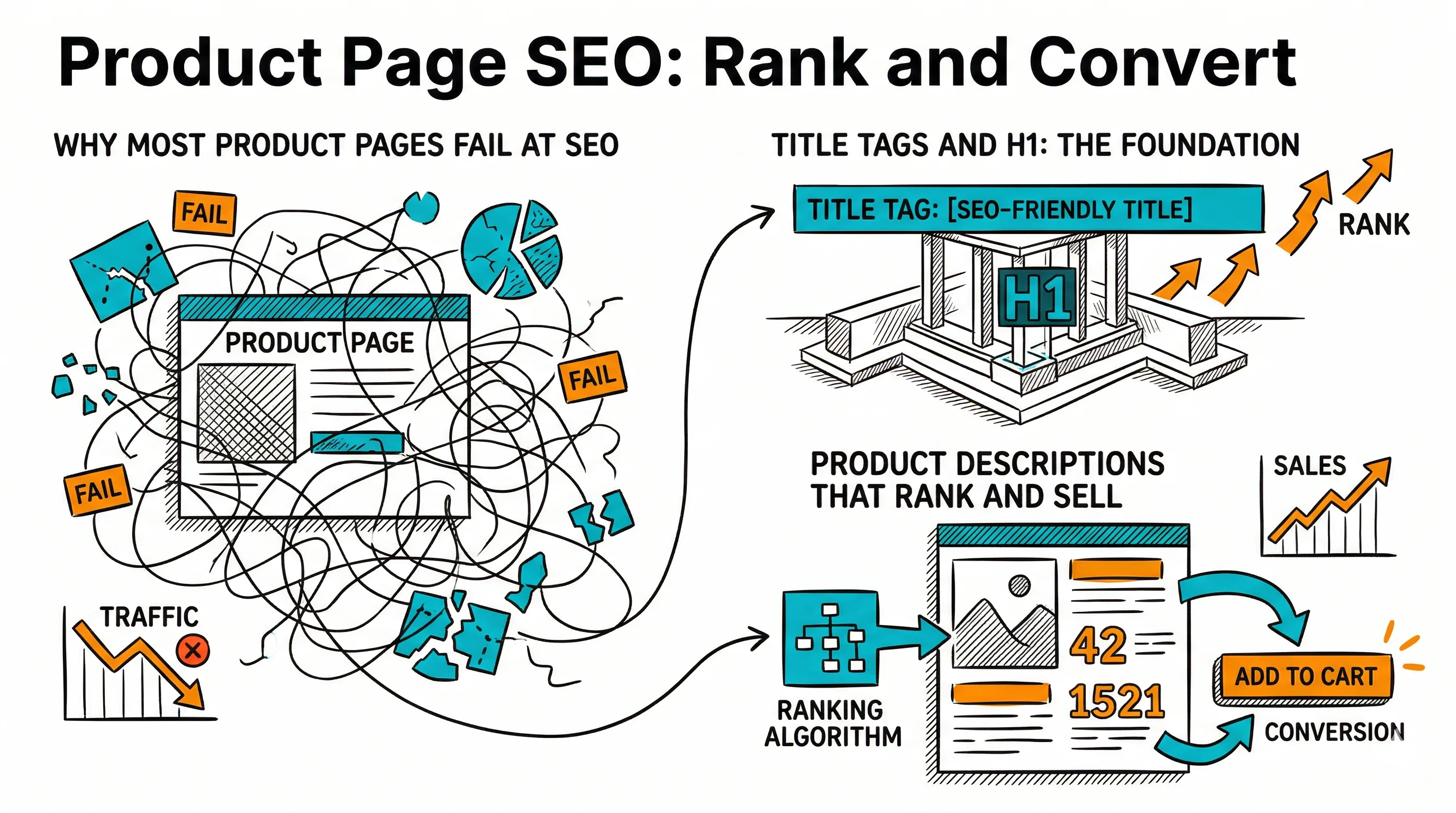
A product page that ranks on page 2 of Google earns almost no traffic. A product page that ranks on page 1 but doesn't convert earns traffic but not revenue. The goal is both—and the tactics for ranking and converting are more aligned than most brands realize. This guide covers what it takes to optimize D2C product pages for search visibility and sales simultaneously.
The typical D2C product page has:
This combination means the page ranks poorly (no keyword signals, no structured data), gets low click-through rates (no star ratings in SERP), and converts poorly even when it does rank (thin content doesn't answer purchase questions).
The fix requires treating the product page as both a sales page and a content asset.
The title tag is the most important on-page SEO element. It tells Google what the page is about and appears as the clickable headline in search results.
Formula for product page title tags:
[Product Name] | [Primary Keyword] | [Brand Name]
Example: "Vitamin C Face Serum 20% | Best Brightening Serum | Plum Goodness"
This structure includes: the product (what it is), the keyword customers search (brightening serum), and the brand (trust and recognition).
What to avoid:
The H1 on the page should match the intent of the title tag but can be written slightly more naturally. Google expects the title tag and H1 to align. If the title tag is "Vitamin C Face Serum 20% | Brightening Serum | Plum", the H1 might be "Plum 20% Vitamin C Face Serum for Radiant Skin."
Product descriptions do two jobs: convince a visitor to buy, and signal to Google what the page is about.
The twin failure mode: Descriptions that are purely sales copy (benefit-focused, no natural keyword inclusion) rank poorly. Descriptions that are purely keyword-stuffed (unnatural language, repetitive) don't convert.
The structure that does both:
Opening paragraph: Lead with the product's primary benefit, naturally including the primary keyword. "Plum's 20% Vitamin C serum is formulated for daily brightening, combining stable L-ascorbic acid with niacinamide to visibly reduce dark spots within 4–6 weeks."
Ingredient/specification section: Where semantically related keywords appear naturally—ingredient names, technical specifications, usage instructions. "Contains: L-Ascorbic Acid 20%, Niacinamide 5%, Hyaluronic Acid 2%. Suitable for: oily, combination, and normal skin. Not recommended for: active acne or very sensitive skin."
Benefits/features section: Bulleted list of key benefits, written in customer language. These often match the longtail terms customers search.
Usage instructions: How to use, when to use, what to use with. Tutorial-style content that also captures "how to use vitamin C serum" searches.
FAQ section (discussed further below): Structured Q&A that captures conversational search queries.
Length: For most products, 200–400 words covers this structure. For high-consideration products (supplements, electronics, skincare for specific conditions), 500–800 words can help capture additional keyword surfaces.
Product schema markup tells Google to display rich information about your product directly in search results—price, availability, reviews, and more. Without it, you're leaving SERP real estate on the table.
Essential schema types for D2C product pages:
Product schema: Name, description, brand, SKU, image, offers (price, availability, currency). This enables the product information panel in search results.
Review/AggregateRating schema: Total review count and average rating. This generates the star rating display in SERPs—which improves click-through rate by 15–30% in most studies.
BreadcrumbList schema: Navigation path. Helps Google understand site structure and displays category breadcrumbs in search results.
FAQ schema: Frequently asked questions about the product. Generates FAQ expandables directly in search results, significantly increasing SERP real estate.
On Shopify, structured data is often partially handled by themes—but product schema completeness varies significantly by theme. Audit your existing schema using Google's Rich Results Test tool and add or fix gaps.
Customer reviews help product pages in two distinct ways:
SEO value: Reviews add continuously-refreshed, keyword-rich content to product pages. Real customers naturally use the words other customers search: "this serum helped with my dark spots," "good for Indian skin tones in humid weather," "works well under sunscreen." This language boosts semantic relevance.
Conversion value: Reviews reduce purchase hesitation by providing social proof from real buyers. Star ratings, review volume, and specific testimonials all influence purchase confidence.
Review strategy for SEO:
Google's Core Web Vitals are ranking factors—and page speed directly affects conversions. A product page that loads in 2 seconds converts significantly better than one that loads in 5 seconds.
The three CWV metrics:
LCP (Largest Contentful Paint): Time until the largest image or text block loads. For product pages, this is almost always the hero product image. Target: under 2.5 seconds. Fix: WebP images, CDN, properly sized images (don't serve a 4000px image for a 600px display container).
FID (First Input Delay): Time until the page responds to the first user interaction. Target: under 100ms. Fix: reduce JavaScript load, defer non-critical scripts.
CLS (Cumulative Layout Shift): How much page elements jump around as the page loads. Target: under 0.1. Fix: define image dimensions in HTML so the browser reserves space before the image loads.
For Shopify stores, the biggest LCP issues are typically: unoptimized product images, unminified JavaScript from apps, and excessive font loading.
Quick wins for Shopify product page speed:
Meta descriptions don't directly affect rankings—but they affect click-through rate (CTR), which does affect rankings indirectly (higher CTR signals relevance to Google).
An effective product page meta description:
Example: "Shop Plum's 20% Vitamin C Face Serum—formulated for dark spots and brightening on Indian skin tones. Free shipping above ₹499. 14-day easy returns."
This includes the keyword (Vitamin C Face Serum), a brand-specific claim (formulated for Indian skin tones), and a purchase-reduction trust signal (free shipping, returns).
Internal links from product pages distribute link equity through your site and help Google discover related pages.
Effective internal linking:
Cross-linking between product pages within the same collection keeps visitors on site longer and increases average pages per session—both positive signals for Google.
Links: Search Engine Optimization | Conversion Rate | Social Proof | Product Page Optimization Pillar | Product Page Layout Best Practices | Product Photography Conversions