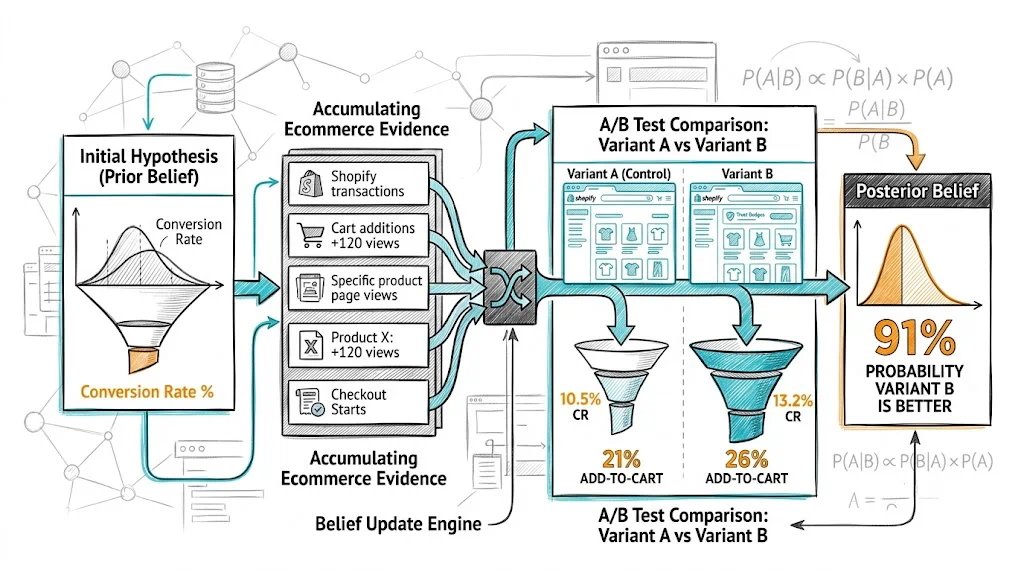
 Bayesian Statistics explained as an editorial whiteboard sketch.
Bayesian statistics is a framework for probability and inference that updates beliefs about an outcome as new evidence accumulates. Unlike frequentist statistics — which treats probabilities as fixed properties of a repeating experiment — Bayesian statistics treats probability as a degree of belief that starts with prior knowledge and updates with observed data. In A/B testing, this translates to outputs like "there is an 87% probability that Variant B is better than control," which is more intuitive and actionable than a p-value.
The core formula is Bayes' Theorem:
P(H|Data) = P(Data|H) × P(H) / P(Data)
Where P(H|Data) is the posterior probability (updated belief after seeing data), P(Data|H) is the likelihood (how probable the data is given the hypothesis), P(H) is the prior (initial belief), and P(Data) is the normalizing constant.
Why Bayesian Statistics Matters for Ecommerce
For D2C brands running A/B tests, Bayesian statistics offers two practical advantages over the traditional frequentist approach. First, you can check results at any time without inflating false positive rates — the Bayesian framework naturally handles peeking. This matters enormously for high-traffic Indian ecommerce events (Diwali sales, Republic Day) where you might need to make a call after 2 days, not 2 weeks.
Second, Bayesian outputs are business-readable. Telling a founder "Variant B has a 91% probability of beating control" is clear and actionable. Explaining "the p-value is 0.04, which is below our significance threshold of 0.05" requires statistical literacy that most business teams lack, creating friction in test-and-learn culture.
Bayesian testing also quantifies expected uplift in probabilistic terms — "Variant B is expected to generate 8% more revenue per visitor, with 85% confidence" — letting teams make informed decisions even before reaching the sample size a frequentist test would require.
Real-World Example
Plum Goodness (Indian skincare brand) runs a Bayesian A/B test on their moisturiser product page, testing a new ingredient-focused description against the existing benefit-led copy. After 4 days and 3,200 visitors per variant, the Bayesian dashboard shows an 89% probability that the ingredient-focused variant drives higher add-to-cart rate. The prior was set based on historical data from similar tests on other SKUs. Instead of waiting for a frequentist test to hit 95% significance (which would require 7–8 more days), the team ships the winning variant. The 89% probability means they accept a roughly 11% chance they are wrong — a calculated risk that makes sense for a low-stakes copy change on a ₹600 product.
How to Improve / Optimize Bayesian Statistics in Testing
- Set informed priors. If you have historical test data, use it. A prior that reflects "our tests typically lift conversion rate by 2–8%" is more useful than a flat uninformed prior and produces faster, more reliable posteriors.
- Define your decision threshold before the test. Decide in advance: at what probability of winning will you ship? 90%? 95%? This prevents cherry-picking a threshold post-hoc when results almost reach it.
- Use expected loss, not just probability of winning. Expected loss quantifies how much revenue you give up if you're wrong — a variant with 85% probability of winning but high expected uplift may be worth shipping even below 90%.
- Don't confuse probability of winning with effect size. An 85% probability that Variant B wins could mean a 0.5% lift or a 15% lift. Always report the magnitude alongside the probability.
- Pick a Bayesian tool that shows credible intervals. These are the Bayesian equivalent of confidence intervals — they give you a range of plausible true values for the lift, not just a point estimate.
Bayesian Statistics in A/B Testing
Most modern A/B testing platforms offer a choice between Bayesian and frequentist statistical engines. CustomFit.ai uses Bayesian methods as the default for ecommerce experiments, giving operators a live "probability to be best" metric that updates as data comes in. This is especially practical for Indian D2C brands where test durations are constrained by flash sale calendars and high-traffic windows.
Run smarter A/B tests with CustomFit.ai — 14-day free trial, no credit card required.