From the conversion glossary
Concepts referenced in this article, defined.
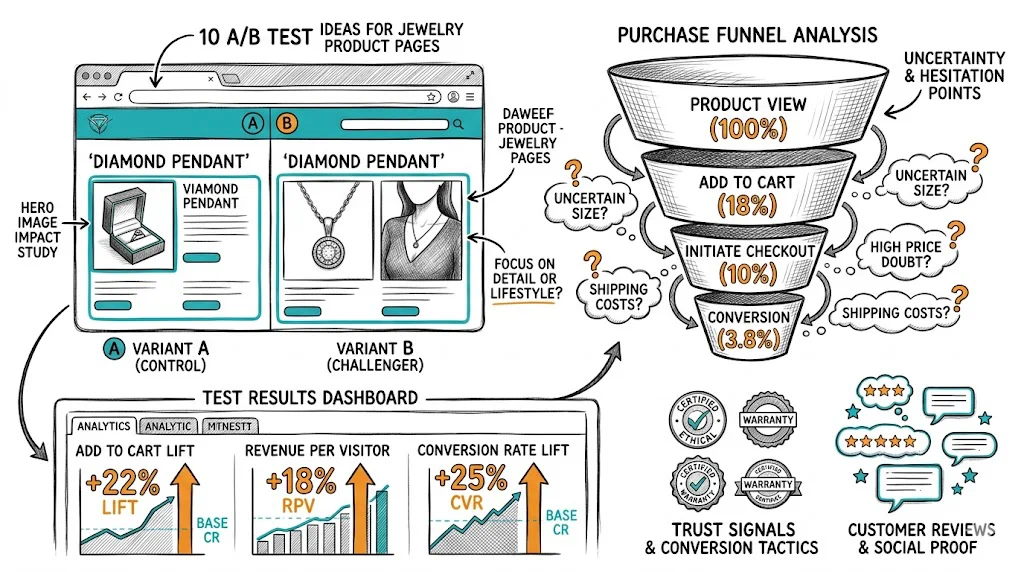
10 proven A/B test ideas for jewelry ecommerce product pages — photography style, trust signals, gifting UX, try-at-home offers, and COD prominence for Indian D2C brands.
 Ashwin KumarCo-Founder & CEO, CustomFit.ai7 min read
Concepts referenced in this article, defined.
 ab testing
A practical framework for discussing winning, losing and inconclusive A/B tests in growth, CRO and ecommerce job interviews.
 ab testing
A/B testing isn't magic. Learn about the common myths that waste traffic and skew results, plus how to run smarter tests that improve conversions.
 ab testing
Server-side A/B testing and edge experimentation explained - how they eliminate flicker, improve speed, and where they fit vs client-side testing.
Run rigorous A/B tests and personalize every visit on Shopify or any storefront — no engineers required.
Online jewelry brands face a conversion problem that other categories don't: you're asking someone to spend ₹2,000–₹50,000 on something they can't touch, try on, or examine in person. The brands winning in this space — Melorra, Youbella, Caratlane, Giva — have cracked this by making their product pages work harder to resolve purchase hesitation. These 10 A/B tests address the specific barriers to jewelry purchase decisions online.
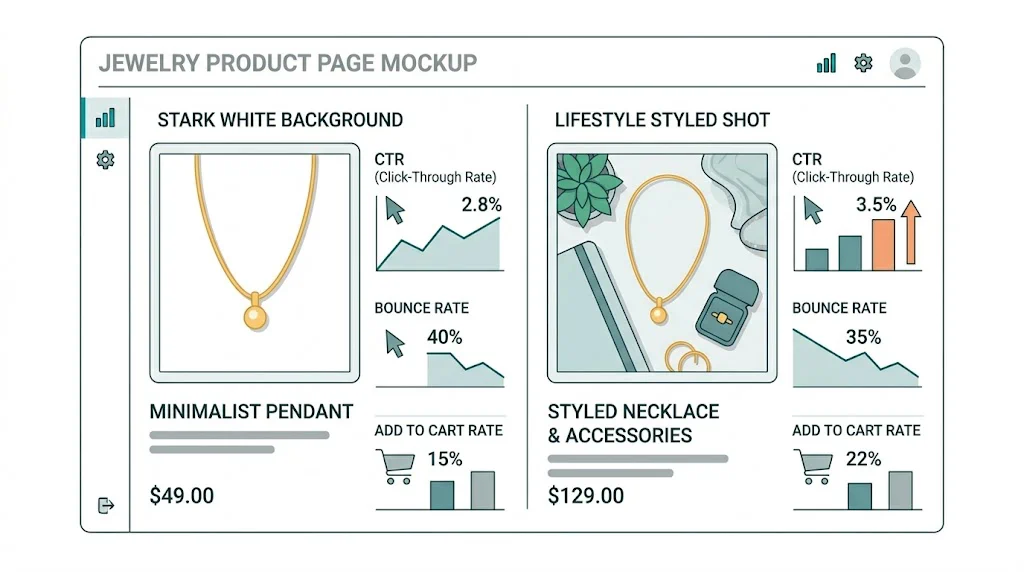
Hypothesis: Images showing jewelry worn on a model increase add-to-cart rate for fashion and everyday jewelry because visitors can imagine how the piece looks when worn, reducing photography anxiety.
Control: Jewelry on clean white background Variant: Same jewelry worn by a model, showing face/neck/wrist/hand in context
Expected lift: 15–30% CTR and add-to-cart improvement for fashion jewelry (earrings, necklaces, bracelets) Exception: For fine jewelry and solitaire rings, close-up product shots often outperform model shots because the detail view is more informative.
Hypothesis: A short video or 360° spin showing the jewelry from multiple angles — particularly capturing light reflection and movement — increases CVR because it's the closest online approximation of examining jewelry in person.
Control: 5–6 static product images from different angles Variant: 15-second product video or 360° interactive viewer as first media item
Expected lift: 12–25% add-to-cart rate improvement Production note: Even a smartphone video shot against a clean background, with good lighting to capture shine, can outperform professional static shots.
Hypothesis: Showing an image of the jewelry worn alongside a clear size reference ("This pendant is 18mm, shown on a 5'4" model with a 16" chain") reduces size uncertainty better than a standalone dimension chart.
Control: Dimension measurements in product description ("Pendant: 18mm diameter") Variant: Image with dimension overlay or visual size reference showing piece in scale
Expected lift: 10–18% CVR improvement, particularly for earrings and pendants where scale misperception leads to returns.
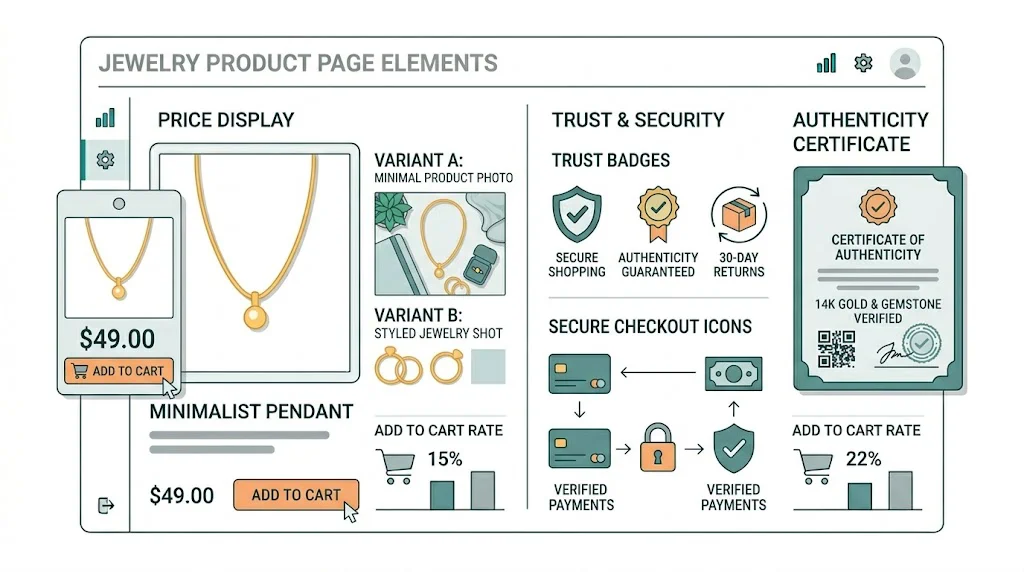
Hypothesis: Prominently displaying BIS hallmark certification, purity guarantee, or authenticity certificate (with certificate ID visible) near the price and CTA reduces authenticity doubt and increases CVR for gold and silver jewelry.
Control: "BIS Hallmarked" text in product description Variant: Visual certificate badge with "Click to verify" option near the price
Expected lift: 15–25% CVR improvement for precious metal jewelry Specifically important for: First-time buyers, Tier 2/3 city visitors, and gifting purchases where authenticity is a key concern.
Hypothesis: Prominently offering free gift wrapping (with a preview image of the packaged product) increases CVR for jewelry because a large percentage of jewelry purchases are gifts, and making the gifting experience feel complete reduces purchase hesitation.
Control: Standard product listing, gift wrapping mentioned as an option in notes Variant: "Free gift wrapping included" badge near the CTA with a small image of the branded gift box
Expected lift: 12–20% CVR improvement for gifting segments (visitors around Diwali, Valentine's Day, anniversary dates) Segment this: Run specifically on visitors from gift-intent search queries or festive ad campaigns.
Hypothesis: A "Try for 7 days, return if you don't love it — free returns" offer converts hesitant first-time buyers by eliminating the return anxiety that prevents online jewelry purchases.
Control: Standard "Easy 30-day returns" policy in footer Variant: "Try at home for 7 days — free returns, no questions asked" prominently displayed near the CTA
Expected lift: 20–35% CVR improvement for higher-value pieces (₹3,000+) Monitor: Return rate closely. If returns exceed 15%, the product photography may be creating unrealistic expectations.
Hypothesis: Making COD explicitly available — and its process simple — for jewelry purchases above ₹2,000 increases CVR among first-time buyers in Tier 2/3 cities who are unwilling to pay in advance to an unfamiliar brand for a high-consideration purchase.
Control: COD available at checkout, not mentioned on product page Variant: "Cash on Delivery available — pay when your jewelry arrives" badge near the price
Expected lift: 15–25% CVR improvement for Tier 2/3 geo-targeted sessions Note: Also include the delivery timeline: "Order today, delivered in 3–5 days, pay on delivery."
Hypothesis: Offering an engraving or customization option ("Add a personal message, ₹199") directly on the product page increases AOV and CVR for jewelry by adding perceived uniqueness and gifting value.
Control: Standard product listing without customization option Variant: "Personalize this piece" expandable section below the CTA, with engraving or custom tag options
Expected lift: AOV improvement of 15–25% for personalized additions; 8–12% overall CVR improvement (more visitors find the product relevant for gifting)
Hypothesis: Showing jewelry styled by a recognizable Indian influencer or celebrity (with their attribution) near the hero image increases CVR by combining aspirational appeal with social proof.
Control: Customer review star rating as primary social proof Variant: "As styled by @[influencer]" image or short video clip with review star rating as secondary
Expected lift: 15–30% CVR improvement for fashion jewelry targeting a social-media-active demographic (18–35 age group) Note: Requires licensing agreement with the influencer for use of their image/video.
Hypothesis: Showing "Only 3 left in stock" (when genuinely true) or "Handcrafted — limited availability" on product pages increases urgency-driven conversions by communicating scarcity authentically.
Control: No stock level indicator Variant: Real-time stock level displayed: "Only [X] left" or "Limited handcrafted stock" for artisanal pieces
Expected lift: 10–20% CVR improvement when stock is genuinely limited; effect diminishes quickly if visitors notice the number doesn't change (false scarcity backfires severely in jewelry where trust is paramount).
| Test | Element | Primary Metric | Expected Lift |
|---|---|---|---|
| 1 | Model vs. product-only image | Add-to-cart | 15–30% |
| 2 | Video/360° vs. static gallery | Add-to-cart | 12–25% |
| 3 | Size reference format | CVR | 10–18% |
| 4 | Hallmark/certificate visibility | CVR | 15–25% |
| 5 | Gift wrapping offer | CVR (gift segment) | 12–20% |
| 6 | Try-at-home offer | CVR | 20–35% |
| 7 | COD prominence | CVR (Tier 2/3) | 15–25% |
| 8 | Personalization CTA | AOV + CVR | 15–25% AOV |
| 9 | Influencer styling social proof | CVR | 15–30% |
| 10 | Genuine scarcity signal | CVR | 10–20% |
See also: A/B Testing Pillar | Social proof glossary | Product page optimization guide.