From the conversion glossary
Concepts referenced in this article, defined.
Server-side A/B testing and edge experimentation explained - how they eliminate flicker, improve speed, and where they fit vs client-side testing.
Concepts referenced in this article, defined.
Run rigorous A/B tests and personalize every visit on Shopify or any storefront — no engineers required.
Anyone who has run an A/B test on a website has probably seen it: the page loads, shows the original version for a split second, then visibly swaps to the test variant. That flicker is not merely annoying. It can bias results, hurt your Core Web Vitals, and make the tested change look worse than it really is.
Flicker is also almost entirely a client-side testing problem. It is a major reason server side A/B testing has moved from a niche, enterprise-only technique to an approach more ecommerce teams are considering.
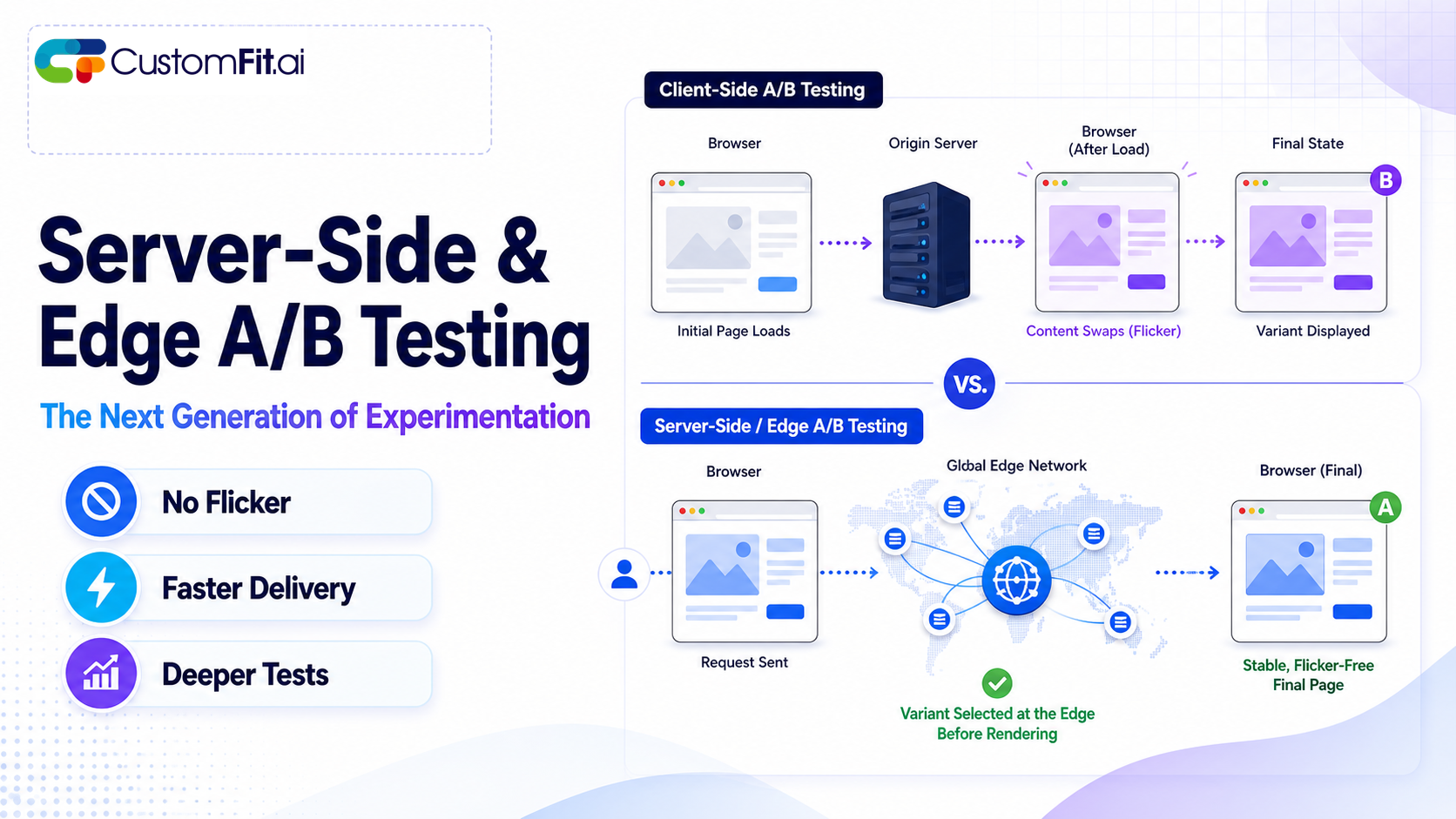
Most A/B testing tools historically worked by injecting a JavaScript snippet that runs after the page has already loaded. The script identifies which variant the visitor should see and rewrites the page on the fly.
That rewrite-after-load step causes flicker. It also adds delay because the browser must load the original page, load the experimentation script, assign the visitor to a variant, and apply the changes before the page becomes stable.
For a checkout flow, a pricing test, or anything layout-heavy, that lag is not cosmetic. It is friction - exactly the kind of problem conversion optimization is supposed to remove rather than introduce.
Server-side versus client-side testing comes down to where the variant decision happens. Instead of the browser choosing a variant after the page loads, the server decides which version to send before the page reaches the browser.
In an edge-experimentation setup, that decision can happen at a CDN node sitting physically closer to the visitor. The first response already contains the correct final version: no swap, no visible flicker, and no browser-side rewrite.
CDN-based A/B testing pushes the decision across geographically distributed edge servers rather than routing every request to a single origin. This keeps the latency added by experimentation logic low, which becomes increasingly valuable as traffic becomes more global.
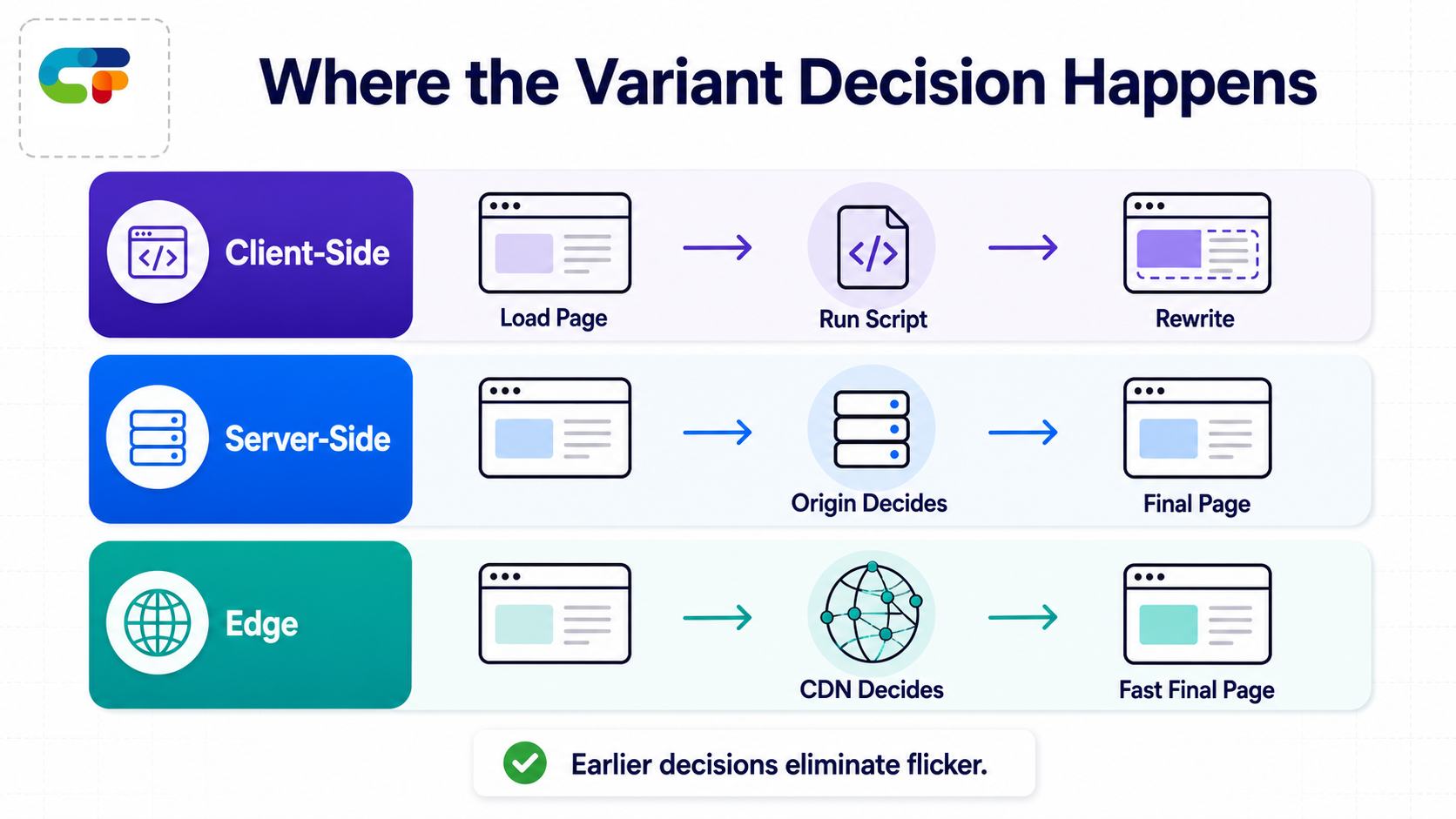
Flicker-free delivery avoids the layout shifts and rendering delays that browser-side rewrites can introduce. That improves the visitor experience and protects search ranking signals tied to page speed and visual stability.
Client-side tools are mainly limited to changes that JavaScript can manipulate after a page loads: text, layout, and visible elements. Server-side experimentation can vary backend logic itself, including different pricing algorithms, different recommendation engines, checkout flows, and API responses.
That opens a class of logic-level tests that browser-based visual tools were never designed to handle.
Because the decision happens before the experience reaches the user interface, server-side testing works naturally across native apps, headless storefronts, and surfaces that do not run the usual browser experimentation script.
The infrastructure that supports edge experimentation can also enable real-time personalization, such as serving a different homepage banner or offer based on geography or segment. The selection occurs at the edge before the page loads, avoiding the flicker caused by client-side personalization.
Server-side testing is not strictly better for every experiment. It introduces real trade-offs:
Use client-side testing for copy changes, layout adjustments, visual elements, and quick low-risk experiments where launch speed matters more than perfect delivery.
Use server-side or edge testing for checkout and pricing tests, anything where flicker would meaningfully bias results or reduce conversion, experiments involving backend logic or personalization rules, and tests that must remain consistent across web, apps, and other frontends.
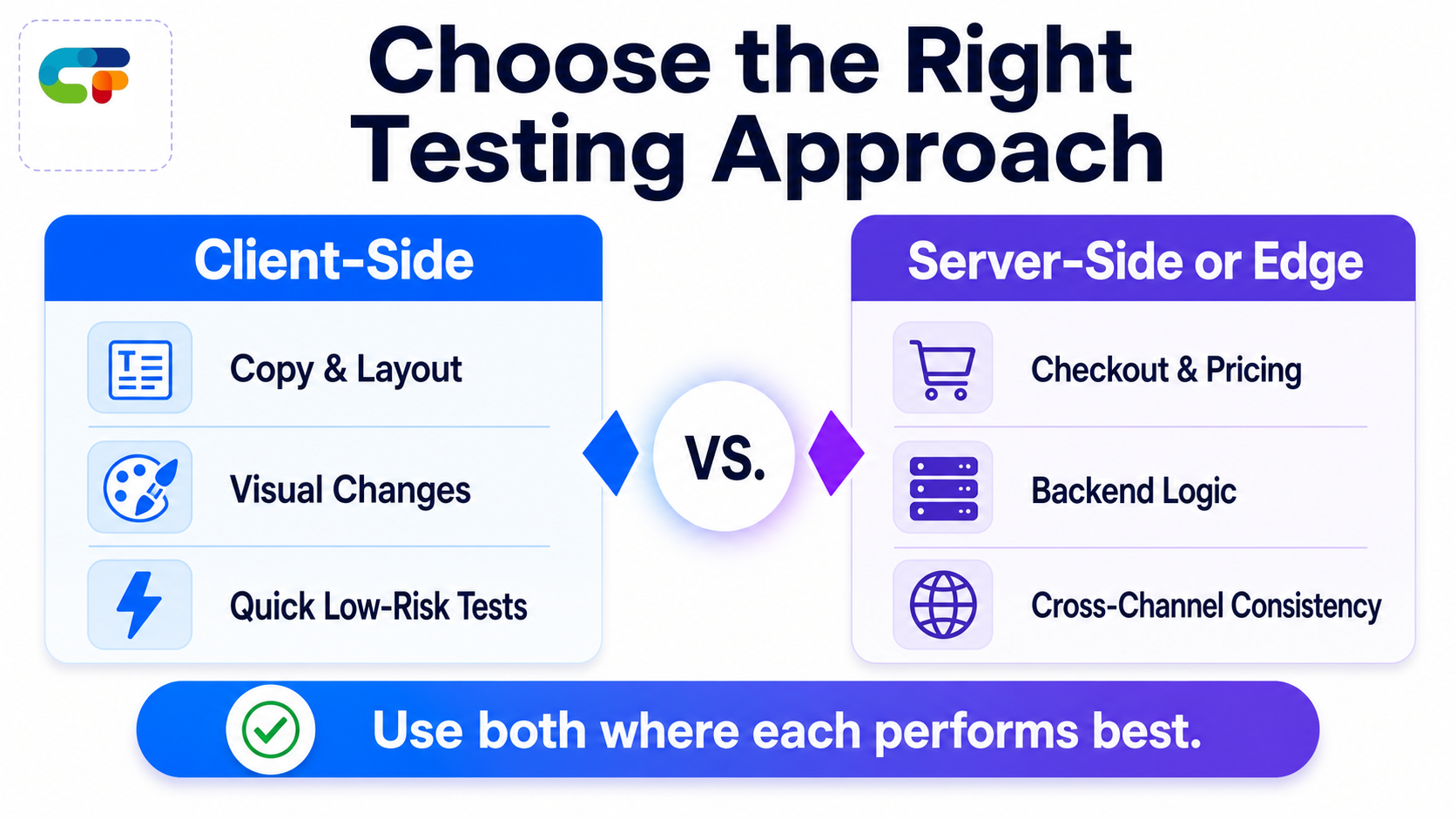
Many mature experimentation programs use both: client-side tools for fast iteration on presentation, and server-side infrastructure for deeper, higher-stakes experiments where flicker, speed, and consistency genuinely matter.
The most common mistake is defaulting entirely to server-side testing because it sounds more sophisticated, then waiting on engineering resources for changes that never required backend involvement.
The opposite mistake is equally costly: running a high-stakes checkout or pricing test entirely client-side and accepting visible flicker as unavoidable. That delivery problem can quietly influence visitor behavior and skew the experiment.
Server side A/B testing and its edge-based variants solve problems that client-side tools structurally cannot: eliminating flicker, testing backend logic, and delivering a consistent experience from the first render.
They are not a wholesale replacement for browser-based experimentation. They are the right tools for the subset of tests where performance, consistency, delivery quality, and application depth justify the additional engineering investment.