From the conversion glossary
Concepts referenced in this article, defined.
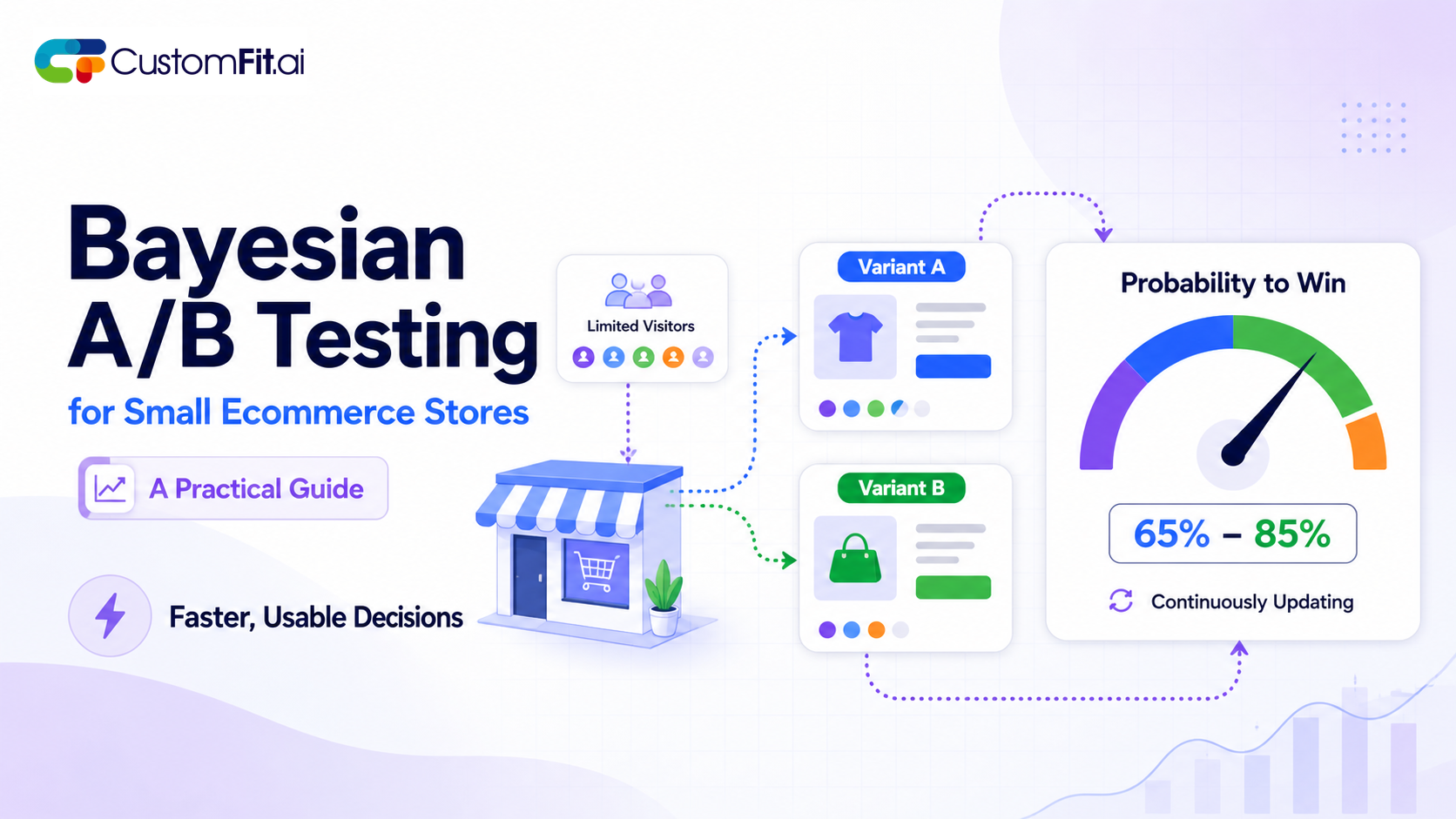
A practical guide to Bayesian A/B testing for small stores - how to get faster, more usable test results without the traffic a big brand has.
 Yuvraj Singh6 min read
Concepts referenced in this article, defined.
 ab testing
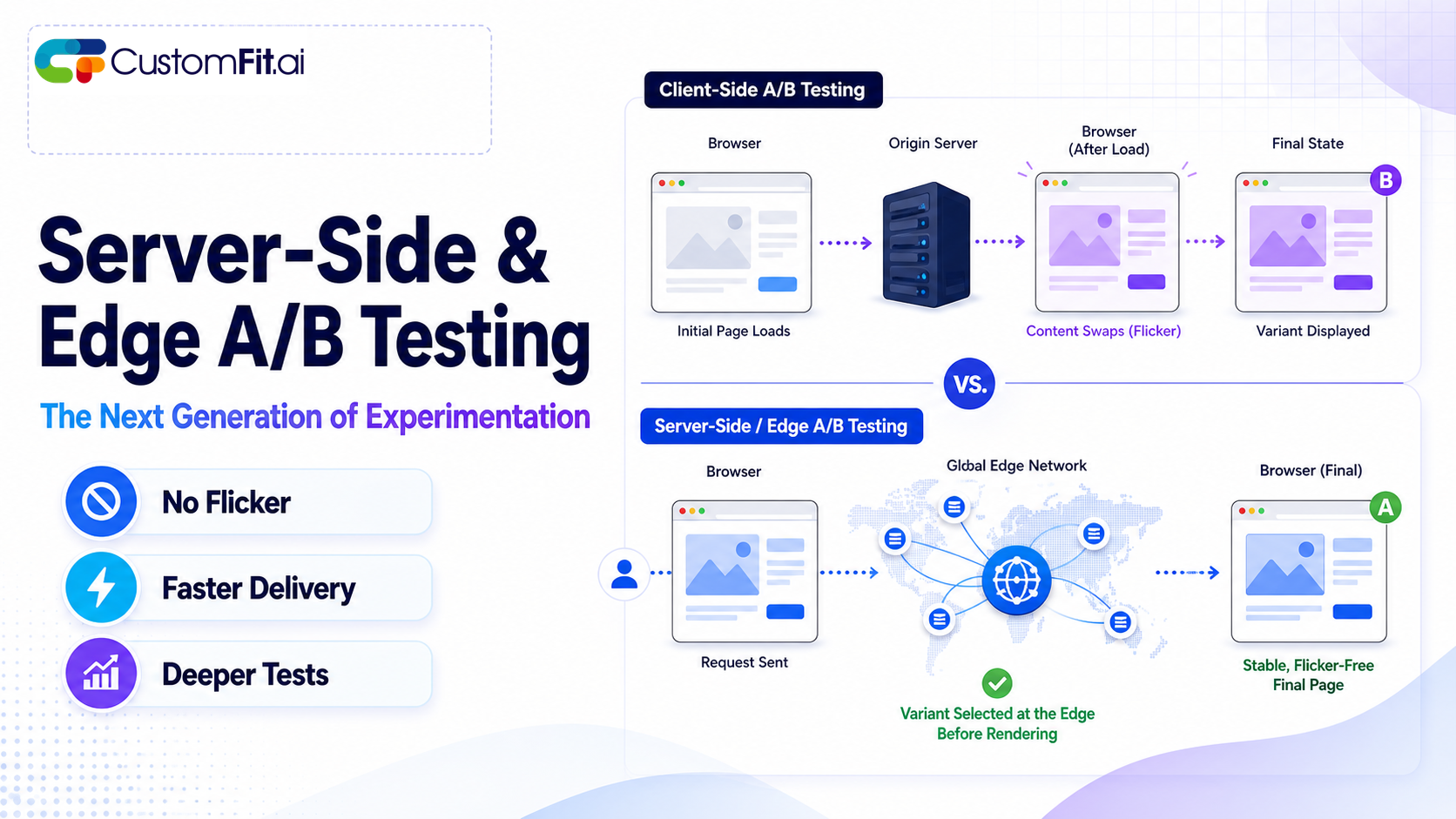
Server-side A/B testing and edge experimentation explained - how they eliminate flicker, improve speed, and where they fit vs client-side testing.
 ab testing
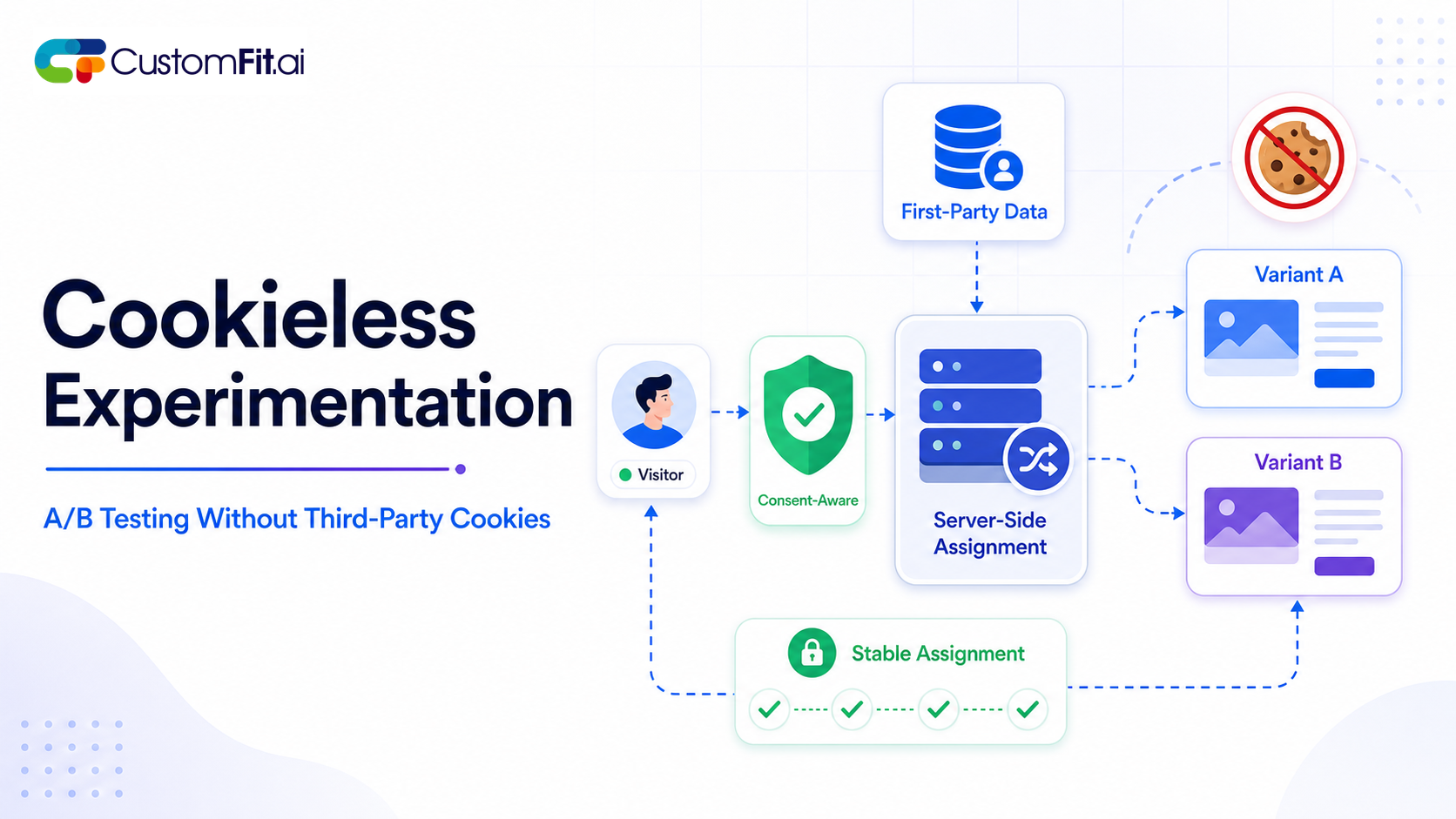
How to run cookieless A/B testing correctly in 2026 - first-party data, GDPR compliant methods, and what actually changed with third-party cookies.
 ab testing
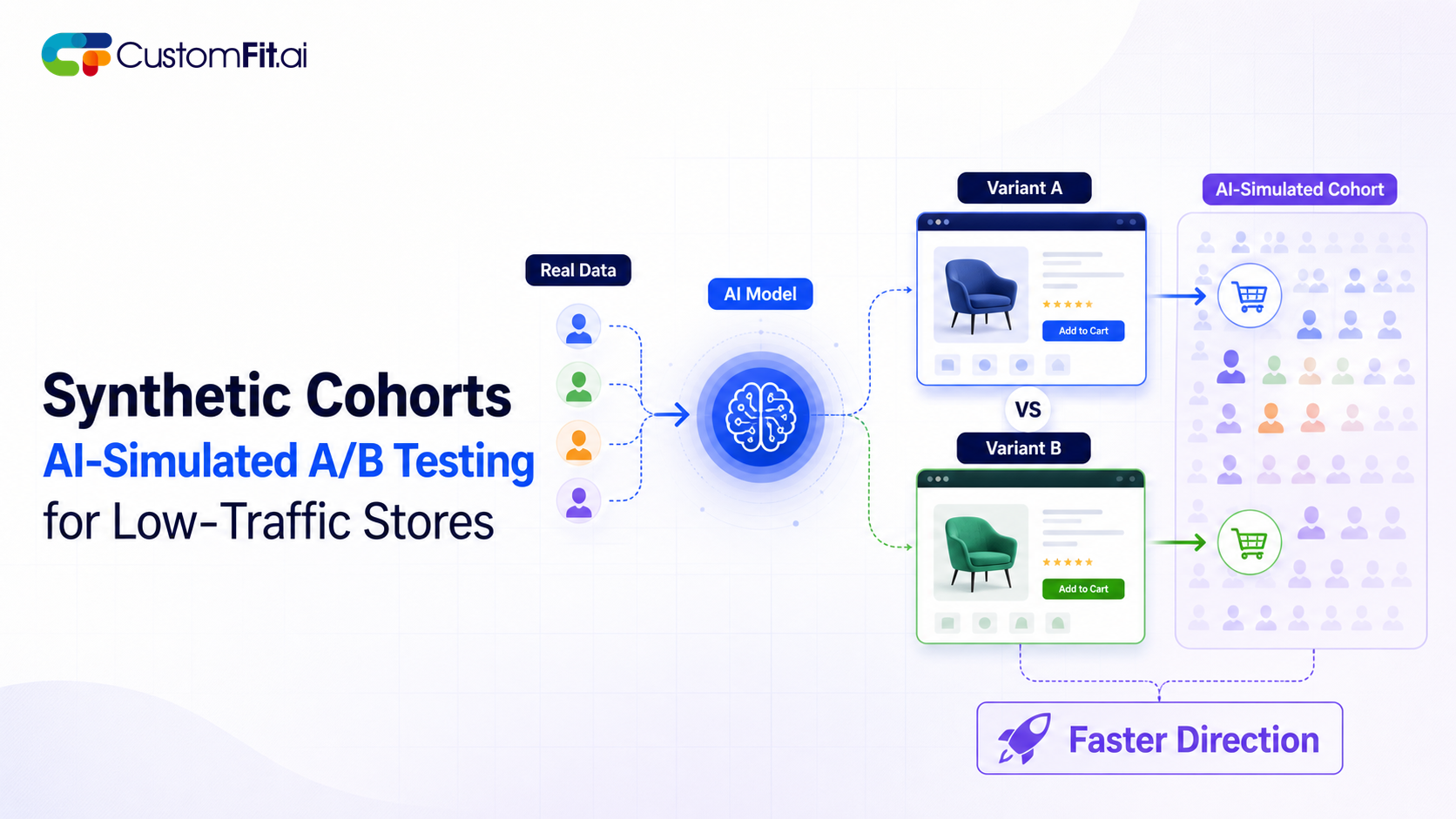
Not enough traffic to A/B test properly? Here's how synthetic cohort testing and AI-simulated experimentation help low-traffic stores test with confidence.
Run rigorous A/B tests and personalize every visit on Shopify or any storefront — no engineers required.
Most A/B testing advice is written for businesses with a lot of traffic. It sounds simple: "Run your test for at least two weeks." "Wait until you hit 95% significance." "Don't peek at results early."
For a large brand, those rules are manageable. For a small ecommerce store, they can make a useful test drag on for weeks or months. By the time the result arrives, the promotion may be over, the catalog may have changed, or the team may have already made the decision by instinct.
Bayesian A/B testing offers a different framework. It does not manufacture certainty from limited traffic, but it gives smaller stores a clearer, more practical way to reason about the evidence they do have.
Classic frequentist statistics asks a specific question: if there were really no difference between variant A and variant B, how likely would it be to observe a result this extreme? The answer is summarized by a test statistic and a p-value.
That framework normally requires you to decide the sample size before the test begins and avoid repeatedly checking the result. If you keep stopping whenever a promising result appears, that's called peeking, and it inflates the false-positive rate.
The method is rigorous, but its practical requirements fit high-traffic sites better. A smaller store may struggle to collect the sample needed to detect a realistic lift, leaving a test unresolved even when the result is commercially useful.
Bayesian A/B testing starts from a prior: an explicit estimate of what is plausible before the current test data arrives. As visitors convert or do not convert, the model updates that belief and produces a probability distribution for each variant.
That creates two practical differences:
For a store owner, that is often easier to act on than a binary significant/not-significant label.
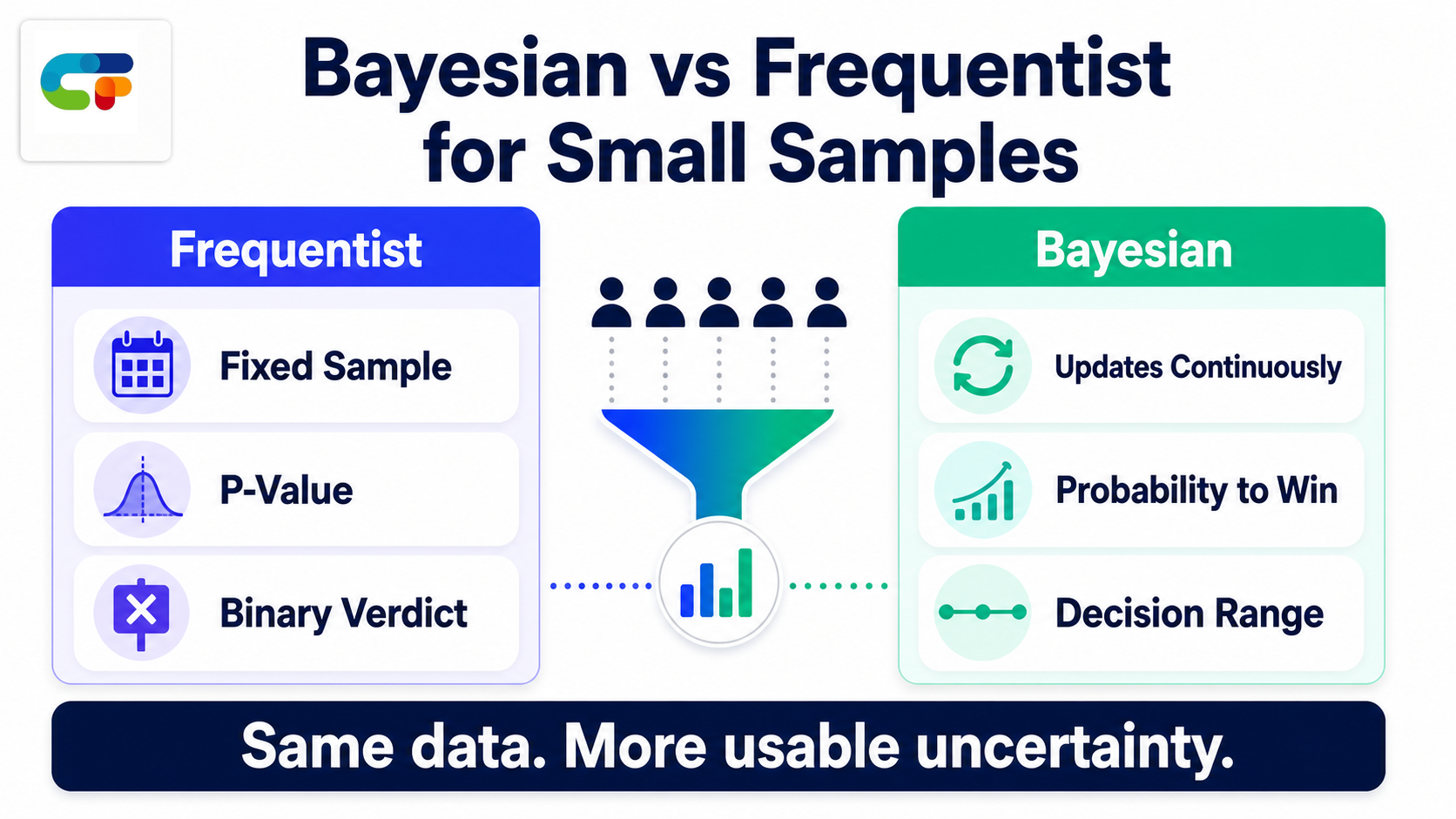
With a small sample, a frequentist test often ends as inconclusive. That does not prove the variants are equal; it only means the experiment did not collect enough evidence to reject the no-difference assumption at the chosen threshold.
A Bayesian analysis does not turn that same small sample into certainty. Instead, it states the uncertainty directly. You may learn that variant B has a 72% chance of winning, but that the plausible outcome still ranges from a small loss to a meaningful gain.
That distinction matters because an inconclusive test also has an opportunity cost. A team can spend weeks waiting for a clean binary result while delaying the next experiment. Bayesian reporting lets the business decide whether the current probability and potential upside justify acting, waiting, or moving on.
Bayesian testing does not literally make the data arrive faster. It helps you extract a more usable decision from the same evidence. Small stores can do that responsibly with four habits:
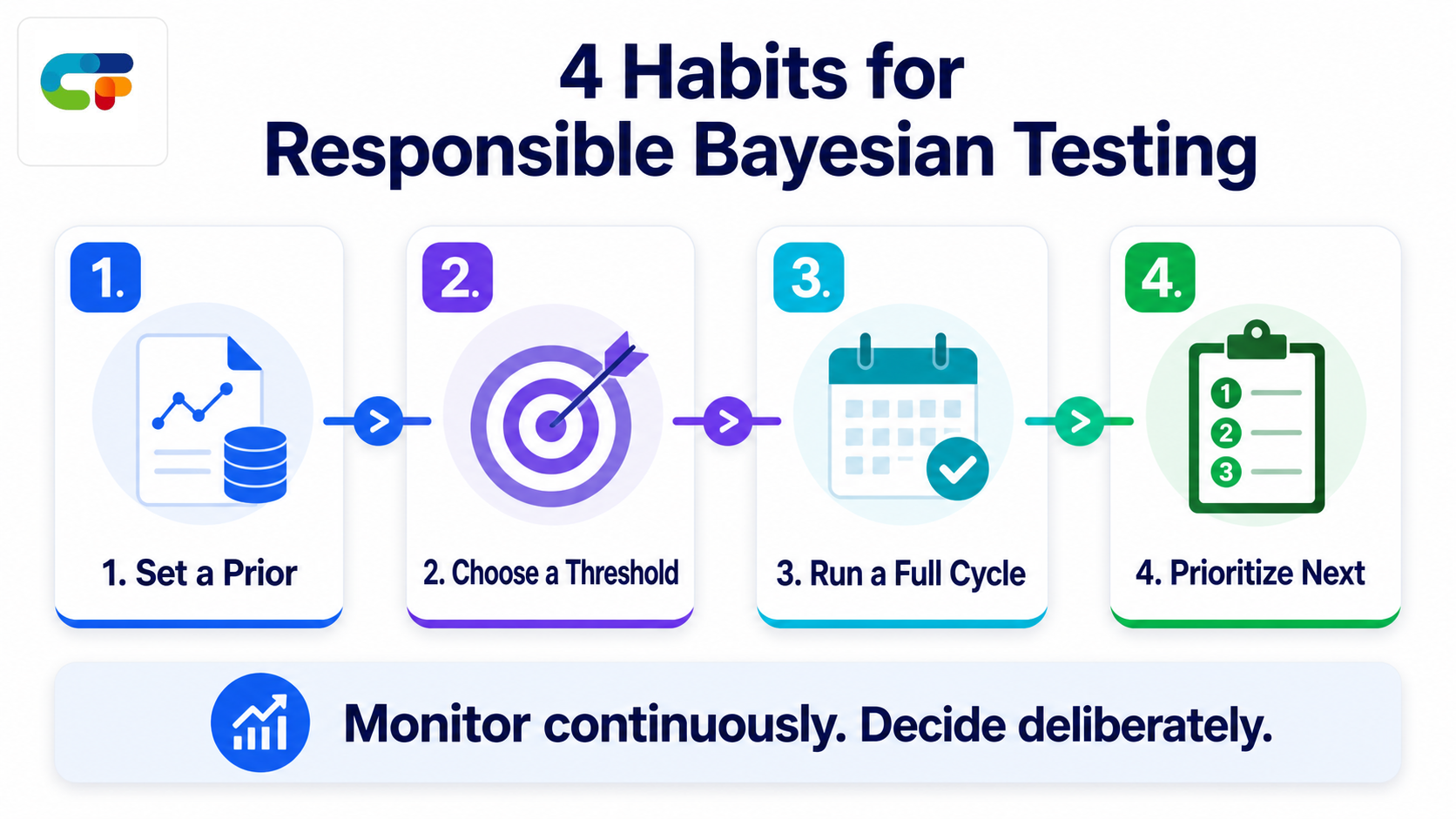
The first mistake is treating a weak prior as a fact. A prior should be documented, defensible, and open to being overruled by new evidence. The second is ending a test the moment its probability crosses a threshold, even if the sample covers only a few hours or one acquisition channel.
Another mistake is focusing only on the probability of winning. A 90% chance of a 0.2% lift may be less valuable than an 80% chance of a 7% lift, depending on implementation cost and downside risk. Look at probability, likely effect size, uncertainty range, and business impact together.
Finally, do not use Bayesian language to disguise a gut decision. If your team changes its threshold after seeing the result, ignores an unfavorable range, or selects a prior to favor one version, the model cannot rescue the process.
Bayesian A/B testing is useful for small ecommerce stores because it matches the decision they actually need to make: given the evidence available now, how likely is this variant to be better, by how much, and is that enough confidence for the risk involved?
It will not replace representative traffic or thoughtful experimentation. It will, however, help a low-traffic team use limited data more honestly, avoid months of unresolved testing, and make clearer decisions without pretending uncertainty has disappeared.