From the conversion glossary
Concepts referenced in this article, defined.
Concepts referenced in this article, defined.
Run rigorous A/B tests and personalize every visit on Shopify or any storefront — no engineers required.
Attribution modeling is how ecommerce brands figure out which marketing channels deserve credit for a sale. Without it, you're flying blind—spending money on channels that look good in dashboards but may not actually be driving revenue. The right attribution model reveals the true customer journey so you can invest in what works.
Most ecommerce stores default to last-click attribution. It's simple: whoever touched the customer last gets 100% of the credit. A shopper sees your Instagram ad, reads a blog post, gets a retargeting ad on Google, then buys. Last-click gives all credit to Google.
The problem: you'll scale Google retargeting spend, cut Instagram (which started the journey), and watch your new customer acquisition dry up within 60 days.
Indian D2C brands running festive campaigns face this especially hard. During Diwali or Raksha Bandhan, customers research for weeks across Meta, YouTube, and influencer content before converting through a branded search or email discount. Last-click makes email look like a hero. It isn't—email just happened to carry the coupon code.
First-click attribution has the opposite problem—it over-credits awareness channels and ignores the channels that nudge customers to convert.
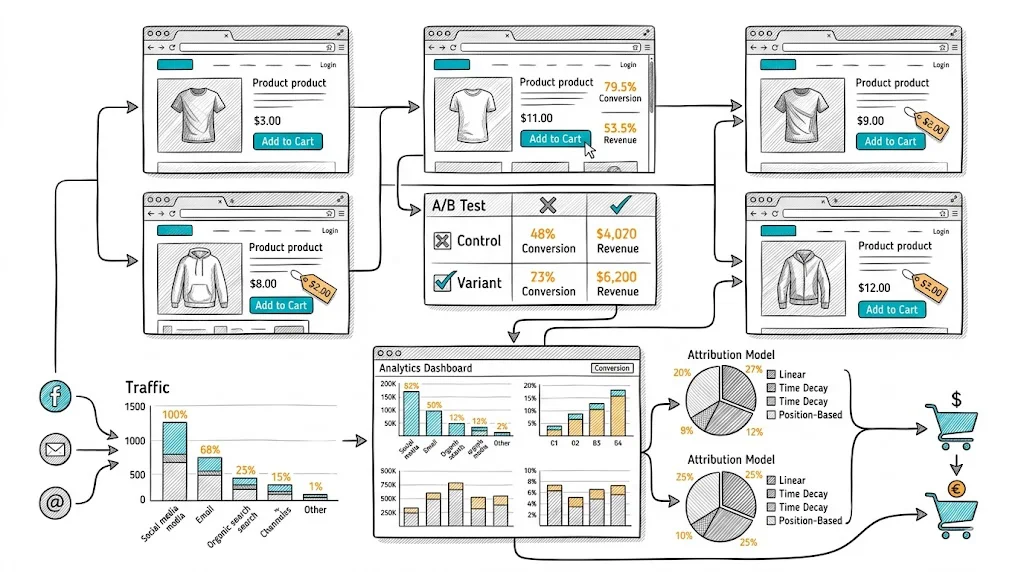
| Model | How it works | Best for |
|---|---|---|
| Last-click | 100% credit to final touchpoint | Simple reporting, not strategy |
| First-click | 100% credit to first touchpoint | Top-of-funnel brand campaigns |
| Linear | Equal credit to all touchpoints | Understanding full journey |
| Time-decay | More credit to recent touchpoints | Short sales cycles |
| Position-based | 40% first, 40% last, 20% middle | Balancing awareness + conversion |
| Data-driven | ML assigns credit based on actual conversion patterns | Brands with high data volume |
For most D2C brands doing ₹5 crore+ annually, position-based or linear attribution gives a more accurate picture without requiring heavy data science infrastructure.
Before picking a model, map how your customers actually discover and buy from you. Run a quick survey with recent buyers: "How did you first hear about us?" Cross-reference with your analytics data.
Common D2C journeys:
GA4's default is last-click. Change it:
For Shopify stores, install the GA4 integration properly. Make sure purchase events fire with the correct transaction_id so you're not double-counting.
In GA4, go to Advertising → Attribution → Conversion paths. Filter for your primary conversion event (purchase). You'll see the actual sequences of channels customers use.
Look for:
Every ad platform over-reports. Meta claims credit for conversions that Google also claims. Add up Meta + Google + email attributed revenue and it will often be 2-3x your actual Shopify revenue.
The fix: use your Shopify or actual order data as the source of truth. Then use attribution as a directional guide, not an exact accounting.
Data-driven attribution uses machine learning to assign fractional credit based on which touchpoint combinations actually lead to conversion versus those that don't. It requires:
Brands like Kapiva and Mamaearth, running large-scale Meta + Google campaigns, benefit from data-driven attribution because the model catches nuances like "Instagram Stories + Gmail ad + branded search" converting at 3x the rate of "Instagram Stories alone."
For smaller brands, data-driven becomes noisy. Stick with linear or position-based until you hit scale.
One challenge unique to Indian ecommerce: COD orders. Attribution breaks when:
Fix: pass UTM parameters into your order confirmation flow. Tools like Postman or custom Shopify scripts can capture the first-touch UTM and store it with the order. This lets you attribute COD orders properly even when the payment session breaks the attribution chain.
UPI payments (PhonePe, GPay, Paytm) also redirect users out of your store, sometimes breaking GA4 session attribution. Use server-side tracking or Shopify's checkout extensibility to capture these correctly.
Once you have reliable multi-touch data, here's how to act on it:
Cut overly credited channels: If retargeting Google ads show up as "last touch" almost every conversion but rarely appear as "first touch," they may be capturing demand rather than creating it. Test reducing spend by 20% and watch if new customer acquisition drops or just your ROAS number (which was inflated anyway).
Invest in under-credited channels: Organic search, influencer content, and PR often drive first-touch but never get last-touch credit. If your path analysis shows 40% of buyers researched via organic blog posts, that's a signal to invest in content.
Adjust campaign objectives: Channels that show up in the middle of paths are nurture channels. Run them as awareness campaigns with CPM bidding, not conversion campaigns with CPA targets. They play a different role.
Attribution data tells you which channels are working. A/B testing tells you what happens when those visitors land on your site. The two work together.
If Instagram is a major first-touch channel, test landing pages specifically built for cold traffic—visitors who don't know your brand yet. If email is your strongest conversion channel, test subject lines, discount structures, and email timing.
CustomFit.ai lets you run those landing page tests without a developer. Visitors coming from different channels can be shown different experiences—matching the message to where they are in their journey. Brands using CustomFit.ai have seen 11% average conversion rate improvement by aligning landing experience with traffic source.
Explore how personalization works with your traffic sources →