From the conversion glossary
Concepts referenced in this article, defined.
Concepts referenced in this article, defined.
Run rigorous A/B tests and personalize every visit on Shopify or any storefront — no engineers required.
Most D2C brands treat their customer list as one audience. They send the same email to their best customer of 3 years and to someone who bought once during a Diwali sale. The result: best customers feel ignored, lapsed customers never come back, and promising new buyers get the same generic follow-up as everyone else. RFM segmentation fixes this. It's a straightforward, high-impact framework that lets D2C brands identify exactly who each customer is and treat them accordingly. This guide covers how RFM works, how to build it, and how to turn segments into revenue.
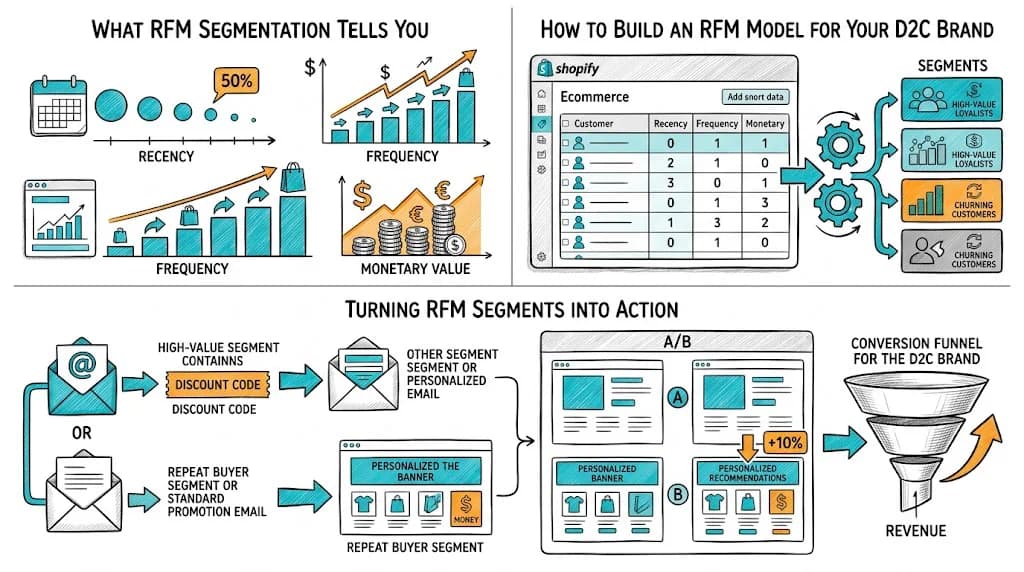
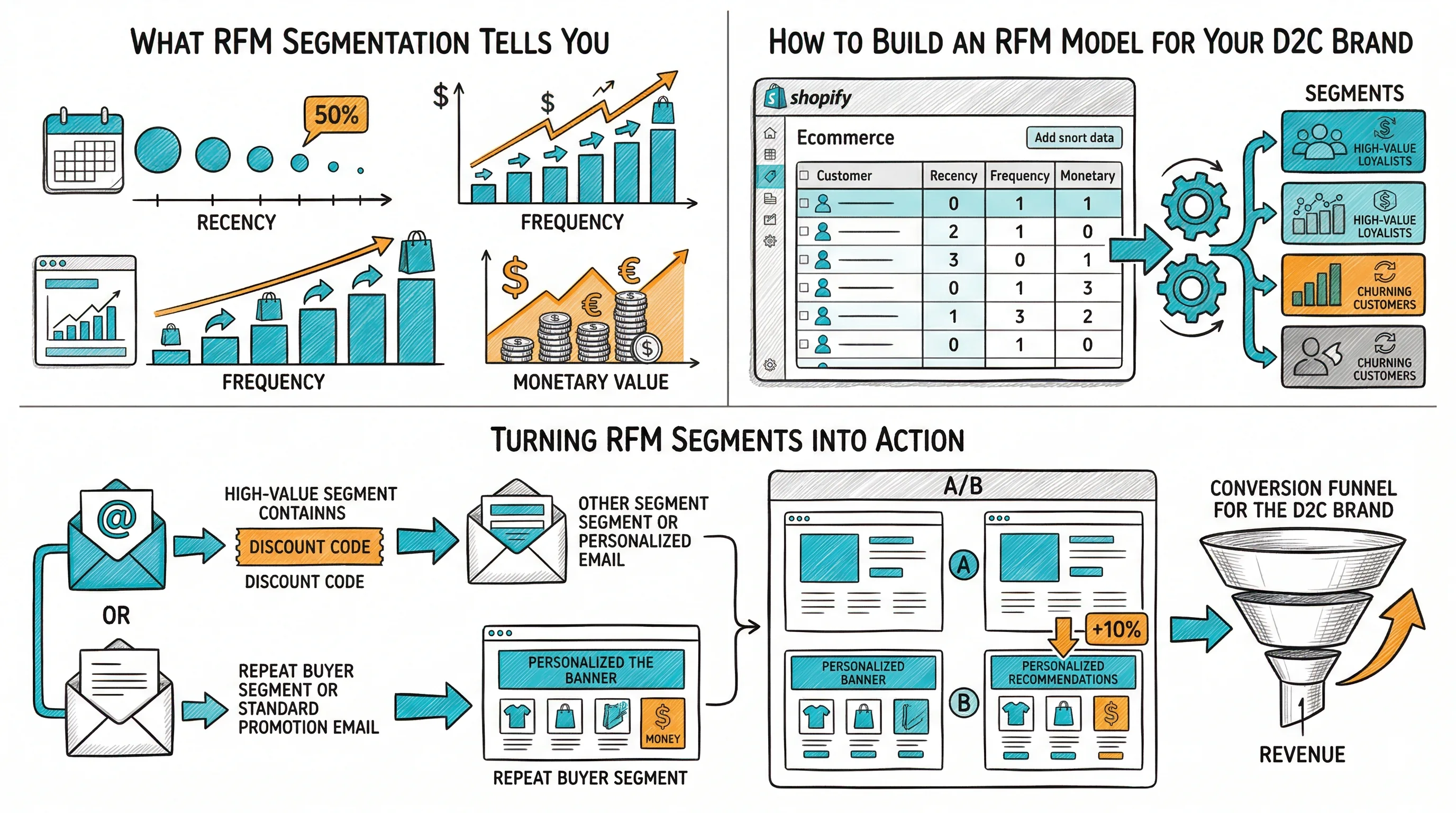
RFM is a customer segmentation framework built on three behavioral dimensions:
Recency (R): How recently did the customer last purchase? A buyer who ordered 10 days ago is more likely to buy again than one who ordered 10 months ago.
Frequency (F): How many times has the customer purchased in a given period? A customer who has bought 8 times is more valuable and more loyal than one who has bought twice.
Monetary (M): How much has the customer spent in total or on average? High-spend customers have different needs and preferences than low-spend buyers.
Each customer gets a score on each dimension (typically 1–5, with 5 being best). A customer who scores 5-5-5 is your ideal customer: bought very recently, buys frequently, and spends the most. A customer who scores 1-1-1 is dormant and low-value.
The power of RFM is that you can cluster similar scores into segments and run targeted campaigns for each segment — instead of blasting your entire list with the same message.
Step 1: Pull your order data
Export from your ecommerce platform (Shopify, WooCommerce, etc.) or CRM:
Define your analysis window — typically the last 12–24 months for D2C brands with monthly replenishment cycles.
Step 2: Calculate Recency
Recency = days since the customer's most recent order.
Rank customers by recency and divide into 5 equal groups (quintiles):
Step 3: Calculate Frequency
Frequency = total number of orders in the analysis window.
Rank and divide into 5 quintiles the same way. A customer who has ordered 12 times in 12 months scores 5; a customer who ordered once scores 1 or 2.
Step 4: Calculate Monetary
Monetary = total spend in the analysis window.
Rank and divide into 5 quintiles. Your top 20% spenders score 5.
Step 5: Combine into a score
Each customer now has an RFM score: R(1–5), F(1–5), M(1–5). Combine as a 3-digit score (e.g., 5-4-3) or as a weighted sum if you want a single number.
| Segment | RFM Profile | Description |
|---|---|---|
| Champions | R5, F5, M5 | Bought recently, buy often, highest spend |
| Loyal Customers | R4-5, F3-5, M3-5 | Regular buyers with solid spend |
| Potential Loyalists | R4-5, F1-2, M1-3 | Recent buyers who could become loyal |
| New Customers | R5, F1, any M | First-time buyers — need nurturing |
| Promising | R3-4, F2-3, M1-3 | Moderate recency and frequency, not yet VIP |
| Need Attention | R3, F2-3, M2-3 | Above average, but starting to slip |
| At Risk | R2-3, F2-4, M2-5 | Were good customers; drifting away |
| Can't Lose Them | R1-2, F4-5, M4-5 | Were your best customers; now dormant |
| Hibernating | R1-2, F1-2, M1-3 | Low activity across all dimensions |
| Lost | R1, F1, M1 | Bought once, long ago, never returned |
For most D2C brands, the three highest-priority segments to act on immediately are: Champions (protect and reward), At Risk (re-engage before they're lost), and Potential Loyalists (nurture to Loyal status).
These are your most valuable customers. Treat them like VIPs:
What NOT to do: Send them the same discount email you send everyone else. Champions don't need discounts — they need to feel seen.
These were good customers who are starting to drift. You have a window to win them back:
For D2C brands with RFM data, the At Risk win-back sequence is often the highest-ROI campaign they can run. You're spending retention budget on people who've already proven they'll buy.
These were your best customers — high frequency, high spend — but they haven't bought recently. This is a fire-alarm situation:
Recent buyers who haven't yet developed a habit:
You don't need a data science team to run RFM. Here's how to do it at a D2C scale:
Using Shopify: Export orders to a CSV → use Google Sheets or Excel with COUNTIFS and SUMIFS formulas to calculate F and M → calculate R using date difference formulas → use PERCENTRANK to assign scores 1–5.
Using Klaviyo or similar email tools: Most modern email marketing platforms (Klaviyo, MoEngage, WebEngage) have built-in segmentation that approximates RFM — use their "purchase date," "order count," and "total spend" segment conditions without building the full RFM model manually.
Using a dedicated analytics tool: Tools like Putler, Metorik, or Glew build RFM dashboards automatically from your Shopify/WooCommerce data.
Once you have the segments, you can feed them into CustomFit.ai for on-site personalization — Champions see a loyalty program CTA on the homepage, At Risk customers see a win-back offer, New Customers see the "Getting started" guide.
Festive season volatility: Diwali and other major festive sales create a spike in one-time buyers who score high on Monetary but may never return. Separate your festive-acquisition cohort from your organic RFM segments for at least 60 days — their behavior patterns are different.
COD order quality: COD orders in India have higher return and non-delivery rates. Consider excluding COD orders that resulted in returns from your Monetary score calculation, or creating a separate "confirmed purchase" Monetary metric.
Repeat purchase cycle by category: Adjust your Recency scoring based on the natural replenishment cycle of your product. A skincare brand where products run out in 45 days has a very different recency threshold than a home decor brand where repurchase is opportunistic. Your "At Risk" threshold should be calibrated to "one cycle beyond expected repurchase" — not a fixed number of days.
After implementing RFM-based campaigns, track:
Related reading: Analytics & Data Pillar | D2C Brand Growth Pillar | Customer Lifetime Value | Customer Acquisition Cost