Cognitive biases systematically influence how buyers make decisions on your ecommerce store — and understanding them is one of the highest-leverage CRO skills available. Buyers do not make purely rational decisions. They are influenced by how information is framed, what they see first, what their peers have done, and dozens of other psychological shortcuts. Applying cognitive bias principles to your product pages, checkout flow, and pricing design can improve conversion rates 10–30% without changing your product, price, or traffic source.
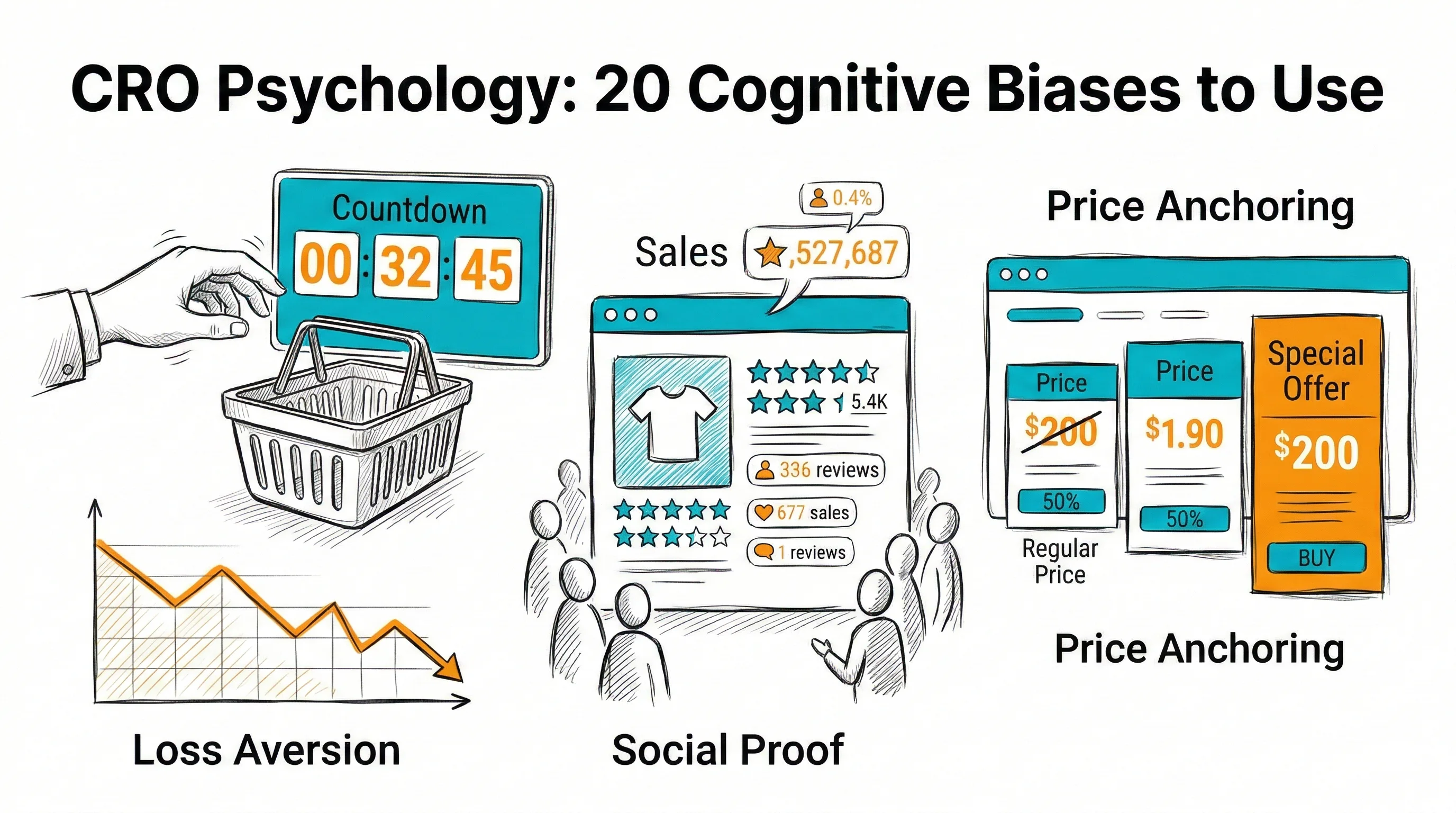
1. Loss Aversion
People feel the pain of losing something roughly twice as strongly as the pleasure of gaining something equivalent. This is the most powerful bias in ecommerce CRO.
Application:
- "Don't miss your ₹300 off" > "Get ₹300 off"
- "Your skin care routine is incomplete without this" > "Add this to your routine"
- "Only 6 units left — don't lose your chance" (authentic scarcity only)
- Free trial framing: "Start free — cancel anytime" vs. "Try risk-free"
2. Social Proof
People assume the choices of others are evidence of the correct choice. The larger the group and the more similar they are to the buyer, the stronger the effect.
Application:
- "47 people bought this today" (real-time social proof velocity)
- "Most popular in [buyer's city]" (location-specific social proof)
- "Recommended by 12,000+ customers with sensitive skin" (specific segment)
- "Mamaearth's #1 best-selling product for the third year running"
3. Price Anchoring
The first price a buyer sees becomes the reference point against which all subsequent prices are judged. Strategic anchoring makes your actual price feel more reasonable.
Application:
- Show MRP ₹999 before sale price ₹699 (retailer discount anchoring)
- Display the most expensive bundle first on pricing pages
- "Salon treatment equivalent: ₹2,500 | Our serum: ₹799"
- Show annual subscription price first, then monthly breakdown ("₹3,999/year — just ₹333/month")
4. Scarcity
Available things become more desirable when their supply is limited. Works for authentic scarcity — manufactured scarcity erodes trust when buyers discover the truth.
Application:
- Real inventory displays: "Only 11 left in stock"
- Limited batch production: "Small batch — next production in 3 weeks"
- Authentic time scarcity: "Diwali pre-order closes Sunday"
- Exclusive access: "Available only to loyalty members until [date]"
5. Urgency
Time pressure accelerates decisions. Buyers who feel a deadline approaching are more likely to act now rather than delay.
Application:
- "Order in 2 hours 14 minutes for delivery by tomorrow"
- "Flash sale ends at midnight"
- "Free COD available today only in your area"
- Countdown timers — only for genuine deadlines, never fake
6. Reciprocity
People feel obligated to return favors. When you give something of value without strings, buyers feel psychologically motivated to give back.
Application:
- Free samples with first orders (Plum, mCaffeine routinely use this)
- Free content (skin care guides, routine calculators) before asking for purchase
- Unexpectedly including a freebie with a shipped order
- "We're giving you ₹200 off because you came back to us"
7. Authority
People follow the guidance of credible experts. Expertise signals increase trust, especially for health, wellness, and technical products.
Application:
- Named dermatologist recommendation with photo and credential
- "Formulated by Dr. [Name], MD Dermatology, AIIMS"
- Award badges from recognized institutions
- Media coverage ("As seen in Vogue India, Femina, Elle")
- Clinical study references (specific, verifiable citations)
8. The Decoy Effect
Adding a third, less attractive option can make your preferred option seem like the obvious choice. The decoy is strategically inferior, not randomly added.
Application:
- 3-tier pricing: Small (₹399) | Regular ₹699 | Family (₹999 — best value)
- The decoy is the middle option that makes the "best value" tier obvious
- Bundle: Single unit | 2-pack (slight savings) | 3-pack (significantly better per-unit value)
- Subscription: Monthly ₹999 | Quarterly ₹2,799 | Annual ₹4,999 (quarterly is the decoy)
9. Endowment Effect
People value things more once they own them. In ecommerce, you can simulate ownership before purchase.
Application:
- "Try at home for 14 days — return if not right for you"
- Virtual try-on features (Nykaa and Sugar use AR for makeup try-on)
- "Your cart is waiting" (implies partial ownership of the items)
- "We're holding your order" abandonment recovery language
10. IKEA Effect
People value things they partially create more than things that are fully finished. Customization and personalization create value beyond the actual customization benefit.
Application:
- Skincare routine builder ("Build your routine") creates more engagement than pre-built routine
- "Personalize your order" options — even minor customization increases perceived value
- Bundle builders (choose your products) vs. pre-set bundles
- "Your subscription box, curated by you" subscription customization
11. Framing Effect
The same information presented differently produces different decisions. How you say something matters as much as what you say.
Application:
- "95% of customers are satisfied" vs. "1 in 20 customers returns this" (same data, very different frames)
- "Pay ₹333/month" vs. "Pay ₹3,999/year" (same price, different frame)
- "You're saving ₹400 today" vs. "On sale for ₹600" (savings emphasis vs. price emphasis)
12. Default Effect
People tend to stick with defaults. Choosing the default option is psychologically easier — it feels like the "normal" or "recommended" choice.
Application:
- Default to annual billing (instead of monthly) on subscription pages
- Pre-select the middle tier in a 3-tier pricing page
- Default cart quantity to 2 (instead of 1) for consumable products
- Auto-add a free sample to the cart by default (opt-out rather than opt-in)
13. Cognitive Ease
Information that is easy to process feels more trustworthy. Simple, clear, and legible copy converts better than complex, technical, or dense content.
Application:
- Short sentences in product descriptions (max 15 words per sentence)
- Bullet points over paragraphs for feature lists
- Large, readable font for price display
- Whitespace around key information (price, CTA, delivery promise)
- Avoid jargon — "pH-balanced formula" with a plain-language explanation, not alone
14. Choice Overload
Too many options reduce the likelihood of any purchase. The paradox of choice is real — and measurable in ecommerce.
Application:
- Limit product variants to the most popular options (hide rarely-selected variants)
- "Editor's choice" or "Most popular" designation on 3-option category pages
- Filter by default to the most relevant products for the visitor's source/behavior
- Limit bundles: 3 bundle options, not 8
15. Bandwagon Effect
People are more likely to take an action if they believe others are doing it. Broader than social proof — it is about trend and momentum, not just peer behavior.
Application:
- "Trending in [city/category]" product badges
- "Fastest-growing skin care brand in India 2024"
- "Join 50,000 customers who've switched to natural formulas"
- Order volume milestones: "Our 100,000th order shipped today"
16. Peak-End Rule
People judge an experience primarily by how it felt at its peak and at its end — not the average. Optimize your highest-emotion touchpoints.
Application:
- Peak: The moment of finding the perfect product — make this a great experience
- End: The post-purchase confirmation and delivery experience — these moments define repeat purchase intent
- Unboxing surprise (handwritten note, sample, unexpected inclusion) creates a positive "end" that drives LTV
17. Zero-Risk Bias
People strongly prefer to eliminate risk rather than reduce it, even when a reduction would be statistically more beneficial. Complete risk elimination converts better than partial risk reduction.
Application:
- "100% money-back guarantee, no questions asked" > "95% customer satisfaction"
- "Free returns, always" > "Returns accepted for most products"
- "COD available — pay only when you receive" (eliminates pre-payment risk)
- Zero-risk trial: "Try free for 14 days — no credit card required"
18. Commitment and Consistency
Once people make a small commitment, they tend to behave consistently with it in the future. Small first steps lead to larger subsequent actions.
Application:
- "Add to wishlist" → lowers barrier to engagement, increases eventual purchase rate
- Quiz completion (skin type quiz) → invested in the recommendation, more likely to buy
- "Save your routine" → creates an account and increases purchase intent
- Free sample claim → initiates a relationship that makes first purchase more likely
19. Contrast Effect
The perception of something changes based on what it is compared with. Placing your product next to a higher-priced alternative makes it appear more affordable.
Application:
- Show a premium bundle before the standard product (makes standard feel like a deal)
- "Compare ingredients: Our formula vs. [premium brand category]" — the comparison itself validates quality
- Pricing page: Most expensive plan on the left, least expensive on the right
20. The Zeigarnik Effect
People remember unfinished tasks better than completed ones. Incomplete actions create psychological tension that drives return and completion behavior.
Application:
- Progress bars in checkout ("3 of 4 steps complete")
- "Your routine is 60% complete" product recommendation
- Wishlist-to-cart nudge: "You have 3 items saved — complete your selection"
- Cart abandonment email: "You left your cart halfway — it's still available"
Key Takeaways
- Loss aversion, social proof, and price anchoring are the three highest-ROI cognitive bias applications for ecommerce CRO
- Always test bias-informed variants against your control — psychological effects vary by audience and product category
- Ethical application means accurate information framed persuasively — not false scarcity, manufactured urgency, or misleading anchors
- Indian D2C buyers show particularly strong responses to social proof (community validation) and COD-related risk elimination
- The default effect and decoy effect on pricing pages often deliver some of the fastest, cleanest test results
- Track return rates and customer satisfaction alongside CVR — some bias applications produce short-term conversion gains with long-term trust costs
Related reading:
 cro
cro cro
cro cro
cro