From the conversion glossary
Concepts referenced in this article, defined.
Concepts referenced in this article, defined.
 cro
croPre-order waitlist CRO strategies that convert hype into real revenue - how to design waitlist and pre-order pages that don't lose momentum before launch.
 cro
croFirst purchase experience optimization - practical strategies to turn first-time visitors into buyers, from welcome offers to a smarter new customer funnel.
 cro
croRetail media CRO explained - how to monetize on-site ads and sponsored placements without tanking your conversion rate. A practical balance guide.
Run rigorous A/B tests and personalize every visit on Shopify or any storefront — no engineers required.
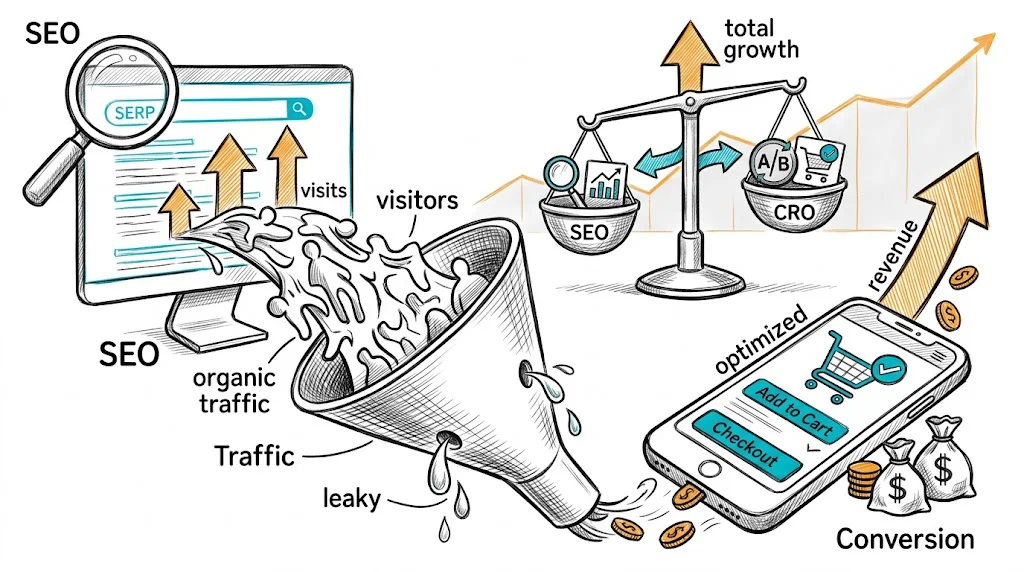
CRO and SEO solve different problems. SEO brings visitors to your website; CRO converts those visitors into buyers. They are not competitors. They are sequential stages of the same growth problem. A brand that invests only in SEO traffic but ignores conversion rate is filling a leaky bucket, and a brand that optimizes conversion without building traffic has nothing to convert. The highest-growth Indian D2C brands (Nykaa, Mamaearth, mCaffeine) use both together, systematically.
Once you understand where each discipline applies and how they reinforce each other, you can allocate your growth budget by the numbers instead of treating CRO and SEO as an either/or choice.
SEO (Search Engine Optimization) is the practice of improving your website's visibility in organic search results. It involves:
CRO (Conversion Rate Optimization) is the practice of improving the percentage of website visitors who take a desired action (purchase, sign up, add to cart). It involves:
SEO generates traffic. CRO determines how much of that traffic becomes revenue. If you double your organic traffic via SEO without touching CRO, and your conversion rate stays at 2%, you double your conversions. If you improve your conversion rate from 2% to 3% via CRO without changing traffic, you add 50% more revenue from the same traffic. Improving both compounds, and that is what separates the market leaders.
Google's Core Web Vitals (Largest Contentful Paint, Cumulative Layout Shift, First Input Delay) are ranking factors, and they are also conversion rate factors.
A page that loads in 2 seconds converts better than one that loads in 5 seconds, and it ranks higher too. CRO work on page speed benefits both conversions and rankings.
A low bounce rate works the same way. It is a positive SEO signal (though indirect) and a positive conversion signal. Content that engages visitors and reduces bounce improves both metrics.
Long-form product descriptions written for CRO (the information visitors need to make a purchase decision) also serve SEO goals:
A Kapiva product page that describes ayurvedic ingredients, dosage, benefits, and FAQs in full converts better than a thin description, and it ranks higher for ingredient-specific search queries.
A common concern: "If I run an A/B test that changes my product page, will Google penalize me?"
No, not if you implement it correctly. Google's guidelines explicitly permit A/B testing. The requirements are:
CustomFit.ai implements tests consistently across all visitors, including search engine bots, which keeps them SEO-safe.
Invest primarily in CRO when one of these describes you:
Invest primarily in SEO when one of these describes you:
The strongest Indian D2C brands don't choose. They run SEO and CRO as parallel programs with shared learning.
SEO informs CRO hypotheses:
CRO data improves SEO strategy:
Shared infrastructure: Both disciplines use analytics, customer research, and behavioral data. A single analytics setup (GA4 plus event tracking) serves both teams. Heatmaps and session recordings inform both content strategy (SEO) and page design (CRO).
Using redirects incorrectly in A/B tests. Using 301 (permanent) redirects for test variants can cause Google to transfer ranking signals to the test URL. Use 302 (temporary) redirects or JavaScript-based variant delivery for A/B tests.
Running CRO on SEO content pages. Blog posts and category pages primarily serve SEO goals. Running conversion-focused A/B tests on them can reduce the content quality signals that support ranking. Be deliberate about which pages you optimize for which objective.
Removing content that ranks to make pages "cleaner." CRO sometimes pushes minimalist design advocates to strip content out. But content that Google indexes and ranks for is also content that informs visitors. Don't remove ranking content without checking its organic search impact first.
Ignoring Core Web Vitals in CRO work. If a CRO change (adding a large image, adding a popup, embedding video) worsens Core Web Vitals scores by a wide margin, it may hurt SEO rankings. Test the CWV impact of any significant page change.
Month 1 to 3 (traffic building phase):
Month 4 to 6 (foundation phase):
Month 7 to 12 (optimization phase):
Ongoing:
Use organic search query reports to write better product copy. What language do people search to find products like yours? Use it verbatim on your product pages.
Treat your "SEO pages that don't convert" as CRO priorities. Pages with high organic traffic and low conversion rates are your best CRO opportunities.
Never run indefinite A/B tests. Google may demote pages that seem stuck in a perpetual redirect loop. Always set an end date and roll out winners fully.
Measure Core Web Vitals before and after any significant CRO change. Use Google's PageSpeed Insights (free) to check whether your test changes hurt page performance.
Treat customer search queries as a source of hypotheses. "Which sunscreen doesn't leave white cast" tells you exactly what to address in your CRO copy tests for sunscreen products.
Run integrated monthly reviews. Your SEO and CRO teams (even if that's one person) should review shared data monthly: which pages are driving traffic, which are converting, and where the gap is.
Related reading: CRO ROI: How to Measure | CRO Roadmap: 90-Day Plan | Conversion Rate Definition | Bounce Rate | CRO Pillar Guide