From the conversion glossary
Concepts referenced in this article, defined.
Concepts referenced in this article, defined.
 cro
croPre-order waitlist CRO strategies that convert hype into real revenue - how to design waitlist and pre-order pages that don't lose momentum before launch.
 cro
croFirst purchase experience optimization - practical strategies to turn first-time visitors into buyers, from welcome offers to a smarter new customer funnel.
 cro
croRetail media CRO explained - how to monetize on-site ads and sponsored placements without tanking your conversion rate. A practical balance guide.
Run rigorous A/B tests and personalize every visit on Shopify or any storefront — no engineers required.
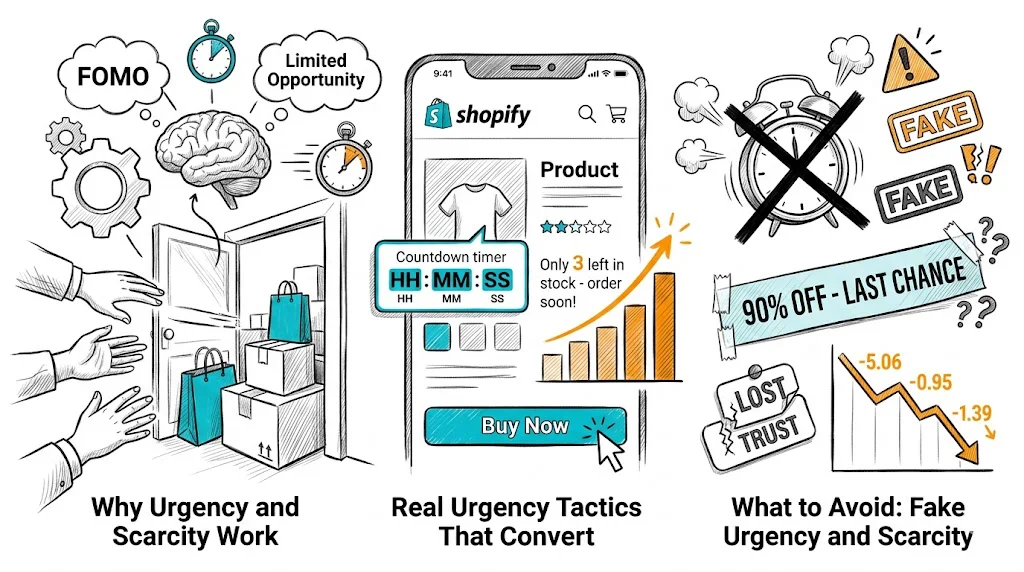
Urgency and scarcity are two of the most powerful psychological triggers in ecommerce — and two of the most abused. When used with genuine constraints, they drive immediate purchase decisions from visitors who might otherwise delay. When faked, they train customers to ignore them (at best) or distrust your brand (at worst). This guide covers the urgency and scarcity tactics that consistently deliver conversion lifts for Indian D2C brands — and how to avoid the fake tactics that look like quick wins but erode brand value.
Brands like Mamaearth, Boat, and Sugar Cosmetics use urgency and scarcity as part of structured campaigns — not as always-on gimmicks. The pattern that works is: real constraint + clear communication + prominent placement + timely exit. The brands that get burned use permanent "sale ends tonight" banners that everyone knows aren't real.
Urgency exploits our aversion to missing opportunities. When something is available for a limited time, the potential loss of not acting now feels more significant than the potential gain of purchasing. This loss-aversion effect (documented in behavioral economics) is particularly strong for planned purchases — items the visitor was already considering.
Scarcity triggers the same loss-aversion plus a social proof signal: if others are buying this, it must be good. "Only 8 left" means both "you might not get one" and "8 people before you wanted this."
In the Indian context: Indian consumers are sensitive to both — particularly around festive seasons where genuine scarcity (limited Diwali edition packaging, early-bird offers for new launches) is a natural part of shopping culture. The challenge is that decades of fake "sale" messaging in Indian retail has made consumers skeptical of urgency signals. Authenticity is the key differentiator.
Countdown timers tied to real offer expiration are one of the highest-converting urgency elements in ecommerce.
Implementation: Show a countdown to a genuine offer end time. "Diwali price ends in 4:23:17" when the offer genuinely ends at midnight is credible.
What to test:
Don't: Use a countdown timer that resets every 24 hours or when the page is refreshed. Customers notice, and it invalidates your other urgency signals.
Shipping cutoff timers create genuine urgency around delivery speed.
Examples:
Why this works: It's genuine (you're telling the truth about dispatch windows), specific (the time remaining is real), and provides a real benefit (faster delivery). This is the cleanest form of urgency because it creates value rather than just fear.
Testing opportunity: Test where the shipping urgency message appears — product page near the CTA, cart page, or in the checkout header. Also test the specific benefit framing ("same-day dispatch" vs. "arrive by tomorrow" vs. "within 24 hours").
"Only 8 left in stock" when you genuinely have 8 units is a powerful scarcity signal.
Implementation guidelines:
What to test:
What not to do: Permanently showing "Only 3 left" for a product you manufacture continuously. Customers who buy and see the same "Only 3 left" on their next visit learn to ignore it.
Creating products with genuine limited availability — Diwali packaging, collaboration collections, festival-specific bundles — creates real scarcity that needs no artificial amplification.
Examples:
Why it works: Customers understand that seasonal products are genuinely limited. This framing is culturally resonant in India where festive shopping is embedded in gift-giving culture.
Testing opportunity: Test "First batch pricing" vs. "Launch price" vs. standard pricing display for new product launches. The "first batch" framing often outperforms generic launch messaging.
Real-time signals showing other customers' activity.
Effective implementations:
Important: Only use these when the numbers are real. If your product truly has 23 concurrent viewers during peak hours, show it. Don't fabricate this data.
Testing opportunity: Test the format ("23 viewing now" vs. "Popular — 23 people viewing") and placement (near price vs. near add-to-cart vs. product title).
Countdown timers that reset: If your "sale ends in 24 hours" timer resets every day, customers will notice — especially returning visitors. This trains them to ignore your timers.
Permanent "Only X left" when stock is full: Showing "Only 3 left" for items you produce in batches of 1,000 is dishonest. Indian consumer communities (beauty forums, Reddit's India subs, YouTube review channels) actively call out brands that do this.
Fake "viewed by X people": Showing fabricated viewer counts is detectable (always shows the same number) and erodes trust when noticed.
Pressure language without real constraint: "Buy now before it's gone!" when the product has never gone out of stock is unconvincing to anyone who's ordered from you before.
What to test:
Urgency presence vs. absence: Run a test with no urgency signals vs. a genuine countdown timer or low-stock alert. Measure the lift. This validates whether urgency is effective for your specific audience.
Urgency type: Countdown timer vs. low-stock alert vs. dispatch cutoff — which urgency type resonates most for your category?
Message copy: "Only 8 left" vs. "Selling fast — order now" vs. "Almost gone" vs. "Last chance at this price"
Placement: Near product title vs. near CTA vs. in product image (overlay badge) vs. multiple placements
Threshold for display: For low-stock alerts, test displaying at 5 vs. 10 vs. 20 units remaining
What to measure:
Indian consumers are primed for urgency during festive seasons. Diwali, Navratri, Raksha Bandhan, and Holi shopping involves genuine limited-edition products, time-constrained delivery windows (gifts must arrive before the festival), and competitive pricing that genuinely ends after the festive period.
During festive seasons, amplify urgency signals you'd use year-round:
Festive urgency is your easiest CRO opportunity because the urgency is built into the cultural context — you're reinforcing a genuine time constraint, not manufacturing one.
Never use fake urgency — beyond the ethical problem, it's a brand risk. Indian D2C communities are increasingly aware of dark patterns.
A/B test urgency presence before copy — first confirm that urgency elements lift CVR for your specific audience. Some categories (luxury, high-consideration health products) respond less to urgency than impulse categories.
Combine genuine urgency with genuine value — "sale ends tonight" works better when paired with "get ₹300 off" rather than as a standalone pressure tactic.
Use dispatch urgency year-round — "order before 3 PM for next-day delivery" is always true if you have a dispatch window. This is the safest, most credible urgency tactic.
Set low-stock alerts at a threshold that's genuinely low for you — if you regularly sell out in 24 hours, 20 units is "low." If you rarely sell more than 50 units/month, 10 is "low." Calibrate to your actual sales velocity.
Test urgency message fatigue — if you use countdown timers on every product, they lose effectiveness. Test whether showing urgency on select products only (genuine limited items) vs. site-wide increases per-product impact.
Related reading: Exit Intent Strategies | A/B Testing Popups | A/B Testing Cart Pages | Conversion Rate Optimization | CRO Pillar Guide