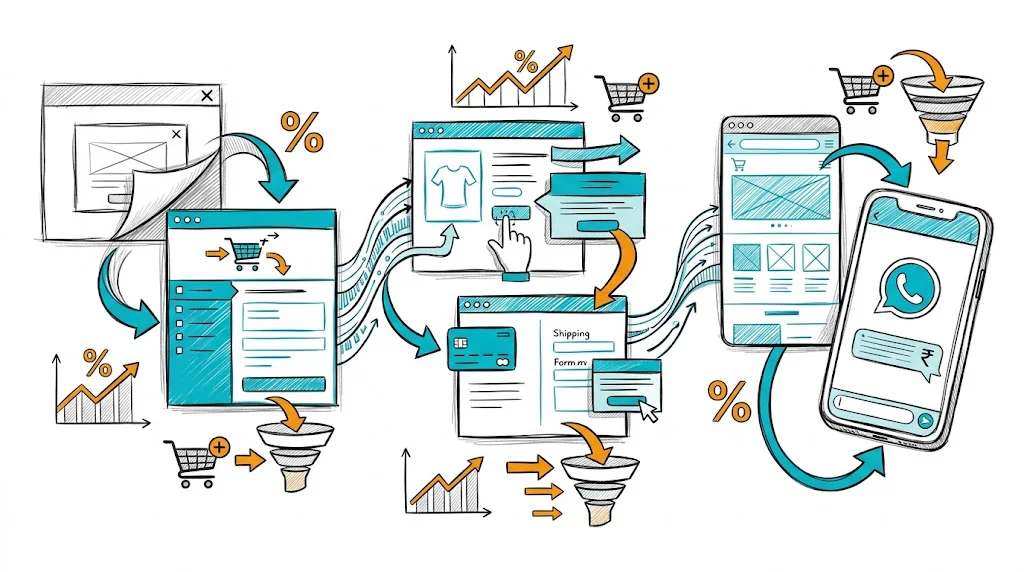
From the conversion glossary
Concepts referenced in this article, defined.
Concepts referenced in this article, defined.
 cro
croPre-order waitlist CRO strategies that convert hype into real revenue - how to design waitlist and pre-order pages that don't lose momentum before launch.
 cro
croFirst purchase experience optimization - practical strategies to turn first-time visitors into buyers, from welcome offers to a smarter new customer funnel.
 cro
croRetail media CRO explained - how to monetize on-site ads and sponsored placements without tanking your conversion rate. A practical balance guide.
Run rigorous A/B tests and personalize every visit on Shopify or any storefront — no engineers required.
Exit intent is the moment between a visitor deciding to leave and actually leaving — a 2–3 second window where the right message can change a no-conversion into a sale. Basic exit intent (a popup with a discount code) is table stakes. Advanced exit intent strategies personalize the message based on what the visitor was doing, what they have in their cart, where they came from, and how many times they've visited — turning a generic interruption into a relevant, timely conversation. For Indian D2C brands, exit intent strategies adapted to COD behavior, WhatsApp re-engagement, and festive season abandon patterns deliver significantly better results than generic Western playbooks.
The brands that do exit intent well — Mamaearth, Plum, mCaffeine — don't show the same popup to every visitor. They show the cart abandoner something different from the product browser, who sees something different from the first-time visitor. This segmentation is where real exit intent value lives.
Level 1 — One exit intent for all visitors: A single popup with a discount code. Most brands are here. Results: 1–2% conversion.
Level 2 — Segmented exit intent by page type: Different exit messages for product pages vs. cart vs. checkout. Results: 2–4% conversion.
Level 3 — Segmented by visitor behavior and history: Cart abandoners with high-value carts get one message; new visitors browsing without adding to cart get another; returning non-converters get a third. Results: 4–8% conversion.
Level 4 — Personalized by session context: Exit intent message references the specific product the visitor was viewing, the amount they'd save with a promotion, or the specific barrier (COD concerns, shipping cost, price uncertainty) identified from behavioral signals. Results: 5–10% conversion.
This guide helps you move from Level 1 to Level 3 and begin implementing Level 4 thinking.
A visitor leaving a product page is still in consideration — they haven't decided not to buy, they've decided "not now, and not here." Your exit intent goal is to either capture their intent (email/WhatsApp) or resolve the specific objection.
Strategy 1: Address the likely objection For a supplement brand like Kapiva: "Not sure about your dosage? Get a free consultation with our nutrition expert → [WhatsApp link]" — this works because it addresses a real barrier to supplement purchase (uncertainty about efficacy/suitability).
For a beauty brand: "Not sure if this matches your skin type? Take our 30-second skin quiz →" — leads to a personalized product recommendation that increases purchase confidence.
Strategy 2: Lower the entry barrier "Try the 5ml travel size — free, just pay ₹49 shipping" gives a fence-sitter a risk-free entry point. This works particularly well for skincare and fragrance where product experience is the conversion barrier.
Strategy 3: Content upgrade "Get our free guide: Complete skincare routine for [their skin type, if you've captured it from quiz/navigation]" — builds your list while providing value. Particularly effective when the exit happens from educational content on the product page.
Cart abandoners have higher purchase intent than product page abandoners. They chose the product — they just didn't complete checkout. The exit intent strategy should be proportional to this higher intent.
Strategy 1: Address the cart-specific objection Cart abandonment is most often caused by unexpected shipping cost, COD unavailability concerns, or price reconsideration. Your exit intent should address these:
Strategy 2: Cart-specific discount A discount code specifically for the items in their cart (e.g., "Your Vitamin C Serum is waiting — here's 12% off to complete your order") outperforms generic site-wide discounts because it references their specific context.
Strategy 3: Payment alternative offer "Prefer not to pay now? Order with COD — pay on delivery, no advance payment." This is particularly effective for first-time buyers on new D2C brands where payment trust is a barrier.
Checkout exit intent is the highest-stakes recovery — someone who started the checkout process and left has very high purchase intent. The friction point is usually in the form itself, a payment method issue, or an unexpected cost.
Strategy 1: Identify the dropout point If your checkout analytics show high exit on "payment method" screen, your exit intent message should reference payment: "Having trouble completing payment? Here are your options: UPI, Card, NetBanking, or COD →"
Strategy 2: Offer assistance "Need help completing your order? Chat with us →" (WhatsApp link) — checkout is not the time for a discount popup. It's the time for frictionless assistance.
Strategy 3: Save cart for later "Your order isn't complete yet — save it and continue later from any device. Enter your email:" — gives the visitor a commitment device (saved cart) and gives you their email for retargeting.
Unlike Western markets where email is the primary exit intent capture channel, Indian D2C brands have WhatsApp as a high-engagement alternative.
WhatsApp exit intent flow:
WhatsApp open rates (60–80%) vs. email open rates (15–25%) make this a significantly more effective recovery channel for Indian audiences. Brands using WhatsApp for cart recovery typically see 2–3× the recovery rate of email-only strategies.
What to test:
CustomFit.ai's visitor segmentation enables exit intent personalization without developer effort:
By traffic source:
By cart value:
By product category viewed:
By visit number:
Primary metrics:
Secondary metrics:
Guardrail metrics:
Segment exit intent by page type before anything else — a cart exit popup and a product page exit popup should be completely different messages.
Lead with value, not guilt — "Get ₹150 off your first order" outperforms "Wait — are you sure you want to leave?" every time.
Test WhatsApp capture alongside email capture for Indian audiences — WhatsApp recovery rates are significantly higher than email for Indian ecommerce.
Don't show exit intent to visitors who've already purchased — segment out past purchasers from exit intent triggers. Showing a discount popup to someone who just bought at full price is jarring.
Limit exit intent frequency — show once per session, maximum. Re-triggering exit intent every time a visitor moves their mouse creates a bad experience.
Test your exit intent offer for each category separately — what works for skincare (free sample, skin consultation) is different from what works for electronics (price guarantee, warranty information).
Run cart abandonment email/WhatsApp flow in parallel with exit intent popup — the two reinforce each other. Exit intent captures the email; the abandonment flow follows up.
Related reading: A/B Testing Popups | Urgency and Scarcity Tactics | A/B Testing Cart Pages | Bounce Rate | CRO Pillar Guide