From the conversion glossary
Concepts referenced in this article, defined.
Concepts referenced in this article, defined.
Run rigorous A/B tests and personalize every visit on Shopify or any storefront — no engineers required.
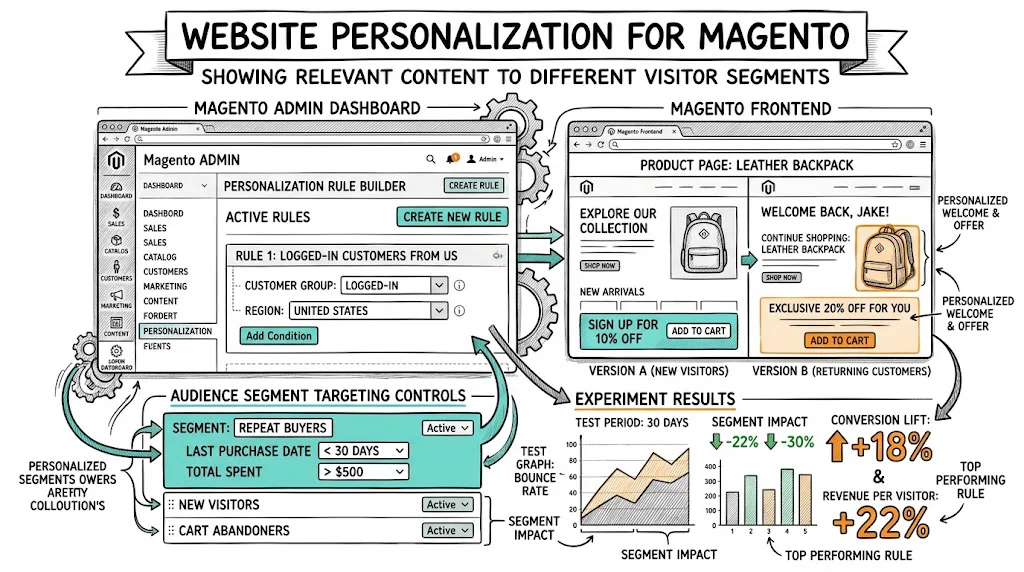
Magento personalization means showing each visitor content, products, and offers that match their behaviour, location, or purchase history — without a full rebuild. Done right, it lifts conversion rates by 10–15% on mid-traffic stores. The good news: you can implement it today with a no-code overlay tool, even if your Magento developer is unavailable.
Magento powers a huge slice of Indian D2C — fashion labels, wellness brands, electronics retailers — precisely because it handles large catalogues and complex pricing rules well. But a large catalogue is also a curse: shoppers land on your store and face choice paralysis.
Personalization solves this by narrowing the signal-to-noise ratio. Instead of displaying 800 products equally, you surface the 8 most relevant ones for each visitor.
The numbers back it up:
Beyond conversion rate, personalization increases average order value by pushing complementary products to the right people at the right moment.
Magento's architecture introduces a few things you need to plan for before flipping on personalization.
Magento's built-in FPC and Varnish serve cached HTML to anonymous visitors at very high speed. The moment you inject personalized content into that cached HTML, you break the cache — or serve the wrong content to the wrong person.
Solution: Use client-side personalization. The page loads from cache; a lightweight JavaScript snippet fires after the DOM is ready and swaps in the personalized elements. This keeps TTFB fast while delivering unique experiences.
Adobe Commerce (Magento 2 Enterprise) includes Customer Segments — rule-based groups you can target with different catalogue price rules or banners. This is useful but limited:
Third-party tools fill this gap by targeting anonymous visitors using session recording signals, UTM parameters, device type, referral source, and on-page behaviour.
Magento's block-based layout XML means page structure varies heavily by theme. Before installing any personalization tool, map out:
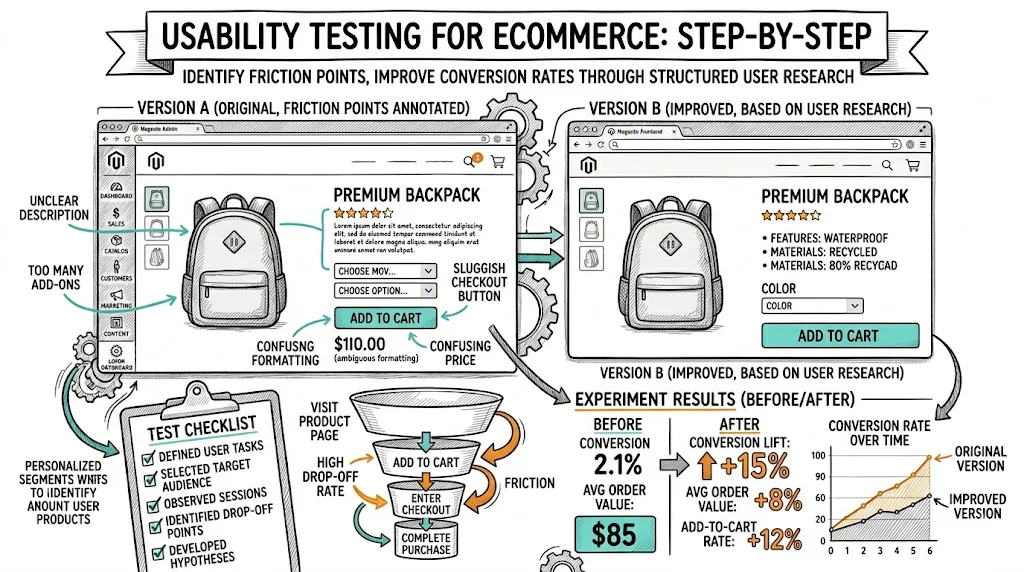
For CustomFit.ai (and most overlay tools), place one <script> tag in your theme's default_head_blocks.xml or via Google Tag Manager if you prefer a no-deploy approach.
<!-- app/design/frontend/YourVendor/YourTheme/Magento_Theme/layout/default_head_blocks.xml -->
<block class="Magento\Framework\View\Element\Template" name="customfit_script">
    <arguments>
        <argument name="template" xsi:type="string">Magento_Theme::customfit.phtml</argument>
    </arguments>
</block>
Or simply paste the snippet into GTM — no deployment needed.
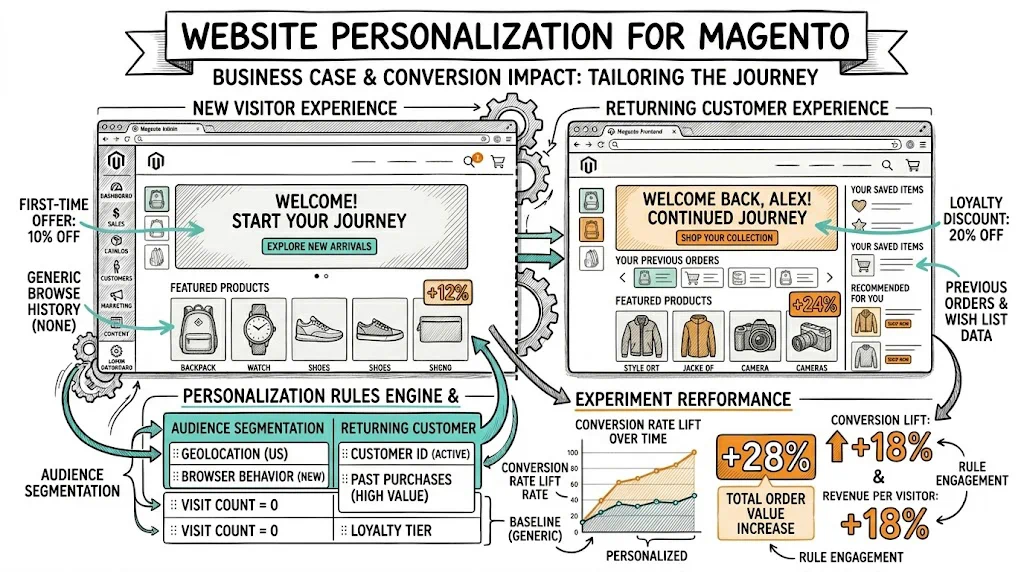
Common segments for Magento D2C stores:
| Segment | Signal | Personalization |
|---|---|---|
| First-time visitor | No cookie | Welcome offer banner |
| Return visitor, no purchase | Visited 2+ times | Urgency message + social proof |
| Cart abandoner | Cart cookie present, session ended | Cart reminder strip |
| High-value shopper | Past AOV > ₹2,500 | Premium product showcase |
| Mobile + COD region | Device + IP geo | Highlight COD badge prominently |
Pick one element. Your homepage hero banner is the best starting point because it has maximum exposure.
Test: Control = generic lifestyle image. Variant = category-specific image based on the visitor's browsing history (e.g., showed them skincare products → skincare-focused hero).
Set your goal metric to Add-to-Cart or Revenue per Visitor, not just clicks. Run until you hit statistical significance — typically 1,000–2,000 conversions per variant.
Once the homepage test is validated, expand to:
Track these metrics per segment:
Export data weekly. Kill variants that underperform by more than 10% vs control after reaching significance.
A prioritized testing roadmap for Magento stores:
Highest impact (run immediately):
Medium impact (run after first wins): 4. Product page: COD availability badge (show prominently for tier-2/3 city visitors) 5. Navigation: highlight sale category for coupon-traffic visitors 6. Exit intent: offer a UPI-exclusive discount to mobile visitors about to leave
Exploratory (run when bandwidth allows): 7. Search bar placeholder text personalized by device 8. Footer trust signals personalised by category (e.g., "Dermatologist tested" for skincare visitors)
To be clear about what the platform itself cannot do without add-ons:
| Tool | Best for | Notes |
|---|---|---|
| CustomFit.ai | D2C brands, no-code teams | Shopify-native but works on Magento via script; visual editor, ₹99/mo starting |
| Adobe Target | Enterprise Adobe Commerce | Powerful but expensive; requires developer setup |
| VWO | Mid-market | Good visual editor; per-month pricing scales steeply |
| Google Optimize (sunset) | — | No longer available |
| Nosto | Product recommendations | Strong ML recommendations; less A/B testing |
For most Indian D2C brands on Magento with a marketing team and no spare developer hours, CustomFit.ai hits the right balance: no-code setup, meaningful segmentation, and A/B testing in one tool at ₹99/mo with a 14-day free trial.
1. Keep personalization invisible from the shopper's perspective. They should feel the site "just works" for them — not feel surveilled. Avoid pop-ups that reference too much personal data explicitly.
2. Test on mobile first. In India, 70%+ of D2C traffic is mobile. A desktop-centric test will give you misleading results.
3. Use UTM parameters as a fast-start segment. If you're running Google or Meta ads, the UTM source and campaign name are in the URL. Personalize the landing page headline to match the ad creative — this alone can lift CVR 5–8%.
4. Respect FPC. If you're on Magento with Varnish, test your personalization tool's impact on cache hit rate before rolling out. A well-built overlay tool will not break your cache.
5. COD and UPI signals matter. For tier-2 and tier-3 visitors, showing "Cash on Delivery available" prominently in the hero or product card can meaningfully reduce bounce rate. Test this as a standalone variant.
6. Festive season prep. Before Diwali, Navratri, or Republic Day sales, set up segment-specific banners 2 weeks in advance. Don't scramble on launch day.
Related reading: