From the conversion glossary
Concepts referenced in this article, defined.
Concepts referenced in this article, defined.
 ab testing
Server-side A/B testing and edge experimentation explained - how they eliminate flicker, improve speed, and where they fit vs client-side testing.
 ab testing
How to run cookieless A/B testing correctly in 2026 - first-party data, GDPR compliant methods, and what actually changed with third-party cookies.
 ab testing
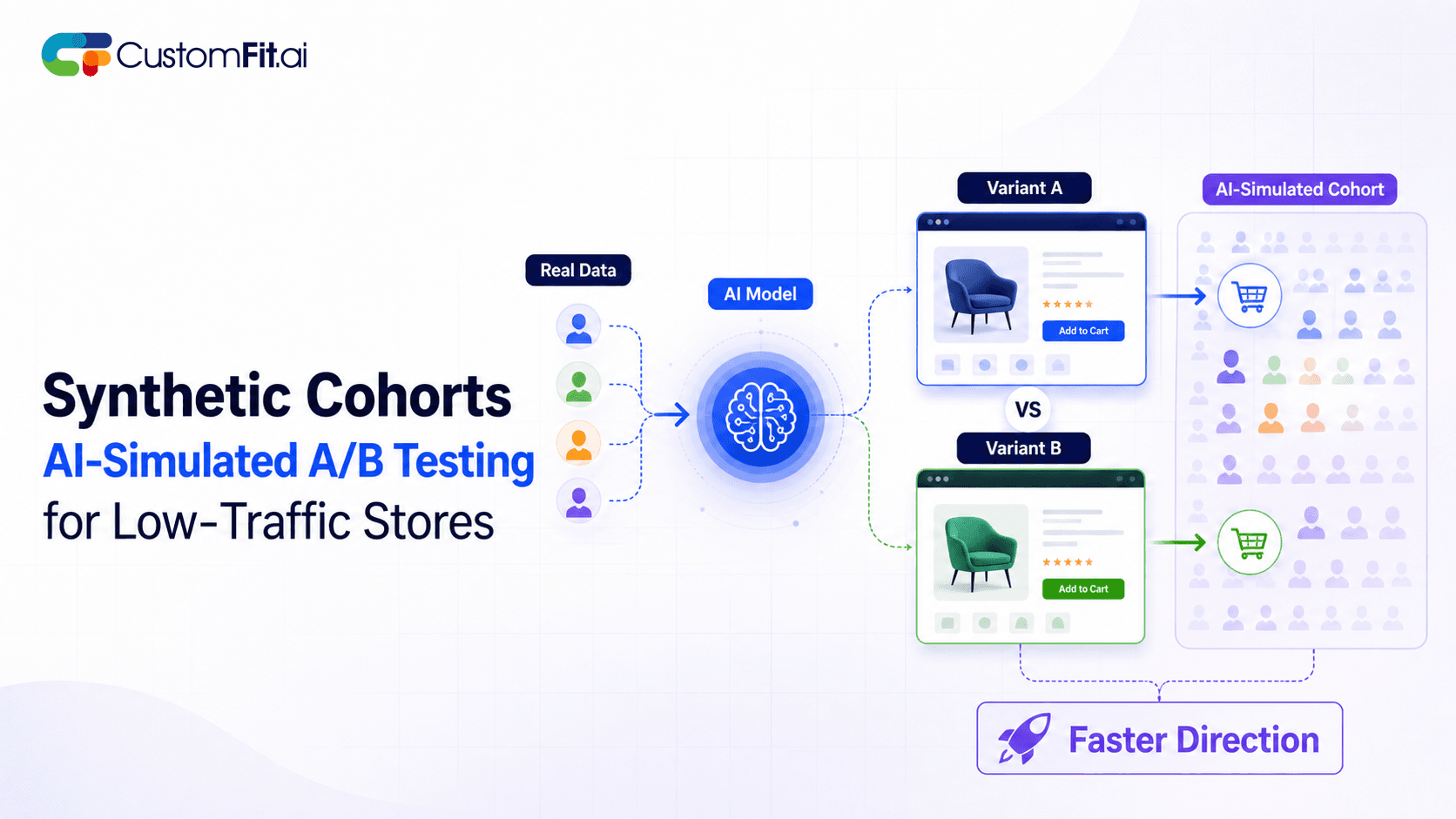
Not enough traffic to A/B test properly? Here's how synthetic cohort testing and AI-simulated experimentation help low-traffic stores test with confidence.
Run rigorous A/B tests and personalize every visit on Shopify or any storefront — no engineers required.
Multi-armed bandit (MAB) testing reallocates traffic to winning variants while the experiment is still running. Traditional A/B testing keeps a fixed split until the test reaches statistical significance. Both methods test which version of a page, offer, or element performs better, but they trade off statistical certainty against opportunity cost in different ways. Knowing when to use each one matters for any ecommerce brand running an optimization program.
Traditional A/B testing follows a fixed protocol:
The traffic split stays fixed at 50/50 regardless of early results. If Variant B is clearly winning after day 3, you still send 50% of traffic to the losing Variant A until the test concludes. That is the cost of A/B testing: you give up short-term revenue for statistical certainty.
Advantages of A/B testing:
Disadvantages:
Multi-armed bandit algorithms start with equal traffic allocation, then keep shifting more traffic toward better-performing variants as data comes in. Common algorithms include:
Epsilon-greedy: Allocates ε% of traffic randomly (exploration) and (1-ε)% to the current best performer (exploitation). It is simple, but it can get stuck on early leaders.
Thompson Sampling: Uses Bayesian probability to estimate each variant's true performance and samples traffic proportionally. It is more sophisticated and is a good default for ecommerce.
Upper Confidence Bound (UCB): Favors variants with high uncertainty so every variant gets adequate exploration. It works well for multi-variant experiments.
Here is how that plays out over a two-week test:
The algorithm keeps adjusting as it goes, sending less traffic to the underperformers.
Advantages of MAB:
Disadvantages:
| Factor | A/B Testing | Multi-Armed Bandit |
|---|---|---|
| Traffic allocation | Fixed 50/50 | Dynamic, shifts toward winner |
| Statistical rigor | High | Lower |
| Revenue during test | Lower (traffic to loser) | Higher (optimizes in real-time) |
| Learning quality | High | Lower |
| Traffic requirement | High (1,000+ per variant) | Lower |
| Best for | Hypothesis testing | Revenue optimization |
| Multiple variants | Requires large sample | Handles well |
| Result stability | Stable | Can fluctuate |
Use traditional A/B testing when:
You want to learn, not just optimize. If your goal is to understand why a change works, and to build a model of how your customers behave, A/B testing gives you cleaner, more interpretable results.
You have sufficient traffic. Sites with 10,000+ monthly visitors per page can reach statistical significance in a reasonable time, so the opportunity cost of the fixed split is acceptable.
You are testing structural changes. Major page redesigns, new checkout flows, or pricing page restructures are worth the statistical rigor of A/B testing. Getting a structural change wrong has long-term consequences.
You are running a regulated experiment. If your test results will inform product decisions, go to investors, or change pricing, you need A/B testing's statistical standards.
You are building a testing program from scratch. Hypothesis-driven A/B testing builds team learning. MAB optimizes without giving the team the same development.
Use MAB when:
You have low traffic. Sites with under 5,000 monthly visitors per page cannot reach A/B testing significance quickly. MAB pulls value from limited data while the experiment runs.
You are testing many variants. Testing 5+ variants with A/B testing requires impractically large samples. MAB handles multi-variant experiments without that overhead.
You want to minimize revenue loss. During high-stakes periods such as the festive season or product launches, you may not want to send 50% of traffic to an underperforming variant for 3 to 4 weeks.
You are optimizing for short-term conversion. If your goal is pure revenue optimization rather than learning, MAB earns more revenue during the test window.
Your traffic patterns shift seasonally. MAB adapts to changing performance in real time. A static A/B test started in October may be optimizing on Diwali traffic that doesn't represent November buyer behavior.
Some testing programs use both methods:
Explore-then-exploit: Run a standard A/B test for 2 to 3 weeks to find a statistically significant winner, then use MAB to keep optimizing within the proven winner space.
Bandit for initial screening, A/B for validation: Use MAB to spot promising variants from a large set, then run a standard A/B test on the top 2 to 3 performers to validate them rigorously.
Time-based switching: Default to A/B testing during stable traffic periods, and switch to MAB during high-stakes, short-window events such as Black Friday or Diwali, when opportunity cost is highest.
Say Kapiva wants to test 4 different homepage hero messages for their Apple Cider Vinegar product.
With A/B testing: Testing 4 variants at 95% confidence would require 2,500 visitors per variant, or 10,000 total visitors. At Kapiva's traffic levels, this would take 4 to 6 weeks.
With MAB (Thompson Sampling): The algorithm starts at 25% each and begins shifting within 3 to 4 days toward the top performer. By day 10, the winning variant is receiving 60 to 70% of traffic, which limits how much revenue the poorer performers lose.
Conclusion for this scenario: MAB fits here because there are 4 options to test, the traffic level is medium, and Kapiva wants to limit exposure to the underperforming messages.
Don't let MAB run indefinitely. Set a maximum runtime, typically 30 days, even for MAB tests. Algorithms can get stuck in local optima and stop improving.
Use A/B testing for learning and MAB for optimizing. The two tools complement each other. Build your understanding of what works through A/B testing, then let MAB optimize within that understanding.
Validate MAB winners with a short A/B test. If MAB strongly favors one variant, run a clean A/B test against it to confirm the result before making permanent changes.
Track statistical significance even in MAB. Most MAB platforms report a confidence score. Do not treat a 60% confidence winner as a conclusive result.
Check that your platform supports MAB properly. Basic A/B tools that approximate MAB with manual traffic reallocation are not true MAB. They introduce human bias and get no benefit from algorithmic optimization.
Related reading: