From the conversion glossary
Concepts referenced in this article, defined.
Concepts referenced in this article, defined.
 cro
croPre-order waitlist CRO strategies that convert hype into real revenue - how to design waitlist and pre-order pages that don't lose momentum before launch.
 cro
croFirst purchase experience optimization - practical strategies to turn first-time visitors into buyers, from welcome offers to a smarter new customer funnel.
 cro
croRetail media CRO explained - how to monetize on-site ads and sponsored placements without tanking your conversion rate. A practical balance guide.
Run rigorous A/B tests and personalize every visit on Shopify or any storefront — no engineers required.
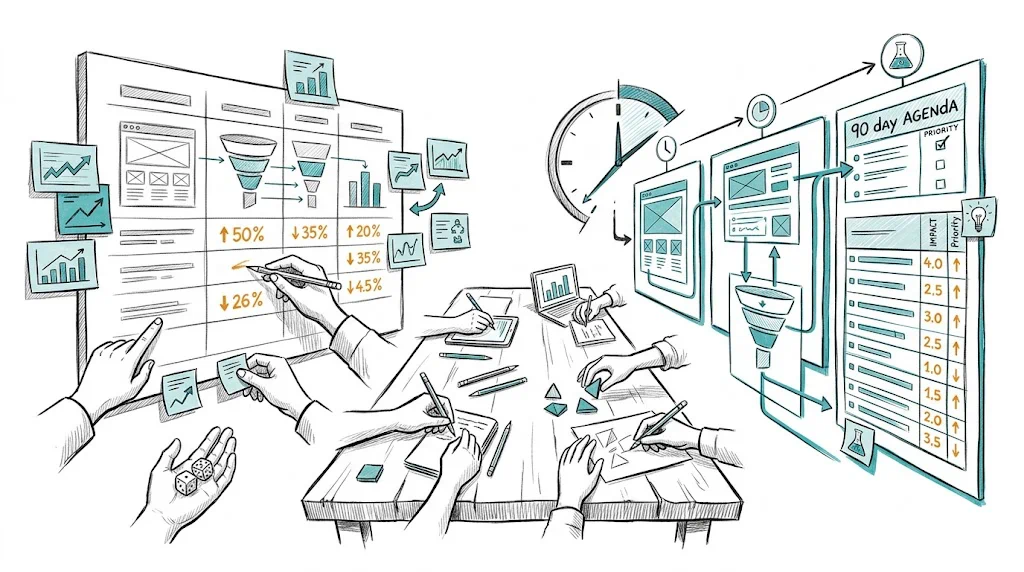
A CRO workshop is a structured team session that transforms conversion data into a prioritized testing agenda — and builds the shared understanding of buyer behavior that makes CRO a team capability rather than an individual skill. Most D2C brands with successful testing programs run quarterly planning workshops and monthly review sessions, creating a cadence that keeps optimization moving without overwhelming the team. A well-run workshop produces 10–20 actionable test hypotheses and a clear 90-day testing plan in a single afternoon.
CRO tools — A/B testing platforms, heatmaps, analytics — generate data. Workshops generate decisions. The gap between data and action is where most CRO programs die: teams have access to analytics showing 72% cart abandonment but never reach agreement on what to test or who owns the test.
A workshop creates:
For Indian D2C brands growing quickly (Mamaearth, Kapiva, Pilgrim, mCaffeine), the teams running effective CRO programs are those who have made optimization a team habit, not a one-person project.
Before generating hypotheses, everyone needs to see the same data. Prepare and present:
Funnel metrics (15 minutes):
Behavioral data (15 minutes):
Competitive context (15 minutes):
Workshop facilitator rule: No hypotheses during the data review segment. Just observation and questions. Hypothesis generation comes next.
Now that everyone has seen the data, generate hypotheses. Run a structured brainstorm:
Step 1: Individual generation (10 minutes) Everyone writes down their top 5 test hypotheses on sticky notes (physical or Miro/FigJam for remote workshops). Format each hypothesis as: "I believe [change] will [improve metric] because [reason based on data]."
Step 2: Category grouping (10 minutes) The facilitator groups hypotheses into categories: product page, checkout, navigation, trust/social proof, pricing, mobile experience, email/off-site.
Step 3: Discussion and refinement (25 minutes) Work through each category. For each hypothesis:
Consolidate similar hypotheses. Eliminate hypotheses without data support. End with 15–25 refined hypotheses.
Not all hypotheses have equal value. Prioritize using the ICE framework (Impact, Confidence, Ease):
Impact (1–10): How much will this move the primary metric if it works? Confidence (1–10): How confident are we the hypothesis is correct based on available evidence? Ease (1–10): How easy is this to implement and run? (10 = can deploy today without developer)
ICE Score = (Impact + Confidence + Ease) / 3
Score every hypothesis. Sort by ICE score. Your top 8–10 become your next quarter's testing agenda.
Prioritization rules:
Convert the prioritized list into a testing plan:
For each of the top 8 tests:
Create a shared tracking document (Notion, Airtable, or Google Sheets). This is your CRO backlog. Update it after every test.
Between quarterly workshops, hold monthly reviews:
15 min: Test results For each completed test: what was the result? What did we learn? What is the next hypothesis this finding suggests?
15 min: Running test status For each active test: what are results showing? Are we on track for significance? Any issues with implementation?
15 min: Backlog review Are current priorities still correct? Have new data sources changed what we should test? Add new hypotheses generated from completed test learnings.
15 min: Upcoming test preparation What test launches next week? Is the variant built? Is the analytics tracking confirmed? Is the sample size calculator run?
Hypothesis template:
Hypothesis: I believe [specific change] will [improve/increase/reduce] [metric]
because [specific data evidence: session recording / funnel data / survey response].

Variant: [Description of what changes]
Control: [Description of current state]
Primary metric: [CVR / add-to-cart rate / checkout completion rate / etc.]
Guardrail metric: [What must not drop]
Estimated sample size: [X visitors per variant]
Test duration: [X weeks]
Owner: [Name]
Implementation method: [CustomFit.ai / developer / email platform]
ICE scoring sheet: Create a shared spreadsheet with columns: Hypothesis, Impact (1–10), Confidence (1–10), Ease (1–10), ICE Score, Owner, Status.
Test log template: For each completed test: Hypothesis, Result (winning variant or no significant difference), Confidence %, Metric movement, What we learned, Next hypothesis suggested.
Workshops are the engine; culture is the fuel. A CRO culture means:
Data before opinions. When stakeholders propose changes ("We should change the homepage banner"), the response is "Let's test it" not "I disagree." Data resolves design arguments.
Celebrating learning, not just winning. A well-run test that returns no significant difference is valuable — it tells you the hypothesis was wrong and helps you prioritize elsewhere. Teams that punish test losses run fewer tests and learn less.
Sharing results broadly. After every completed test, send a 1-paragraph summary to all stakeholders: what we tested, what we found, what it means. This builds shared knowledge and generates new hypotheses from people outside the core team.
Connecting CRO to business metrics. Test results reported as "Variant B improved CVR by 12%" land differently when translated to: "Variant B generates an estimated ₹4,80,000 additional monthly revenue at current traffic levels." Connect tests to business outcomes in every review.
Prepare data in advance. Nothing kills workshop momentum like waiting for dashboards to load. Have all data prepared and exported before the session.
Include customer support. The support team hears buyer friction directly, in their own words. Their input generates hypotheses that analytics alone never surfaces.
Time-box every segment. Use a timer. Without time-boxing, data review expands to fill all available time and prioritization gets rushed.
Remote workshops: Use Miro or FigJam for collaborative sticky note brainstorming. Share screens for data review. Record the session for team members who cannot attend.
Start with quick wins. In your first workshop, identify 2–3 tests that can launch within a week without developer work. Early wins build confidence in the process and momentum for longer-term experiments.
Related reading: