From the conversion glossary
Concepts referenced in this article, defined.
Concepts referenced in this article, defined.
 cro
croPre-order waitlist CRO strategies that convert hype into real revenue - how to design waitlist and pre-order pages that don't lose momentum before launch.
 cro
croFirst purchase experience optimization - practical strategies to turn first-time visitors into buyers, from welcome offers to a smarter new customer funnel.
 cro
croRetail media CRO explained - how to monetize on-site ads and sponsored placements without tanking your conversion rate. A practical balance guide.
Run rigorous A/B tests and personalize every visit on Shopify or any storefront — no engineers required.
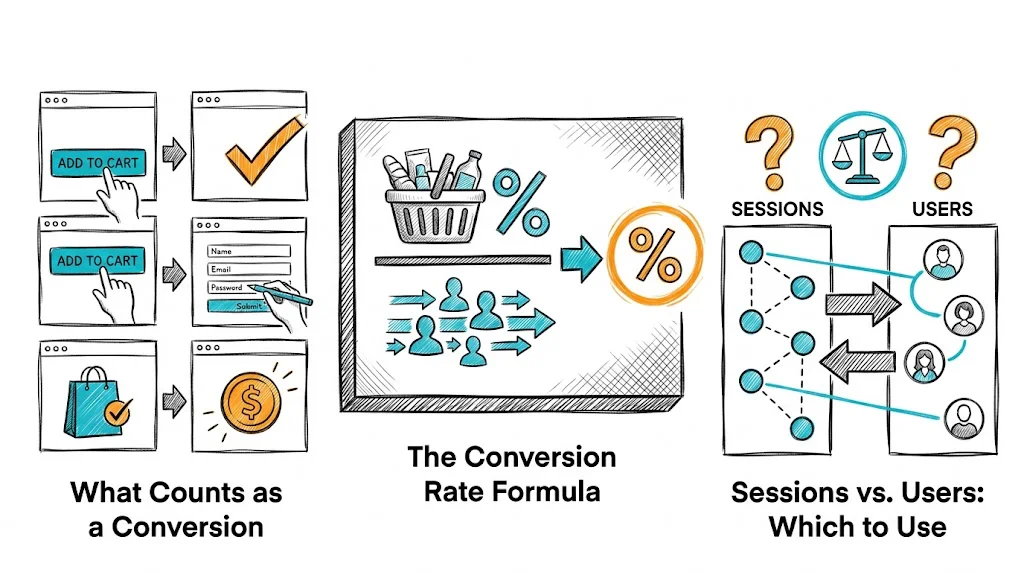
Conversion rate is the percentage of website visitors who complete a desired action — for ecommerce, that's typically a purchase — and it's the single most important metric for measuring how effectively your store turns traffic into revenue. The formula is straightforward: divide the number of conversions by total visitors and multiply by 100. But knowing the formula is only the start — understanding what a good conversion rate looks like for your category, how to segment it meaningfully, and how to use it to diagnose growth opportunities is where the real value lies.
Basic formula:
Conversion Rate = (Conversions ÷ Total Visitors) × 100
Example:
This tells you that 2.49% of everyone who visited your store made a purchase.
The answer depends on what you define as your goal. For ecommerce:
| Conversion Type | Definition | Use Case |
|---|---|---|
| Purchase | Completed transaction | Primary ecommerce metric |
| Add to Cart | Item added to cart | Intermediate funnel metric |
| Checkout Started | Checkout page reached | Diagnosing checkout drop-off |
| Account Registration | New account created | For subscription/loyalty programs |
| Email Signup | Lead captured | For pre-launch or newsletter |
| Wishlist Addition | Item saved | Engagement indicator |
For most D2C brands, your primary conversion is a purchase. Track add-to-cart rate as a secondary metric to diagnose where in the funnel you're losing visitors.
Sessions (visits): Each time someone visits your site counts as a session, even if the same person visits multiple times.
Users (unique visitors): Each person counts once regardless of how many times they visit.
For ecommerce, use sessions. Here's why:
Exception: For subscription products where you want to track subscriber conversion rate, use unique users to avoid inflating the metric.
In Shopify Analytics:
Shopify shows conversion rate as a funnel: Added to Cart → Reached Checkout → Sessions Converted
This funnel view is more valuable than the top-line conversion rate — it shows you exactly where visitors drop off.
Example funnel reading:
If 1,800 added to cart but only 1,200 reached checkout, you're losing 600 potential buyers between cart and checkout. That's your highest-priority optimization opportunity.
Benchmarks vary significantly by product category, price point, and traffic source. Use these as directional guidance:
| Category | Low | Average | Top Performer |
|---|---|---|---|
| Beauty & Skincare | 1.5% | 3% | 6%+ |
| Fashion & Apparel | 1% | 2.5% | 5%+ |
| Health & Supplements | 2% | 3.5% | 7%+ |
| Consumer Electronics | 1% | 2% | 4%+ |
| Home & Kitchen | 1.5% | 2.5% | 5%+ |
| Food & Beverages | 2% | 4% | 8%+ |
| Subscription products | 3% | 5% | 10%+ |
Indian D2C benchmarks: Conversion rates for Indian D2C brands tend to be at the lower end of global benchmarks due to:
CustomFit.ai's customers average an 11% lift in conversion rate after running their first 5 A/B tests — brands like Bellavita hit 11% CVR improvement, Kapiva achieved 9.48%.
A single blended conversion rate hides important information. Always segment:
| Source | Typical CVR |
|---|---|
| Email marketing | 3–8% (highest) |
| Direct/branded | 3–6% |
| Organic search | 2–4% |
| Paid social | 1–3% |
| Paid search | 2–5% |
| Referral | 1–4% |
Email subscribers are typically the highest-converting traffic because they've already opted in and trust your brand. If your email CVR is lower than organic search, your email targeting or content needs work.
| Device | Typical CVR |
|---|---|
| Desktop | 3–5% |
| Tablet | 2–4% |
| Mobile | 1–3% |
Mobile conversion rates are consistently lower than desktop — but since 75–85% of Indian D2C traffic is mobile, optimizing mobile conversion rate is the highest-priority work. A 1% absolute lift in mobile CVR (e.g., 2% → 3%) on mobile-dominant traffic has enormous revenue impact.
Returning visitors typically convert at 2–4x the rate of new visitors. If your returning visitor CVR is low, your retention experience needs work. If your new visitor CVR is very low, your first impression and trust signals need improvement.
Tier 1 cities (Mumbai, Delhi, Bangalore) typically show higher CVR than Tier 2/3 cities. But many D2C brands find that once they optimize for COD and vernacular content, Tier 2/3 CVR improves dramatically and becomes a significant revenue driver.
Conversion rate is powerful but incomplete. Always view it alongside:
Average Order Value (AOV): A 5% CVR at ₹300 AOV generates less revenue than 3% CVR at ₹800 AOV. Optimizing purely for CVR can attract lower-quality buyers.
Revenue per Visitor (RPV): RPV = Conversion Rate × AOV. It captures both dimensions in a single metric and is the best single number for measuring the revenue impact of optimization work.
Bounce Rate: High bounce rate suppresses CVR by removing visitors before they can convert. Fixing bounce rate issues may lift CVR without any product page changes.
Calculate CVR for the past 30 days. Segment by device, source, and new vs. returning.
Compare your segments. If mobile CVR is 1.2% vs. desktop 4.1%, mobile optimization is your biggest opportunity.
Use Shopify's conversion funnel (sessions → add to cart → checkout → purchase) to identify where visitors are leaving.
"Mobile visitors are converting at 1.2% because our mobile product page requires scrolling past the fold to see the CTA button. Moving the CTA above the fold will increase mobile CVR by at least 0.3%."
Use CustomFit.ai to create a variant and test your hypothesis. Track CVR and RPV for the variant vs. control.
The best ecommerce brands run 2–4 tests per month and compound CVR improvements over time. A 5% CVR improvement from 3 tests = compounding growth.
Every A/B test is fundamentally a conversion rate experiment. When you test:
Use CVR as your primary metric for most tests, alongside RPV to capture the full revenue impact.